
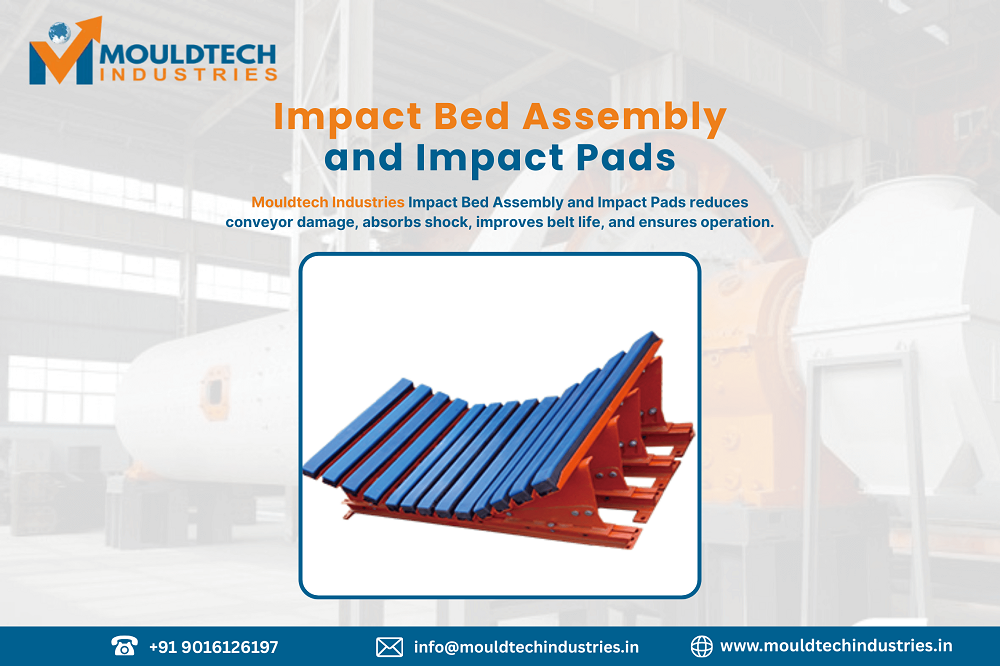
Impact Bed Assembly and Impact Pads Manufacturer in India: Mouldtech Industries
Mouldtech Industries is a Manufacturer, Supplier, and Exporter of Types of Impact Bed assemblies and Impact Pads.
Our Manufacturing Unit is in Vadodara, Gujarat, India.
Mouldtech Industries is a Manufacturer of Ball Mill Solutions, Ball Mill Rubber Lining, Wear Protection Line, Resistant Rubber Liner, Embedded Rubber Liners, Conveyors Solutions, Impact Bed Assembly and Impact Pads, Belt Cleaners, Pulley Lagging, Ceramic Rubber Lagging Services, and Ceramic Rubber Lagging Sheet.
Impact Bed Assembly and Impact Pads: Engineering Dependability for Severe-Duty Conveying Tasks
Introduction
Across sectors such as resource extraction, metal refining, cement production, ceramics, and bulk goods movement, a persistent challenge exists: equipment deterioration under intense operational stress. Conveyor systems, primarily, operate continuously under significant impact forces, abrasive materials, varied material dimensions, and harsh external conditions.
In rigorous industrial settings, even minor malfunctions at conveyor transition points can result in belt harm, material loss, structural decay, unscheduled halts, and safety hazards. As worldwide production volumes climb and facilities push for greater output with minimised maintenance crews, wear defence and equipment dependability have transitioned from optional additions to crucial operational mandates.
Impact Bed Assemblies and their corresponding Pads represent a vital industrial remedy for safeguarding conveyor belts at material discharge locations. Their primary function isn’t to boast higher theoretical output figures, but to absorb kinetic energy, stabilise the belt line, and prolong machinery lifespan in actual field conditions.
The need for these systems is expanding across India, encompassing resource belts in Odisha and Jharkhand, cement factories in Rajasthan and Andhra Pradesh, steel operations in Maharashtra and Chhattisgarh, ceramic manufacturing centres in Gujarat and Morbi, and bulk-handling centres at ports, power stations, and industrial corridors nationwide.
Industrial Difficulties Driving the Need for Impact Bed Assemblies and Pads
Seasoned plant engineers often observe that conveyor damage rarely stems from smooth, continuous running. Failures typically occur at transfer zones, where material first contacts the belt.
Core issues encountered include:
- Friction/Wear: Rough ore, processed clinker, coal, and ceramic precursors continuously erode the belt surface.
- Shock Loads: Large items dropping from significant heights generate severe shock waves that standard idlers cannot manage.
- Deterioration & Environment: Moisture, corrosive agents, and temperature shifts weaken structural components.
- Cost of Stoppages: Belt compromise results in shutdowns that affect the preceding and subsequent processes.
- Maintenance Expenditure: Frequent idler replacements, belt repairs, and site cleaning increase lifecycle outlays.
In mining and metal processing operations, conveyors frequently traverse vast distances with limited backup. Comparable difficulties occur in cement complexes, power facilities, and ceramic production units, where the reliability of transfer points directly determines overall plant availability.
Defining the Impact Bed Assembly and Impact Pads
An Impact Bed Assembly is a conveyor support mechanism positioned at loading areas, intended to substitute conventional impact idlers. It comprises a robust structural framework fitted with Impact Pads that support the conveyor belt across its width.
Impact Pads generally consist of:
- A low-friction UHMW or polymer top sheet interacts with the belt.
- An energy-dampening rubber cushioning layer.
- A sturdy base for a secure fixture.
This setup distributes impact forces over a broader surface, lessening localised strain on the belt. Unlike rolling supports, impact beds offer uninterrupted belt contact, minimising sagging, oscillation, and misalignment during material feeding.
This is a pragmatic engineering measure designed to manage impact energy—not an accessory intended to boost operational figures.
Applications Across Various Sectors
- Resource Extraction Industry: Deployed at primary crushers, secondary transfer points, and long-distance conveyors handling iron ore, coal, bauxite, limestone, and manganese.
- Cement Facilities: Installed beneath storage bins, crusher outlets, and clinker conveyors where materials descend from height.
- Metal & Steel Works: Utilised in sinter installations, furnace charging conveyors, slag handling lines, and raw material storage yards.
- Ceramic Production: Found in raw material handling systems moving feldspar, quartz, clay, and dried powders, especially in Gujarat’s specialised production hubs.
- Power Generation: Employed within Coal Handling Plants (CHP) to shield belts from hard coal impacts.
- Bulk Material Handling: Commonplace in port facilities, fertiliser factories, aggregate processing, and EPC-managed conveying deployments.
Material Science & Engineering Principles
From an engineering perspective, the effectiveness of an impact bed hinges on material selection and structural design.
- Rubber Characteristics: The elastomer section must strike a balance between pliability and energy absorption without undue recoil.
- Resistance to Wear: Top layers are chosen to reduce belt drag and withstand abrasive action.
- Impact Dissipation: Layer thickness and firmness are calibrated based on drop elevation and typical lump size.
- Ceramic Additions: In areas subject to extreme abrasion, ceramic protective elements may be incorporated before or after the impact beds.
Manufacturers with a deep sector background recognise that no solitary material suits every situation. Material science decisions must be guided by observed operational data, rather than simple assumptions.
Design Specifications & Customisation Needs
Impact Bed Assemblies are rarely universally applicable.
Crucial design elements include:
- Conveyor belt dimensions and travel speed
- Design of the material guiding chute
- Vertical drop distance and material dimensions
- Compatibility with existing conveyor framing
- Requirements for service access
Tailored sizing, sectional pad arrangements, and adaptable frames permit impact beds to be integrated into new builds or retrofitted onto existing conveyors without significant structural modification.
Manufacturing Excellence & Process Control
Industrial purchasers anticipate consistency, not deviation.
Precise manufacturing entails:
- Managed compounding of rubber materials
- Accurate dimensions of structural frameworks
- Consistent fusing between material layers
- Testing per production batch for firmness and elasticity
Process oversight ensures that replacement pads maintain performance parity over time, enabling maintenance groups to schedule interventions dependably.
Setup & Servicing Directives
From a plant maintenance perspective:
- Impact beds are engineered for swift mounting without needing belt removal.
- Modular pads allow targeted renewal instead of replacing the entire unit.
- Reduced belt wear results in fewer sudden operational halts.
Correct positioning and support setting during initial setup are vital for achieving the anticipated service life.
Safety & Operational Dependability
Conveyor-related incidents frequently happen at transfer points.
Impact Bed Assemblies contribute toward:
- Lessened belt oscillation and material spillage
- Decreased probability of belt rupture failures
- Safer conditions for inspection and upkeep
By stabilising the belt, they indirectly support safer facility functions and adherence to internal safety mandates.
Economic Value Over the Equipment Lifespan
While the upfront purchase price is only one element, lifetime efficiency holds greater importance.
Long-term advantages encompass:
- Prolonged belt service duration
- Fewer idler replacements needed
- Reduced costs associated with cleaning labour
- More predictable maintenance timetables
The emphasis is not just on lowering costs, but on optimising maintenance and ensuring workflow continuity.
Export Readiness & International Acceptance
Global industrial procurement entities anticipate:
- Uniform dimensions between batches
- Traceability of materials used
- Comprehensive technical documentation
- Awareness of conformity to global industrial benchmarks
Impact Bed Assemblies dispatched to overseas venues must meet these benchmarks, particularly for mining, cement, and EPC-managed undertakings.
The Value of Seasoned Manufacturers
Impact beds operate in highly punishing environments. Design oversights become evident rapidly in practical application.
Manufacturers with extensive sector tenure grasp:
- The ways failures manifest in the field
- Limitations specific to different applications
- The necessity of trustworthy supply chains and after-sales aid
- Engineering expertise directly translates into plant reliability.
About Mouldtech Industries
Mouldtech Industries is an established Indian producer specialising in mill rubber liners, ceramic guarding solutions, rubber cladding systems, rubber components for mills, conveying apparatus, and impact bed assemblies.
Serving all of India across every key industrial region—spanning locales like Gujarat, Maharashtra, Rajasthan, Tamil Nadu, Andhra Pradesh, Telangana, Karnataka, Odisha, Jharkhand, Chhattisgarh, West Bengal, Madhya Pradesh, Uttar Pradesh, Punjab, Haryana, Himachal Pradesh, Uttarakhand, Bihar, Assam, Meghalaya, Arunachal Pradesh, Manipur, Mizoram, Nagaland, Tripura, Sikkim, Kerala, Goa, Delhi, Jammu & Kashmir, Ladakh, Chandigarh, Dadra & Nagar Haveli and Daman & Diu, Puducherry, Andaman & Nicobar Islands, and Lakshadweep—Mouldtech supports resource extraction hubs, ceramic manufacturing centers, metal facilities, cement operations, and bulk handling activities throughout the nation’s major industrial zones.
More specifics available at https://www.mouldtechindustries.in/
Conclusion
Impact Bed Assemblies and their Pads fulfil a vital function in safeguarding conveyor systems where impact and friction are unavoidable realities. Their contribution lies in protecting the belt, fostering operational steadiness, and ensuring long-term equipment soundness, rather than pursuing fleeting performance claims.
For facilities running under constant demand, these systems constitute a crucial element of responsible conveyor engineering practice.
Essential Takeaways
- Effective defence against wear at conveyor loading points
- Improved operational stability under heavy shock forces
- Appropriate for mining, cement, metal, ceramic, and bulk transport sectors
- Supports sustained equipment performance
- Broadly accepted across international industrial venues
Trending FAQs
1. What is the typical service life of impact pads?
Service life depends on material type, drop height, and operating conditions.
2. Are impact beds suitable for high-speed conveyors?
Yes, when properly designed for belt speed and load conditions.
3. How often do impact pads require maintenance?
Inspection intervals align with routine conveyor maintenance schedules.
4. When should rubber or ceramic wear solutions be combined?
In zones with both high impact and extreme abrasion.
5. Are impact beds used globally in mining operations?
Yes, they are standard solutions in mining and bulk handling plants worldwide.
For inquiries about Impact Bed Assembly and Impact Pads, contact Mouldtech Industries. Our team is ready to assist with technical support, customisation, and supply solutions.
#ImpactBedAssembly #ImpactPads #ConveyorImpactBed #ConveyorImpactPads #ConveyorLoadingZone #BeltProtectionSystem#ConveyorWearProtection #BallMillRubberLiner #CeramicWearProtection #RubberLining #MiningSolutions #BulkMaterialHandling #ConveyorSolutions #MouldtechIndustries #WearProtection #IndustrialManufacturing