
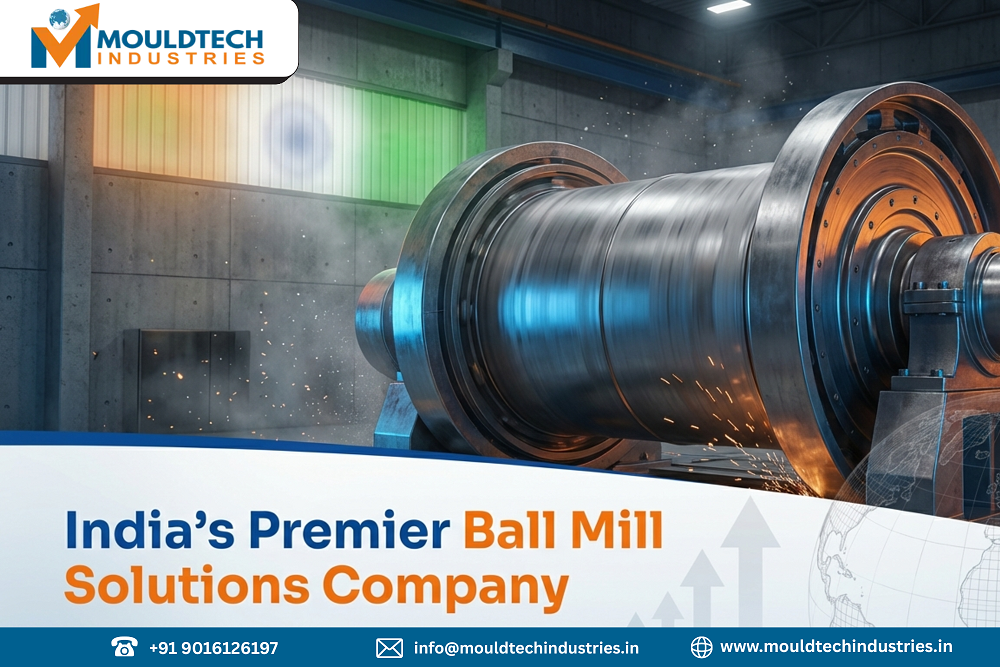
Advanced Ball Mill Solutions for Heavy-Duty Applications: Mouldtech Industries
India’s Premier Ball Mill Solutions Company operates at the center of industries where wear is not a theoretical concern but a daily operational challenge. Across mining, metal processing, cement production, ceramic manufacturing, and bulk material handling, equipment handling abrasive ores, clinker, slag, and fine ceramic powders is subjected to constant mechanical stress. Liners, chutes, mill internals, and conveyors must withstand abrasion, repeated impact, moisture, chemical exposure, and vibration throughout their service life.
In heavy-duty industrial environments, even incremental improvements in wear protection and component reliability can deliver measurable benefits. Better liner performance supports higher plant availability, safer maintenance practices, and more predictable production schedules. Seasoned plant engineers often note that liner failure rarely occurs in isolation; it typically sets off a chain reaction of unplanned downtime, emergency repairs, and production losses that disrupt the entire process line.
Globally, demand for mineral processing and bulk material handling equipment continues to rise, driven by infrastructure expansion, the energy transition, and sustained growth in metal and ceramic consumption. Within this operating landscape, the ball mill rubber liner has emerged as a critical wear-protection solution—particularly in mills operating under variable ore characteristics, fluctuating loads, and high-impact grinding conditions.
Across India’s industrial landscape, these challenges persist despite differences in materials and applications. From mining belts and cement clusters to steel hubs, ceramic manufacturing zones, and large-scale bulk material handling operations across major industrial regions and cities, plant operators face the same fundamental need: reliable, well-engineered ball mill solutions that control wear, stabilize operations, and support long-term production efficiency.
Industrial Challenges That Drive Demand for Ball Mill Rubber Liner
Ball mills operate in one of the harshest mechanical environments found in process industries. The drivers behind the adoption of rubber liners are rooted in persistent, measurable challenges:
- Abrasion: Ores, clinker, and mineral additives cause continuous surface wear on mill internals. Hard particles grind against liner surfaces at high velocity, leading to gradual material loss.
- Impact Loads: Grinding media and feed material generate repeated impact forces. In mining and metal processing operations, the feed size distribution can vary, leading to unpredictable shock loads on liners.
- Corrosion: Moisture, slurry chemistry, and process additives can accelerate corrosion, especially in wet grinding circuits.
- Downtime: Liner replacement is maintenance-intensive. Poorly performing liners increase the frequency of shutdowns and disrupt production schedules.
- Maintenance Cost: Beyond liner replacement, associated labor, crane usage, and lost production hours form a significant part of lifecycle operating costs.
Globally, similar challenges are seen in mineral processing plants in Australia, South Africa, Chile, and Peru, as well as in cement and steel facilities across Southeast Asia and the Middle East. These environments share standard requirements: predictable liner life, controlled wear patterns, and safe installation practices.
What Is a Ball Mill Rubber Liner?
A Ball Mill Rubber Liner is a wear protection component installed on the internal surfaces of a ball mill shell and end walls. Its function is to protect the structural steel shell from abrasion and impact while influencing grinding performance through liner profile design.
Unlike metallic liners, rubber liners are elastomer-based components engineered to absorb impact energy and resist abrasion under cyclic loading. They are commonly used in wet and dry grinding applications where noise reduction, corrosion resistance, and safer handling are operational considerations.
From an engineering standpoint, the liner is part of the mill’s wear system, not just a protective cover. Its geometry, thickness, and fastening system affect the motion of grinding media, material flow patterns, and the distribution of liner wear.
Applications Across Industries
Ball mill rubber liners are used across multiple sectors where grinding or material size reduction is integral to the process:
- Mining: Ore grinding in beneficiation plants, particularly for iron ore, copper, bauxite, and industrial minerals.
- Cement: Raw material grinding and finish grinding circuits, where clinker abrasiveness demands consistent liner performance.
- Metal & Steel: Grinding of slag, additives, and metallurgical by-products.
- Ceramic: Preparation of ceramic body slips and glazes, where contamination control and liner cleanliness matter.
- Power Plants: Coal and mineral grinding in captive power units and auxiliary systems.
- Bulk Material Handling: Ancillary grinding or conditioning equipment used in handling abrasive bulk solids.
Each application places different demands on linear material properties, thickness, and profile design, which is why one-size-fits-all solutions often underperform in practice.
Material Science & Engineering Considerations
The performance of a ball mill liner is primarily determined by material behavior under combined abrasion and impact:
- Rubber Properties: Industrial-grade rubber compounds are selected for abrasion resistance, tear strength, and fatigue life. Elastomer resilience allows energy absorption during impact, reducing the likelihood of crack initiation compared to brittle materials.
- Ceramic Hardness (in hybrid systems): In some wear-protection systems, ceramic elements are combined with a rubber backing to address extreme abrasion zones. Ceramic Hardness resists cutting wear, while rubber absorbs impact.
- Wear Resistance Principles: Wear is not only about Hardness. Elastic recovery, resistance to micro-tearing, and compound formulation influence how the liner surface degrades over time.
- Impact Absorption: Rubber liners dampen impact energy, reducing stress transmission to the mill shell and fasteners. This contributes to structural protection and reduced noise levels.
Manufacturers with long-term industry exposure understand that material selection must account for slurry chemistry, temperature ranges, and feed size variability—not just laboratory abrasion indices.
Design & Customization Requirements
Ball mills differ widely in diameter, length, rotational speed, and operating regime. Effective liner systems require:
- Equipment Compatibility: Accurate fit to mill geometry, bolt patterns, and lifting profiles.
- Custom Sizing: Segment dimensions must match mill shell curvature to avoid gaps and stress concentration points.
- Application-Specific Design: Lifter bar profiles, liner thickness, and wear zones are tailored based on grinding media size and feed characteristics.
In practice, plant engineers often rely on site measurements and historical wear data to refine liner design over successive maintenance cycles.
Manufacturing Quality & Process Control
Liner performance depends as much on manufacturing discipline as on design intent:
- Precision Manufacturing: Mould accuracy, curing control, and dimensional tolerances affect liner fit and load distribution.
- Quality Checks: Material batch testing, hardness verification, and visual inspection help maintain consistency.
- Batch Consistency: Process industries require predictable linear behavior over time. Variability between batches leads to uneven wear patterns and planning uncertainty.
Robust process control ensures that liners installed months apart perform comparably, simplifying maintenance planning.
Installation & Maintenance Considerations
From a plant operations perspective, liner systems must support practical maintenance workflows:
- Ease of Installation: Modular rubber liner segments reduce handling weight compared to metallic liners, supporting safer manual positioning.
- Reduced Downtime: Faster change-out cycles help limit production losses during scheduled shutdowns.
- Maintenance Cycles: Predictable wear rates enable planned replacement schedules rather than reactive maintenance.
Installation procedures must align with plant safety protocols, including confined space entry and lifting operations.
Safety & Operational Reliability
Worker safety and equipment protection are inseparable in milling operations:
- Worker Safety: Lighter liner components reduce the risk of manual handling. Impact-damping properties minimize vibration and noise exposure during operation.
- Equipment Protection: Rubber liners shield the mill shell from direct abrasion and impact, preserving structural integrity.
- Plant Reliability: Stable liner performance contributes to consistent grinding behavior and fewer unplanned stoppages.
In mining and metal processing operations, liner failures often coincide with peak production demands, making reliability a strategic operational concern.
Cost Efficiency Over Equipment Life Cycle
Lifecycle performance matters more than initial component selection:
- Long-Term Savings: Reduced shell wear, fewer unplanned shutdowns, and lower ancillary damage contribute to lifecycle efficiency.
- Reduced Shutdowns: Planned maintenance windows are more efficient when liner life is predictable.
- Maintenance Optimization: Consistent liner performance supports condition-based maintenance strategies rather than reactive repairs.
The economic value lies in the operational stability and reduced disruption, not in isolated component performance.
Export Readiness & Global Acceptance
Industrial buyers in global markets evaluate wear protection systems on multiple criteria:
- Industrial Export Expectations: Documentation, traceability, and conformity to international quality practices are baseline requirements.
- Standards Awareness: Understanding application-specific standards and test methods supports cross-border acceptance.
- Global Buyer Requirements: Packaging, logistics planning, and technical documentation influence acceptance in international projects.
Suppliers serving export markets must align manufacturing processes with these expectations to meet global procurement norms.
Why Experienced Manufacturers Matter?
Wear protection is a system-level engineering challenge, not a commodity purchase. Manufacturers with long-term industry exposure understand:
- Engineering Expertise: Translating site conditions into practical liner designs requires process knowledge.
- Industry Experience: Lessons from previous installations inform realistic performance expectations.
- Reliable Supply: Consistent availability supports planned shutdown schedules and project timelines.
This experience-based understanding reduces the gap between theoretical design and real plant behavior.
About Mouldtech Industries
Mouldtech Industries is an Indian manufacturer with experience in wear protection solutions for mining, cement, metal processing, ceramic manufacturing, and bulk material handling operations across Pan India industrial markets and select global projects. Their portfolio includes ball mill rubber liners, ceramic wear protection solutions, rubber lining systems, ball mill rubber products, conveyor solutions, and related industrial wear components. More information about their manufacturing capabilities and application focus is available at 👉 https://www.mouldtechindustries.in/
Conclusion:
Ball Mill Rubber Liners play a critical role in maintaining equipment reliability in abrasive, high-impact industrial environments. Their performance influences not only wear protection but also maintenance planning, worker safety, and overall plant availability.
For mining, cement, metal, ceramic, and bulk material handling operations across India’s diverse industrial regions and comparable global markets, the right liner system contributes to stable operations and predictable maintenance cycles. Selecting and maintaining liner systems should be treated as an engineering decision rooted in operational realities, not just a procurement exercise.
A practical next step for plant teams is to review historical liner performance data and align future liner selection with documented wear patterns and maintenance outcomes.
Key Takeaways
- Wear protection systems directly affect plant availability and maintenance planning.
- Rubber liners provide impact absorption and abrasion resistance in harsh environments.
- Application-specific design improves linear performance consistency.
- Operational reliability depends on manufacturing quality and installation practices.
- Ball mill rubber liners are relevant across the global mineral, cement, metal, and ceramic industries.
FAQS
Q1. What is the typical lifespan of a ball mill rubber liner?
- Liner life varies based on feed abrasiveness, impact intensity, mill speed, and operating hours. In heavy-duty industrial environments, technicians evaluate lifespan through wear monitoring rather than fixed time intervals.
Q2. Are rubber liners suitable for all grinding applications?
- Rubber liners are suitable for many wet and dry grinding applications, but extremely high-temperature or ultra-abrasive zones may require hybrid solutions combining rubber with ceramic or metallic elements.
Q3. How often should we inspect and maintain liners?
- Maintenance teams usually align inspection intervals with planned shutdown schedules. Experienced plant engineers often observe that early-stage wear patterns provide useful indicators for optimizing replacement timing.
Q4. How do rubber liners compare with ceramic wear solutions?
- Rubber liners offer impact absorption and corrosion resistance, while ceramic wear solutions provide high abrasion resistance. Selection depends on impact levels, particle hardness, and process conditions.
Q5. Do industries use ball mill rubber liners globally?
- Yes. Similar linear systems are used in mining and processing plants across Asia, Africa, Australia, and South America, where operating conditions are comparable.
#BallMillRubberLiner #CeramicWearProtection #RubberLining #MiningSolutions #BulkMaterialHandling #ConveyorSolutions #MouldtechIndustries #WearProtection #IndustrialManufacturing