
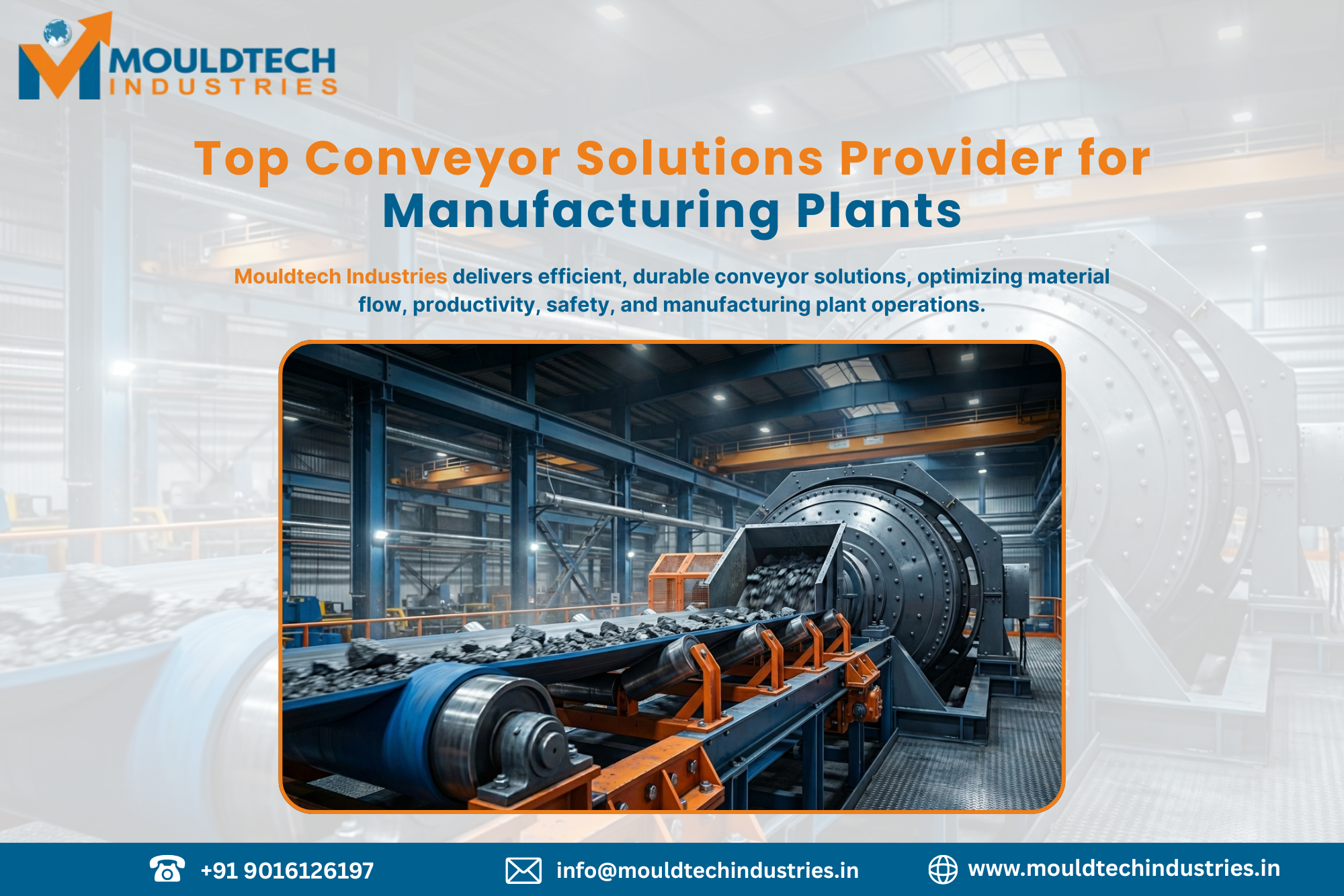
Top Conveyor Solutions Provider for Manufacturing Plants Custom-Built Conveyor Engineering by Mouldtedh Industries
In heavy-duty industrial environments, Top Conveyor Solutions Provider for Manufacturing Plants play a crucial role in addressing persistent challenges faced by mining, metal processing, cement production, ceramic manufacturing, and bulk material handling operations. These industries regularly encounter severe equipment wear, material abrasion, and reliability issues caused by abrasive materials, high-impact loads, corrosive conditions, and continuous material movement. Without robust conveyor protection and design, such factors lead to frequent breakdowns, unplanned downtime, and rising maintenance costs that directly impact productivity.
Seasoned plant engineers frequently note that conveyors, being vital for efficient bulk material movement, are among the most wear-susceptible components when not properly engineered, safeguarded, or serviced. With industrial expansion across India’s key mining regions, including Jharkhand, Odisha, Chhattisgarh, and Maharashtra, as well as cement and manufacturing centres in Rajasthan, Gujarat, and Uttar Pradesh, the need for robust, high-performing conveyor systems is continually growing. Globally, industrial centres in regions such as Southeast Asia, Europe, and Australia are also actively seeking reliable conveyor solutions that minimise downtime while maintaining steady output.
Complete Conveyor Offerings—encompassing rubber lining systems, ceramic wear-resistant tiles, belt cleaning mechanisms, impact protection beds, and bespoke accessories—have arisen as a crucial answer to these operational hurdles. These remedies improve conveyor reliability, protect high-wear areas, and significantly extend equipment service life. By reducing necessary maintenance and improving operational continuity, advanced conveyor solutions foster safer, more productive, and more economical material handling in demanding industrial settings.
Industrial Hurdles Prompting Demand for Conveyor Remedies
Operations dealing with bulk materials are inherently taxing. Conveyor setups confront various stresses impacting their function and lifespan:
- Friction: In mining, cement, and ceramic processing, rapidly transferring material subjects belts, idlers, and chutes to intense abrasive wear. Over time, this results in thinning of the rubber layer, belt tearing, and potential scatter.
- Shock Loads: Heavy chunks of mineral, clinker, or ceramic pellets striking chutes or conveyor belts can cause localised damage, necessitating frequent repairs and replacements.
- Deterioration: In chemically active settings, such as those found in phosphate processing or cement facilities that utilise fly ash, metal elements, and supporting structures can degrade, shortening the conveyor assembly’s valuable life.
- Stoppage: Conveyor malfunctions disrupt material flow, affecting production lines and causing linked delays in mineral extraction, metal production, or bulk-handling activities.
- Service Expenses: Repeated replacement of worn pieces, labour for repairs, and the need for urgent spare parts drive up running costs.
Global industrial settings present comparable issues. Mining activities in Australia, metal fabrication in Germany, and ceramic manufacturing hubs in Italy require conveyor systems that can endure friction, impact, and corrosive exposure. Manufacturers with extensive sector involvement recognise that addressing these issues in advance enhances overall plant performance and workforce well-being.
What Constitutes Conveyor Solutions?
In an industrial context, Conveyor Solutions refers to a grouping of machinery, protective coverings, and add-ons intended to optimise material movement while reducing wear and interruptions.
These solutions encompass:
- Rubber application for absorbing impact and resisting abrasion.
- Ceramic pieces for intense wear zones subjected to severe friction.
- Belt cleaners and scrapers to prevent material accumulation and damage.
- Customised parts tailored for specific facility needs.
Unlike basic equipment updates, Conveyor Solutions are specifically designed to handle particular materials, operational speeds, and environmental factors. In mineral extraction and metal fabrication processes, they reduce equipment failure rates, increase material throughput, and extend operational life.
Implementations Across Sectors
Conveyor Solutions find use across a broad spectrum of industrial segments, each with unique operational necessities:
- Mineral Extraction: Moving ores, coal, and aggregate demands abrasion-resistant linings and impact-protective structuring. Conveyors in mines in Jharkhand, Odisha, and Chhattisgarh often function under heavy load conditions where material scatter can disrupt output.
- Cement Facilities: Transporting clinker, limestone, and gypsum requires robust wear defence protection, especially in chutes and transfer points. Rubber and ceramic linings help preserve facility operational time while reducing dust and material loss.
- Metal & Steel: Handling iron ore, slag, and scrap metal exposes conveyors to high-impact forces and abrasive wear. Appropriate lining remedies reduce maintenance frequency and safeguard valuable conveyor systems.
- Ceramic Production: Conveying tiles, powders, and raw materials requires abrasive media that can quickly degrade standard conveyor belts. Ceramic wear-defence tiles provide superior resilience, ensuring steady material flow.
- Power Generation: Coal-fired plants and biomass-handling systems rely on conveyors for uninterrupted boiler feeding. Rubber lining and belt cleaners lessen spillage and ensure dependable operation.
- Bulk Material Logistics: Ports, storage facilities, and distribution centres move granular or powdered substances. Tailored Conveyor Solutions boost efficiency while reducing equipment deterioration.
Material Science & Design Considerations
The efficacy of Conveyor Solutions hinges on grasping material characteristics and engineering concepts:
- Rubber Attributes: Natural and synthetic rubber provide excellent flexibility, shock absorption, and resistance to ripping. In heavy-duty industrial settings, rubber overlays reduce the impact of shock loads on metal frameworks and extend conveyor service life.
- Ceramic Firmness: Ceramic pieces have high Mohs hardness, offering superior friction defence in areas exposed to high material velocity or abrasive minerals.
- Wear Resistance Ideals: Engineers must balance hardness with pliability. Hard materials like ceramics resist friction but are fragile under high force, whereas rubber absorbs force but degrades more rapidly under abrasive conditions.
- Impact Buffering: Properly designed linings prevent structural damage to conveyor chutes, idlers, and belt supports, reducing downtime and service expenditures.
Experienced plant specialists frequently emphasise that selecting the right blend of rubber and ceramic materials is vital for maximising operational effectiveness.
Design & Customization Needs
Conveyor Solutions are not universally applicable. Key points for design and customisation include:
- Machinery Interoperability: Linings and accessories must fit existing conveyor models, idlers, and frames without hindering performance.
- Tailored Sizing: Bespoke solutions ensure that every chute, skirtboard, and belt segment receives appropriate protection.
- Application-Specific Schematics: Material type, transfer velocity, impact zones, and environmental factors determine the design of protective systems and linings.
Custom-developed Conveyor Solutions guarantee dependable performance across diverse plant layouts, from large-scale mining lines in Rajasthan to ceramic facilities in West Bengal.
Manufacturing Excellence & Process Oversight
High-calibre Conveyor Solutions necessitate precise fabrication and strict quality management:
- Accurate Fabrication: Components must be manufactured to exact measurements for flawless integration with conveyor equipment.
- Quality Vetting: Routine checks for hardness, density, and impact toughness ensure uniform performance.
- Batch Uniformity: Consistent material characteristics across different production runs reduce variation in plant operations, preventing unforeseen wear or failure.
Manufacturers with a deep sector background recognise that rigorous quality checks mitigate unexpected stoppages and extend component lifespan.
Fitting & Servicing Points
Simplicity of setup and upkeep is a crucial element of Conveyor Solutions:
- Installation Simplicity: Pre-formed linings and modular components enable swift replacement, minimising facility downtime.
- Reduced Halts: Quick fitting and exchange periods prevent extended production interruptions.
- Maintenance Schedules: Predictable wear patterns permit scheduled service, minimising urgent interventions and operational interruptions.
Safety & Operational Dependability
Conveyor Solutions also contributes to worker safety and facility reliability:
- Workforce Protection: Properly lined conveyors reduce scatter, dust, and material ejection, lowering the probability of workplace accidents.
- Equipment Safeguarding: High-impact and abrasive segments are reinforced to avert structural collapse.
- Facility Dependability: Smooth material flow and reduced downtime boost overall plant efficiency, which is crucial in continuous processes such as cement, mineral extraction, and steel production.
Economic Effectiveness Across the Equipment Lifespan
While the initial outlay for Conveyor Solutions might exceed that of standard parts, they offer substantial financial benefits over the equipment’s operational life:
- Long-Term Savings: Durable linings reduce the need for replacements and minimise unplanned downtime.
- Fewer Interruptions: Less frequent servicing assures higher production availability.
- Maintenance Streamlining: Predictable wear patterns and easily fitted components reduce labour and material costs over time.
Export Readiness & International Acceptance
Industrial purchasers, both domestically in India and overseas, require Conveyor Solutions that adhere to global benchmarks:
- Industrial Export Expectations: Consistency, toughness, and adherence to ISO or ASTM norms are vital for international markets.
- Documentation & Standards Awareness: Detailed schematics, test results, and assembly guides help global buyers make informed decisions.
- Global Buyer Preferences: Manufacturers delivering proven, dependable remedies are favoured by mineral extraction and bulk handling firms in Australia, Europe, and Southeast Asia.
Why Proven Manufacturers Are Important?
Selecting an established manufacturer is crucial:
- Engineering Acumen: Understanding material behaviour, plant operations, and industrial wear dynamics ensures optimal solution design.
- Sector Background: Extended exposure to mining, steel, cement, and ceramic sectors informs practical, effective remedies.
- Reliable Supply Line: Consistent product availability guarantees minimal disruption.
About Mouldtech Industries
Mouldtech Industries is a leading manufacturer of Conveyor Solutions, Ball Mill Rubber Liners, Ceramic Wear Protection Systems, and custom rubber lining systems serving India and international industrial markets. With decades of experience in engineering high-performance wear protection solutions, Mouldtech Industries delivers durable, application-specific products for mining, cement, metal, and ceramic plants across India, including major industrial hubs like Jharkhand, Maharashtra, Gujarat, Rajasthan, Uttar Pradesh, Tamil Nadu, West Bengal, and Karnataka.
For more information, visit the official website: https://www.mouldtechindustries.in/
Conclusion:
In mining, cement, metal, ceramic, and bulk material handling industries, Conveyor Solutions play a pivotal role in ensuring operational reliability, wear protection, and long-term cost efficiency. By combining rubber linings, ceramic wear tiles, belt cleaners, and customised components, plants can significantly reduce downtime, protect equipment, and improve overall productivity.
Industrial engineers and plant managers should prioritise solutions engineered for specific operational needs, material types, and environmental conditions to maximise plant performance.
Key Takeaways
- Wear protection benefits extend equipment life and reduce unplanned downtime.
- Operational reliability is improved across mining, cement, metal, and ceramic plants.
- Conveyor Solutions are suitable for a wide range of industrial applications, including bulk material handling.
- Long-term performance relies on material science, engineering, and quality manufacturing.
- Solutions meet global industrial relevance and export standards.
FAQS
Q1: What is the typical lifespan of conveyor linings?
- A: In heavy-duty industrial environments, properly designed rubber and ceramic linings last 3–7 years, depending on material abrasiveness and operational load.
Q2: Which industries benefit most from Conveyor Solutions?
- A: Mining, cement, metal & steel, ceramic, power plants, and bulk material handling industries derive significant advantages.
Q3: How often should maintenance be scheduled?
- A: Experienced plant engineers recommend inspection every 3–6 months, with replacement cycles based on wear thickness and operational conditions.
Q4: Rubber vs ceramic wear solutions: which is better?
- A: Rubber absorbs impact and reduces structural stress, while ceramics resist high abrasion. Often, a combination is used for optimal performance.
Q5: Are Conveyor Solutions used globally?
- A: Yes, they are widely used in Australia, Europe, Southeast Asia, and India in mining, bulk material handling, and steel industries.
#BallMillRubberLiner #CeramicWearProtection #RubberLining #MiningSolutions #BulkMaterialHandling #ConveyorSolutions #MouldtechIndustries #WearProtection #IndustrialManufacturing