

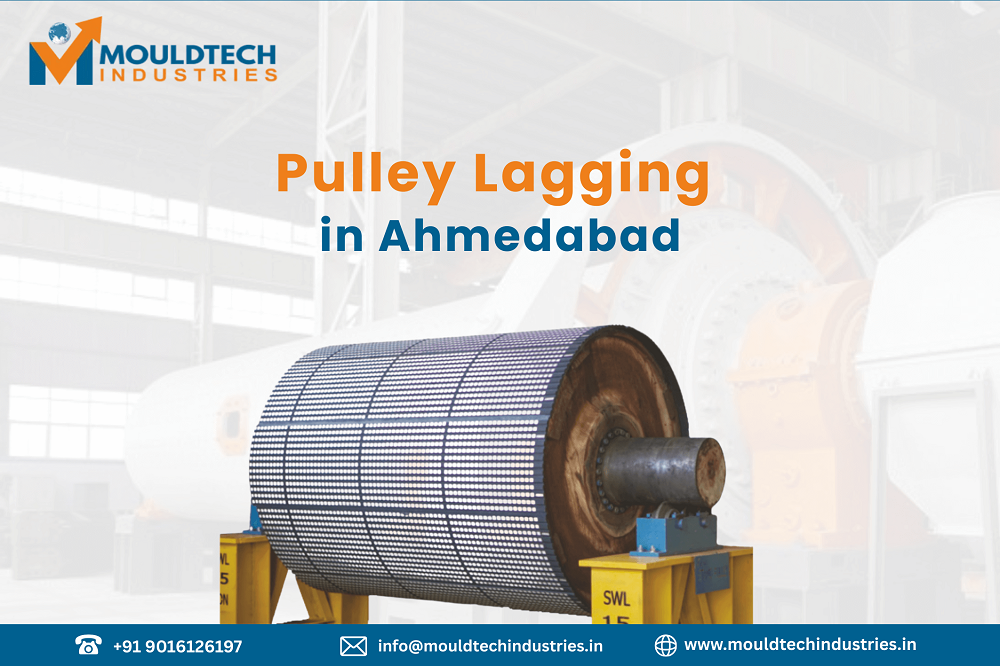
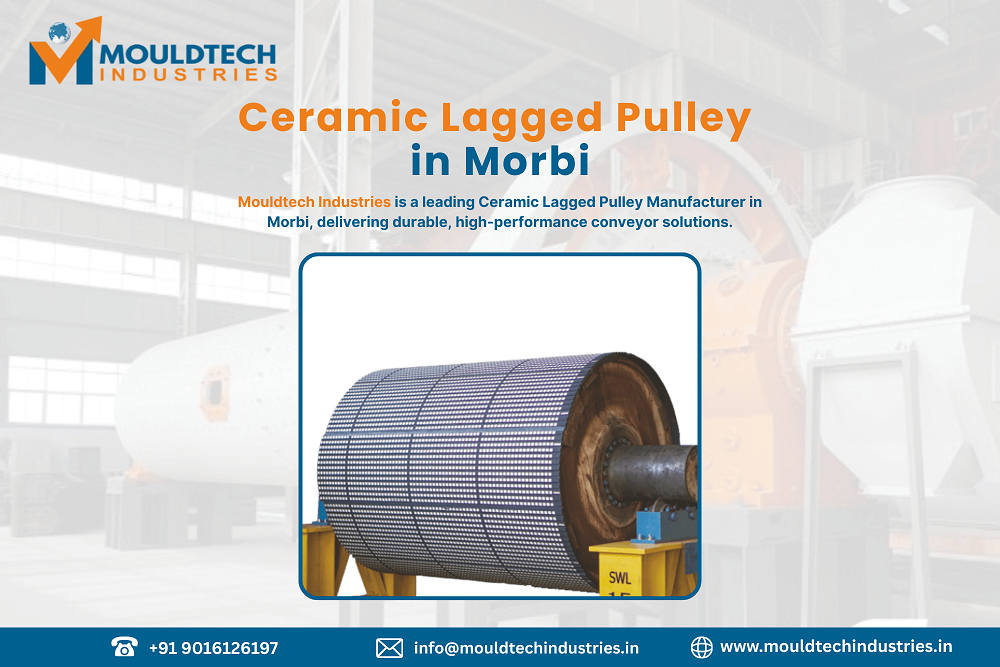
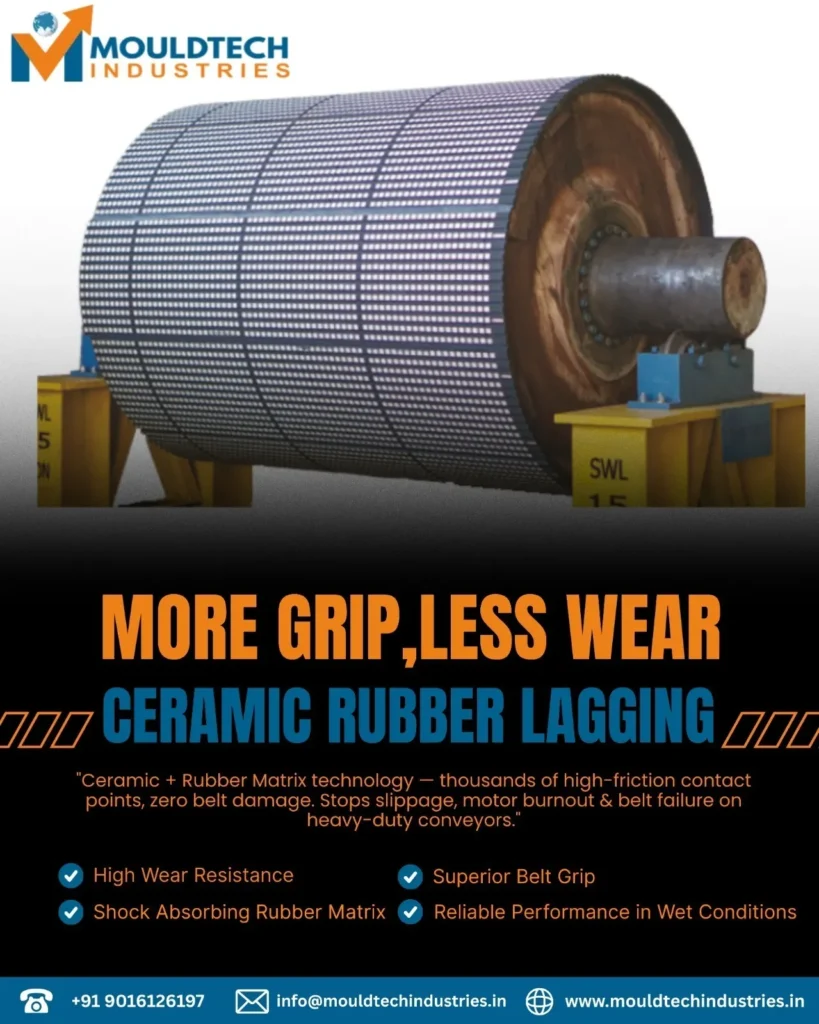
Why Is Ceramic Rubber Pulley Lagging Used in Conveyors?
Ceramic Rubber Pulley Lagging is used in conveyors to improve belt traction, reduce slippage, and increase pulley durability in demanding industrial environments. Mouldtech Industries provides high-quality Ceramic Rubber Pulley Lagging solutions designed for better conveyor efficiency, reliable performance, and longer service life. These lagging systems are ideal for mining, cement, power, and manufacturing industries where strong grip and wear resistance are required.
How Ceramic Lagging Boosts Conveyor Performance?
Conveyor downtime rarely announces itself in advance. It usually starts small — a belt tracking slightly off-center, a pulley running warmer than usual, or a maintenance log entry that gets ignored for a few weeks. By the time the belt slips badly enough to stop production, the plant has already lost hours, and sometimes lakhs, in unplanned shutdown. Ceramic lagging addresses this problem at its source, at the belt-pulley contact point, and understanding how it actually improves performance helps procurement and maintenance teams make a more informed decision rather than a reactive one.
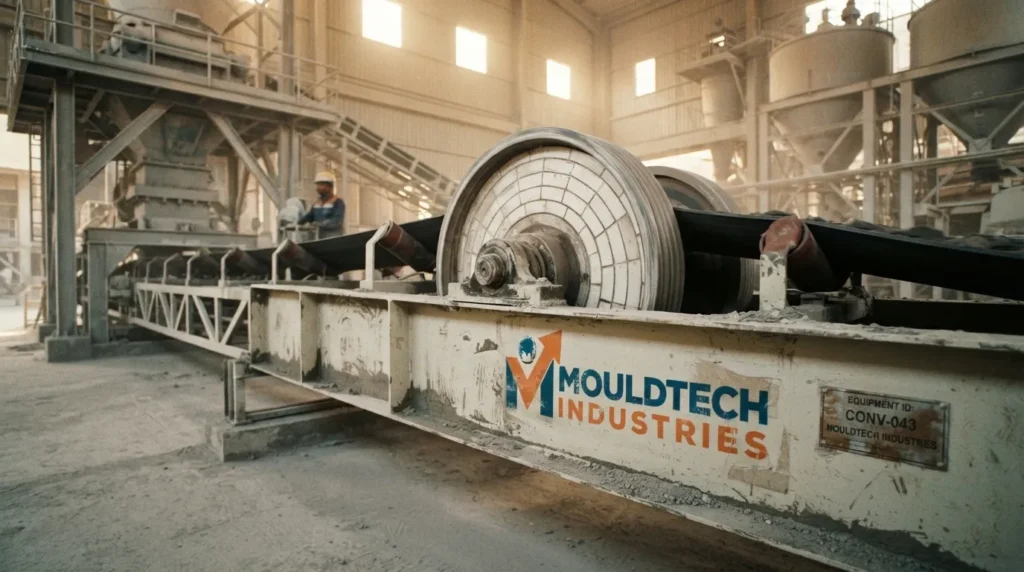
Why Choose Mouldtech Industries for Ceramic Lagging Solutions
Mouldtech Industries, headquartered in Vadodara, Gujarat, has spent 18+ years working with industrial rubber products for mining and cement plants across India. While we’re recognized among ball mill rubber liner manufacturers for our wear resistant rubber liner and ceramic embedded rubber liner ranges, a significant part of our shop-floor work also involves conveyor system components — rubber lagging, conveyor belt cleaners, and impact pads.
Here’s how Mouldtech Industries looks at conveyor performance: it’s rarely just one component failing. A pulley running hot, a belt mistracking, and lagging wearing unevenly are usually connected symptoms. Ceramic lagging improves the friction coefficient between the belt and the drive pulley, which directly reduces slip-related heat generation — one of the more overlooked causes of premature bearing and motor failure in Indian plants running long shifts.
Our Ceramic Lagging Manufacturing Capabilities
Yes, we manufacture ceramic lagging in-house, using the same vulcanization infrastructure that supports our custom rubber liners production line. This integration matters because lagging performance is directly tied to how well ceramic tiles bond to the rubber base during the curing process — a weak bond leads to tile loss within months, especially on high-tonnage conveyors.
Our manufacturing capabilities include:
- Diamond and herringbone ceramic tile patterns for different slip and load conditions
- Tile density selection based on moisture, dust, and abrasive exposure
- Hot-vulcanized bonding for stronger tile adhesion compared to cold-bond methods
- Custom lagging thickness matched to pulley shell diameter
- Application support at plant sites where pulley removal isn’t practical
A Pune-based aggregate processing unit approached us after repeated tile pop-outs from a previous cold-bonded lagging supplier. Switching to hot-vulcanized ceramic lagging resolved the recurring issue within the first service cycle.
Get QuoteHow Does Ceramic Rubber Pulley Lagging Improve Belt Grip?
| Feature | Ceramic Rubber Pulley Lagging Advantage | Result |
|---|---|---|
| Superior Grip | Ceramic surface provides high friction between belt and pulley | Reduced belt slippage and smooth operation |
| High Wear Resistance | Durable ceramic tiles protect against abrasion and damage | Longer pulley service life |
| Better Conveyor Efficiency | Improves power transfer and belt tracking performance | Enhanced conveyor productivity |
| Low Maintenance | Reduces friction-related wear and frequent repairs | Lower downtime and maintenance cost |
| Industrial Applications | Suitable for mining, cement, steel, and power industries | Reliable performance in harsh conditions |
Navigating Quality Standards & ISO 9001:2015 Certification
The best way to evaluate a lagging supplier isn’t just by price — it’s by process consistency, and that’s where certification matters. Mouldtech Industries operates under an ISO 9001:2015 certified quality management system, which governs raw material traceability, batch documentation, and corrective action processes across our production line.
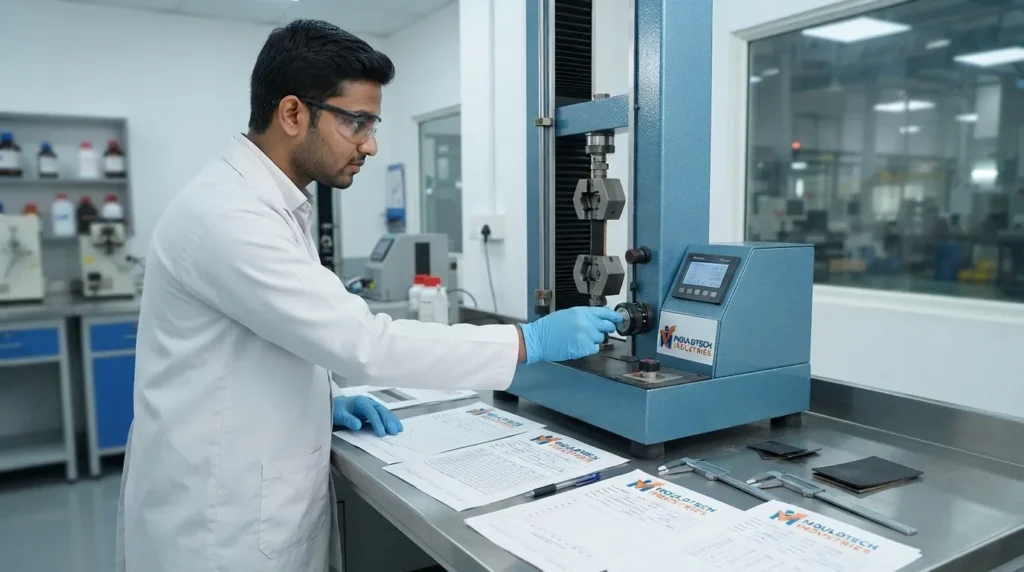
ISO 9001:2015 doesn’t dictate specific rubber compounds or ceramic tile grades — that’s engineering-level decision-making — but it does require documented, repeatable manufacturing processes. For plants in Chennai, Kolkata, or Indore comparing rubber liner manufacturers in Vadodara against regional fabricators, certification status is a reasonable first filter, though it should be paired with asking for actual bond-strength test data.
Local Manufacturers vs Mouldtech Industries
| Parameter | Typical Local Fabricator | Mouldtech Industries |
|---|---|---|
| Bonding Method | Cold-bond, inconsistent adhesion | Hot-vulcanized bonding |
| Quality Documentation | Often absent | ISO 9001:2015 certified process |
| Pattern Customization | Fixed standard patterns | Custom per load and slip condition |
| Track Record | Regional, limited history | 18+ years, 200+ clients |
| Supply Coverage | Local area only | Pan-India supply, export ready |
Step-by-Step Process – How We Deliver Ceramic Lagging Solutions
- Assessment — pulley diameter, belt speed, incline angle, dust/moisture exposure
- Pattern selection — herringbone for high-slip or inclined conveyors, diamond for standard drives
- Tile density and compound matching — based on abrasive load and operating temperature
- Hot vulcanization bonding — controlled cure cycle under ISO-documented parameters
- Bond strength and thickness verification — before dispatch
- Dispatch or on-site fitting — coordinated for plants across Mumbai, Hyderabad, Delhi, and Chandigarh
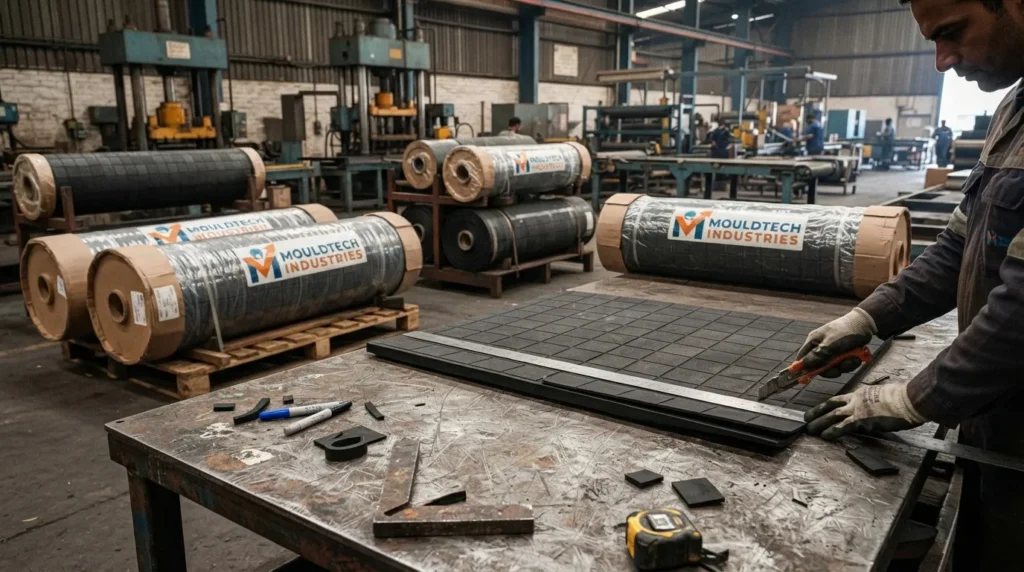
This same process discipline carries over into our cement mill liners and mining equipment rubber solutions production, since bonding failure has similar root causes across rubber-to-metal applications.
What Makes Ceramic Rubber Pulley Lagging Suitable for Heavy-Duty Conveyors?
| Key Factor | Ceramic Rubber Pulley Lagging Feature | Conveyor Benefit |
|---|---|---|
| Friction Control | High-friction ceramic pattern improves belt contact | Prevents belt movement issues |
| Surface Protection | Hard ceramic tiles resist impact and abrasion | Extends pulley operating life |
| Wet Condition Performance | Maintains grip in moisture and dusty environments | Reliable conveyor operation |
| Energy Efficiency | Improves traction between belt and pulley | Reduces power loss during operation |
| Heavy Load Handling | Designed for high-tension conveyor systems | Better performance under heavy-duty conditions |
External Resources
For detailed engineering standards and best practices on Ceramic Rubber Pulley Lagging and conveyor systems, refer to the Conveyor Equipment Manufacturers Association (CEMA) and ISO Technical Committee 41 for reliable technical guidance and industry recommendations.
Real Client Case Study
A cement grinding unit near Ahmedabad was experiencing recurring belt slippage on its main drive conveyor, initially attributed to belt tension loss. The maintenance team kept re-tensioning the belt every few weeks, which accelerated wear on the take-up pulley bearings instead of solving the actual problem.
During a site assessment, our team found the existing rubber lagging had glazed over from heat buildup, significantly reducing its grip. We replaced it with ceramic lagging in a herringbone pattern suited to their inclined conveyor section. Slippage incidents dropped noticeably within the first quarter, and the plant’s maintenance head reported a meaningful reduction in belt replacement frequency over the following year.
For plants in Bangalore and Jaipur dealing with similar recurring slippage, this misdiagnosis — treating a lagging wear issue as a tensioning problem — is more common than most teams expect, and it usually costs more in the long run than the lagging replacement itself would have.
FAQs
Q1. Ceramic Rubber Pulley Lagging kya hota hai?
- Ceramic Rubber Pulley Lagging ek protective layer hoti hai jo conveyor pulley par lagayi jati hai. Yeh belt grip improve karti hai aur wear ko reduce karti hai.
Q2. Ceramic Rubber Pulley Lagging conveyor me kyu use hoti hai?
- Yeh conveyor belt ka slippage kam karti hai, traction badhati hai aur heavy-duty applications me better performance provide karti hai.
Q3. Ceramic Rubber Pulley Lagging ke kya benefits hain?
- Iske benefits me better grip, longer pulley life, low maintenance aur improved conveyor efficiency shamil hain.
Q4. Ceramic Rubber Pulley Lagging kaha use hoti hai?
- Yeh mining, cement, steel, power plant aur manufacturing industries ke conveyor systems me use hoti hai.
Q5. Ceramic Rubber Pulley Lagging belt life kaise improve karti hai?
- Ceramic tiles aur rubber combination belt movement ko stable banate hain, jis se wear aur damage kam hota hai.
Q6. Mouldtech Industries Ceramic Rubber Pulley Lagging kyu choose kare?
- Mouldtech Industries durable Ceramic Rubber Pulley Lagging solutions provide karta hai jo high-performance conveyor systems ke liye suitable hain.
Get Quote
Facing recurring belt slippage or unexplained pulley wear? Call +91-9925618287 or +91-7600030602, message us on WhatsApp for a quick site discussion, or email mouldtechindia@gmail.com. Ask about our Free Rubber Liner Consultation or the Download Ball Mill Liner Cost Guide before your next shutdown window.
Get Quote