

How Conveyor Belt Cleaners Save Maintenance Costs by Reducing Downtime
Mouldtech Industries helps businesses understand how conveyor belt cleaners save maintenance costs by reducing unplanned downtime and preventing material carryback. Clean conveyor belts reduce roller wear, minimize belt damage, and improve equipment reliability. Efficient belt cleaning keeps production running smoothly, lowers maintenance frequency, and increases operational efficiency. With durable conveyor belt cleaning solutions from Mouldtech Industries, industries can achieve higher productivity while reducing long-term maintenance and repair expenses.
How Conveyor Belt Cleaners Save Maintenance Costs: A Practical Guide for Indian Cement & Mining Plants
Material carryover on conveyor belts is one of those problems that plant managers learn to live with — until the cleanup crew, the bearing replacements, and the unplanned shutdowns start adding up on a spreadsheet. After 18+ years of supplying wear-protection solutions to mining and cement plants across India, we’ve seen this pattern repeat at dozens of sites: a belt runs fine for months, then fines start building under the return idlers, spillage piles up, and within a quarter the plant is looking at bearing failures, belt mistracking, and a housekeeping bill nobody budgeted for. Conveyor belt cleaners, when specified and installed correctly, address this at the source rather than downstream.
Why Choose Mouldtech Industries for Conveyor Belt Cleaner Solutions
Mouldtech Industries has been working with rubber wear components since 2007, and conveyor belt cleaners sit alongside our core work in ball mill rubber liner manufacturers and cement mill lining systems. The connection isn’t accidental — the same abrasion science that governs how a wear resistant rubber liner holds up inside a ball mill also governs how a cleaner blade performs against a moving belt carrying wet limestone or iron ore fines.
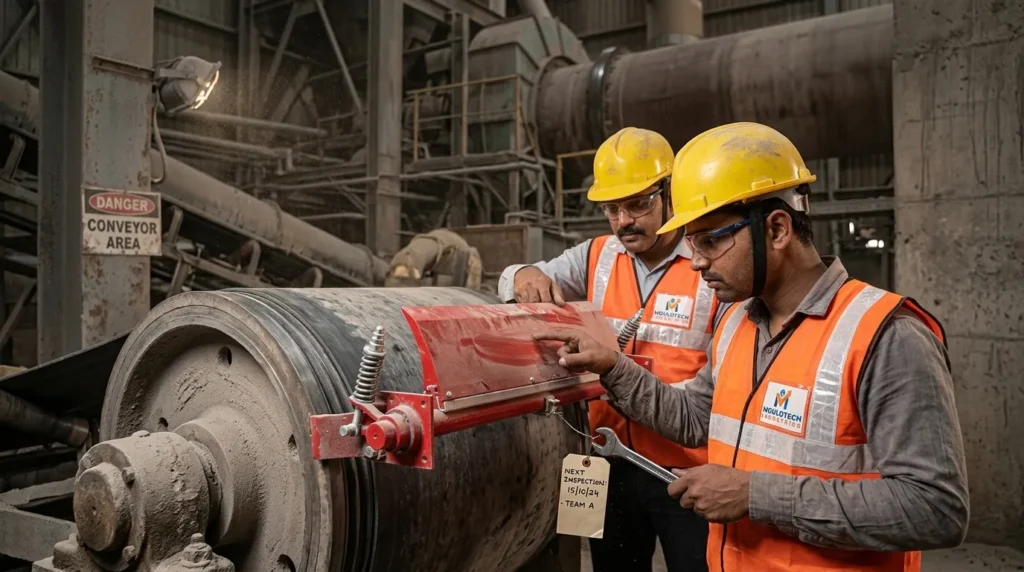
Our team includes rubber technologists who’ve spent years studying belt speed, material stickiness, and blade wear rates specific to Indian plant conditions — different from European or Chinese operating environments where much of the standard equipment is designed. We’re ISO 9001:2015 certified, and every cleaner system we supply is built to match the actual belt width, speed, and material characteristics at your site, not a generic catalogue spec.
Our Conveyor Belt Cleaner Manufacturing Capabilities
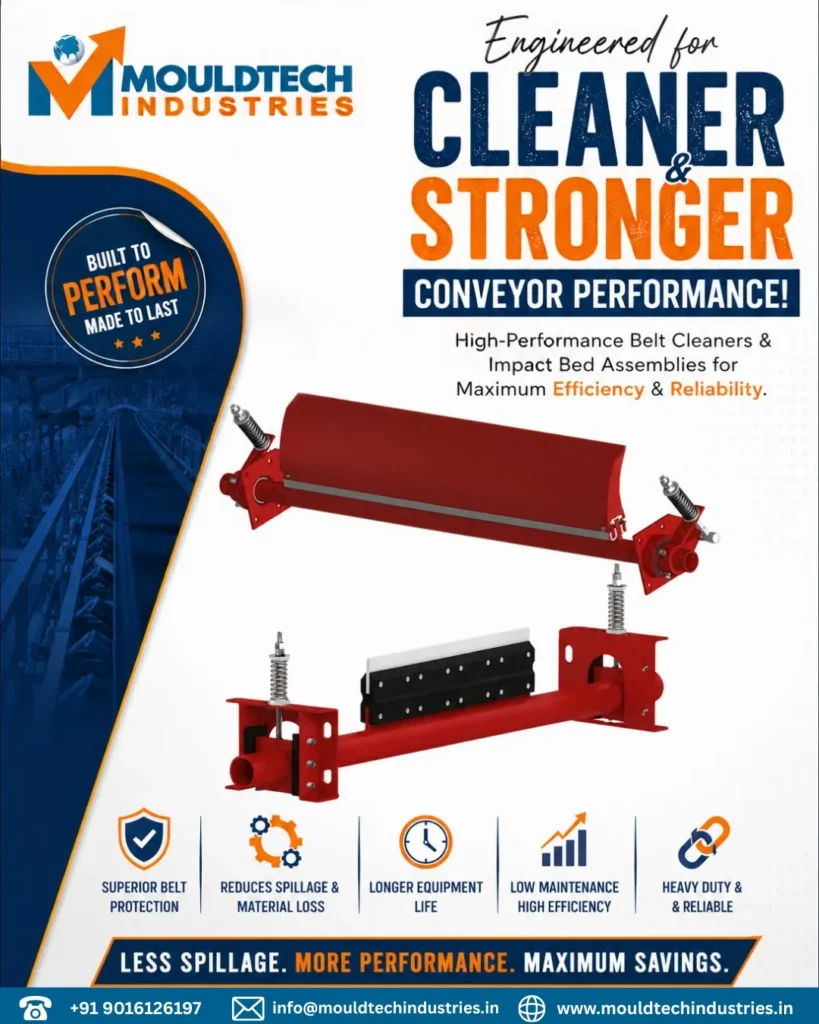
Here’s how Mouldtech Industries approaches belt cleaning as a maintenance-cost problem rather than just a component sale. We manufacture primary and secondary cleaner blades in polyurethane and specially compounded rubber, engineered for different material types — dry cement clinker behaves very differently against a blade than wet, sticky iron ore concentrate.
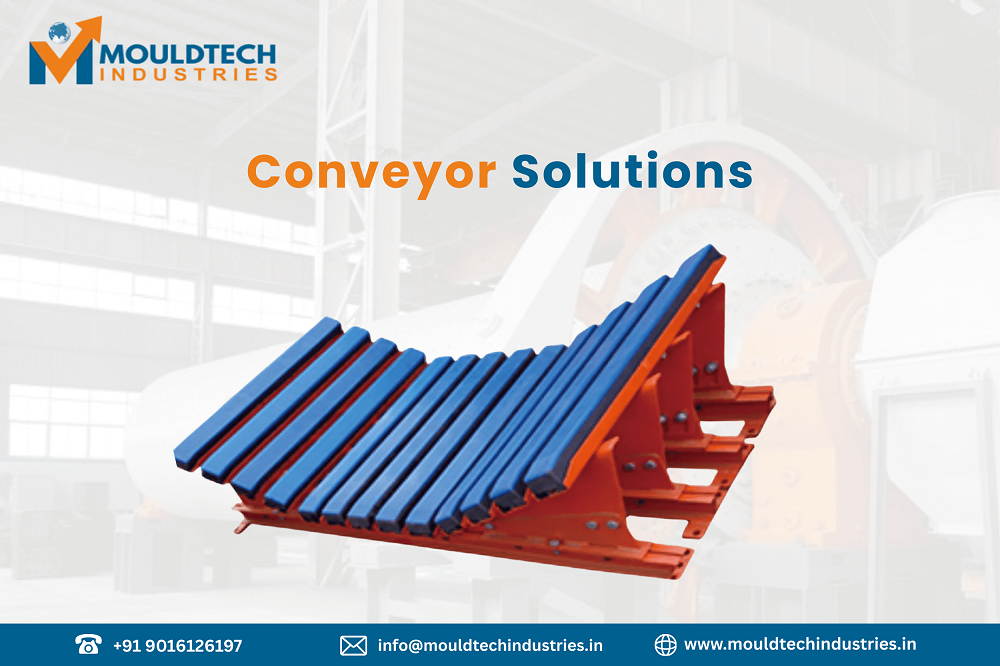
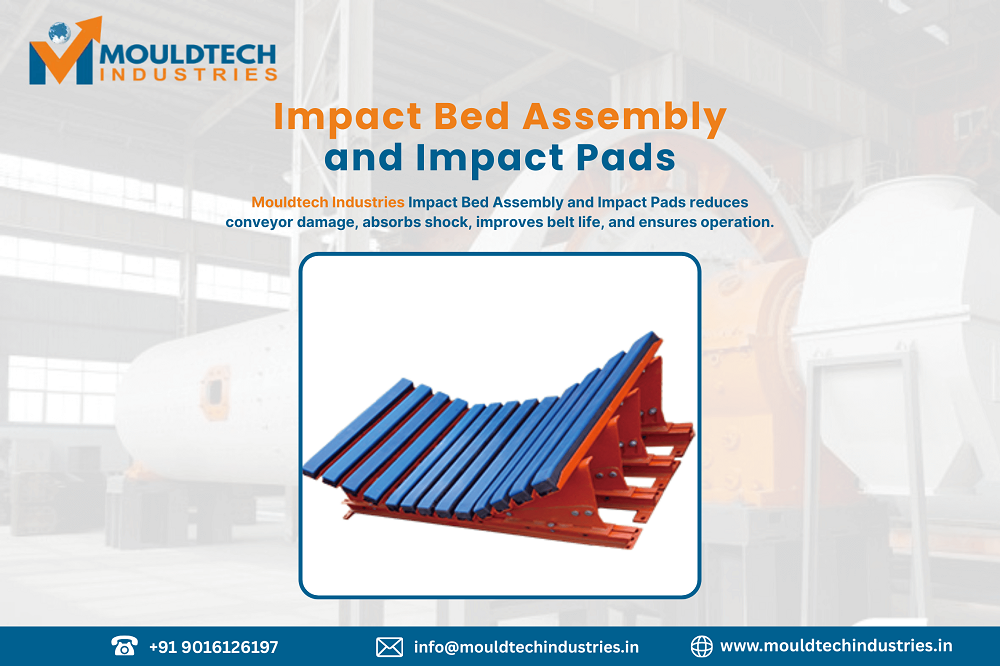
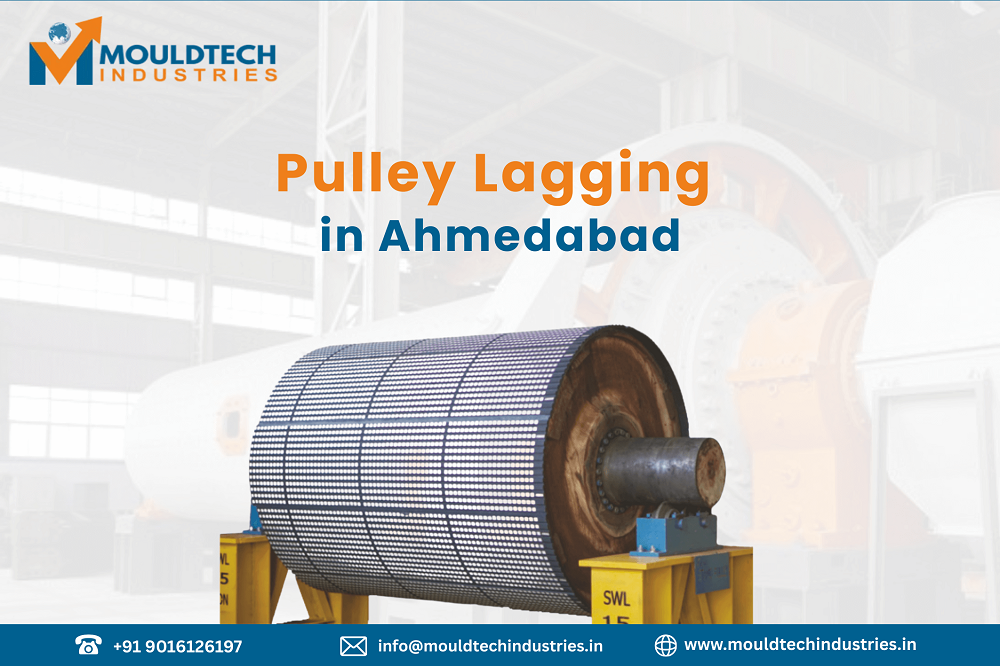
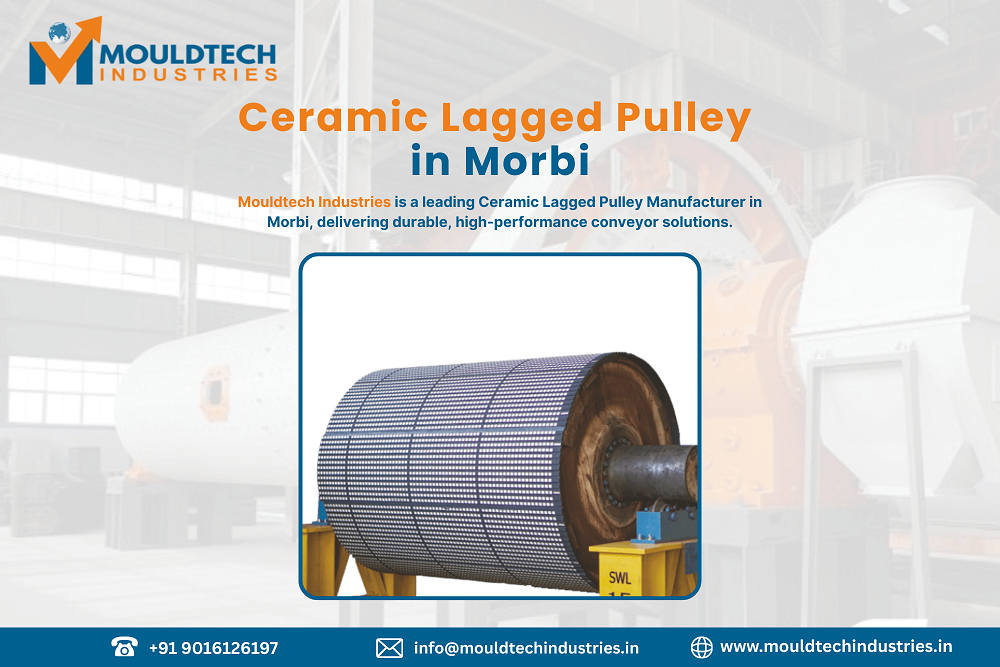
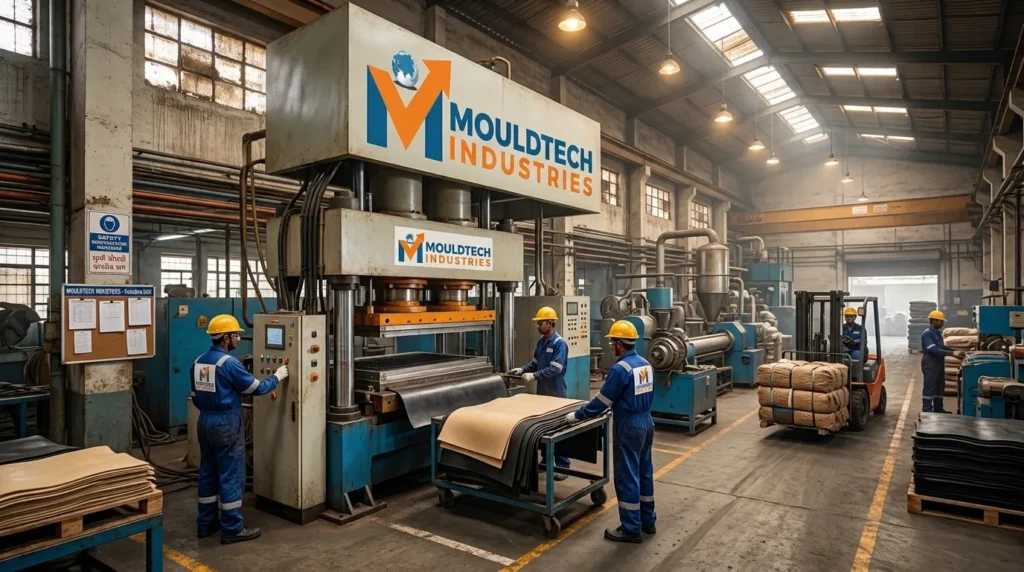
Our production runs alongside our ceramic embedded rubber liner and abrasion resistant liner lines, which means the same quality control — batch testing, durometer checks, bond-strength verification — applies to cleaner blades too. We also produce rubber lagging for pulley systems, since belt tracking and cleaning efficiency are closely linked; a poorly lagged pulley causes slippage that no cleaner blade can fully compensate for. Impact pads at loading zones round out the wear-protection package, reducing the material buildup that cleaners then have to deal with downstream.
Get QuoteNavigating Quality Standards & ISO 9001:2015 Certification
Yes, we provide documented quality traceability on every belt cleaner order — batch numbers, material compound sheets, and test records. ISO 9001:2015 sets out requirements for a quality management system, covering process consistency, documentation, and corrective-action tracking (the standard is published and maintained by the International Organization for Standardization). For a plant procurement team, this mostly translates into one practical benefit: the blade you reorder in month eight performs identically to the one installed in month one.
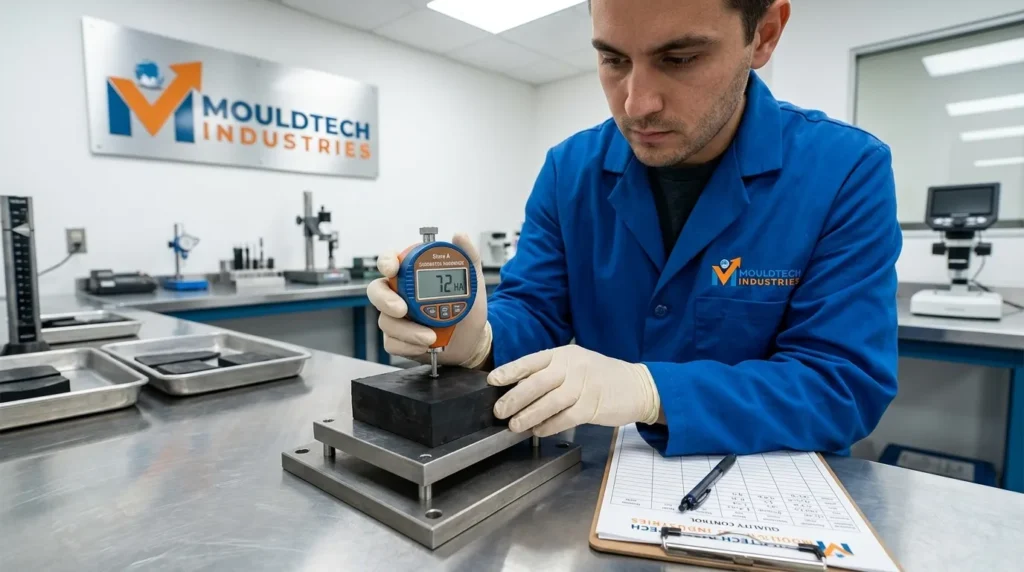
We’ve had maintenance heads in Ahmedabad and Surat specifically ask for compound consistency after getting burned by suppliers whose blade hardness varied batch to batch, causing uneven wear and premature replacement. Certification alone doesn’t guarantee this, but it does mean the process controls exist to catch it.
Local Manufacturers vs Mouldtech Industries
Plants across Mumbai, Delhi, Bangalore, Chennai, Hyderabad, Pune, Jaipur, Chandigarh, Kolkata, Indore, and Vadodara typically source belt cleaners locally for speed, then discover the limitations only after a few maintenance cycles. Here’s a straightforward comparison based on what we hear from clients switching suppliers:
| Parameter | Typical Local Fabricator | Mouldtech Industries |
|---|---|---|
| Blade compound testing | Often not documented | Batch-tested, ISO 9001:2015 process |
| Custom sizing to belt spec | Limited standard sizes | Fully customized to mill/plant specs |
| Integration with liner & lagging systems | Rarely offered as one package | Combined wear-protection approach |
| Pan-India logistics | Regional, limited reach | Pan-India supply and export ready |
| Track record | Varies | 200+ clients across mining & cement, since 2007 |
Step-by-Step Process – How We Deliver Conveyor Belt Cleaner Systems
The best approach starts with understanding what’s actually happening on your belt line, not just quoting a part number.
- Site data collection — belt width, speed, incline, material type and moisture content, current cleaner (if any) and its wear pattern.
- Material compound selection — matching blade polymer to abrasiveness and stickiness of the conveyed material.
- Custom fabrication — cutting and curing blades to exact belt width and mounting configuration.
- Quality verification — hardness, tensile, and dimensional checks under our ISO-documented process.
- Installation guidance or on-site support — tensioning is critical; an over-tensioned blade wears the belt cover, an under-tensioned one leaves carryover.
- Follow-up review — we ask clients to report wear rates after 60–90 days so future orders can be fine-tuned.
Real Client Case Study
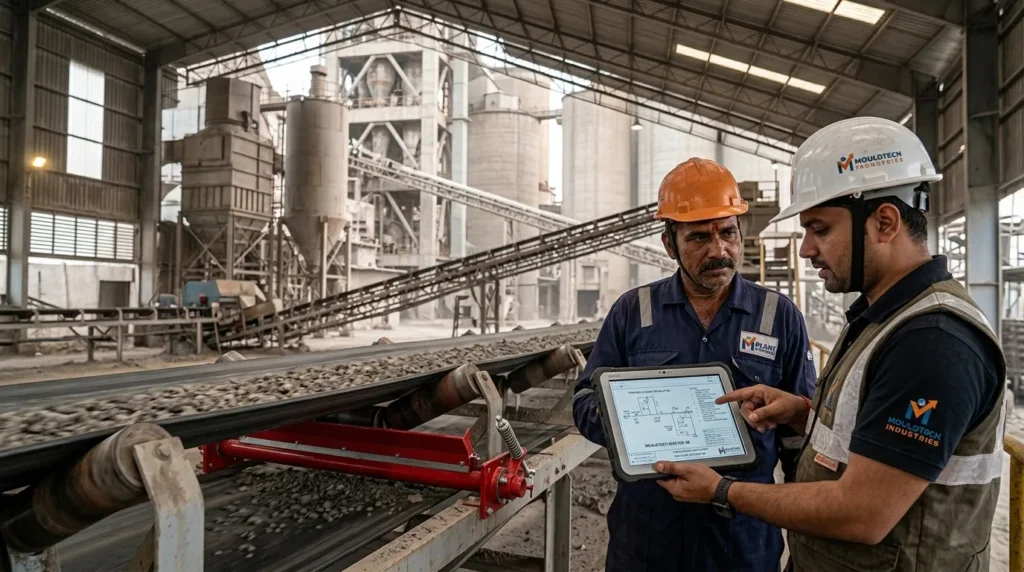
A cement plant in the Indore region had a recurring problem. Return-idler bearings were being replaced every four to five months — well below expected life. Housekeeping labor for belt spillage had become a standing line item in the maintenance budget.
Our team reviewed the belt line. The existing primary cleaner blade had worn unevenly. This let clinker fines build up under the return strand, which accelerated idler wear.
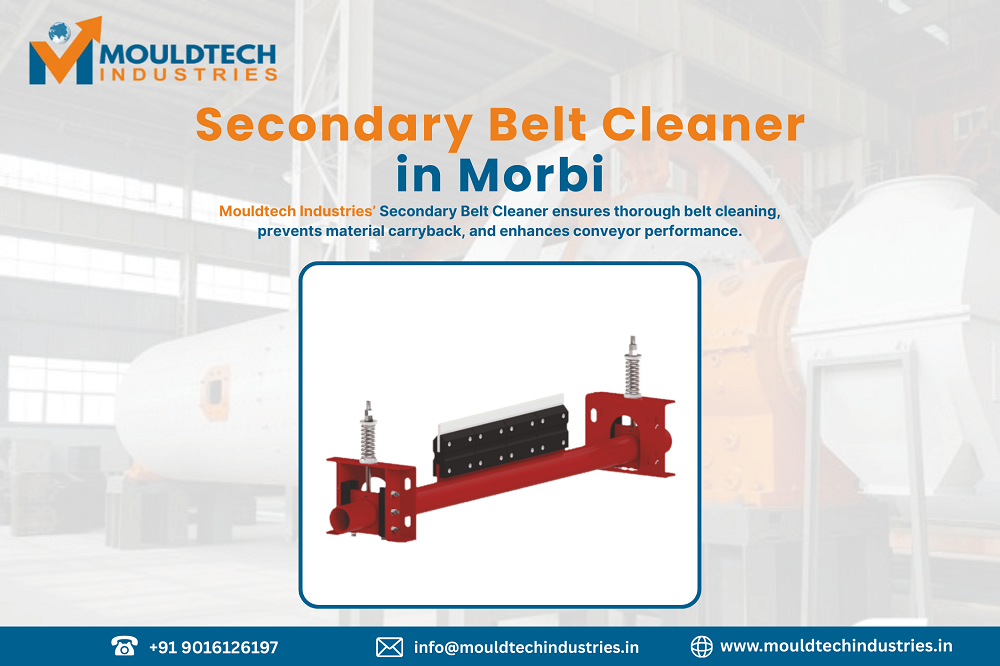
We supplied a custom-profiled polyurethane primary blade. It was matched to the belt’s actual tracking behavior. A secondary cleaner was added for the fines the primary blade couldn’t catch. Every component was manufactured under our ISO quality process. This ensured consistent compound hardness, batch to batch.
Over the following two maintenance cycles, the plant reported reduced spillage. Idler replacement intervals also got longer. It’s a smaller story than a full ball mill relining project. But it illustrates the point: wear resistant rubber liner thinking applies just as much to a two-inch cleaner blade as it does to a mill shell.
We’ve supplied similar combined liner-and-cleaner packages to clients in Chennai and Hyderabad. Humidity and material stickiness there create different wear patterns than the drier conditions further north.
Belt cleaning and mill lining are often reviewed together during annual maintenance planning. Both fall under the same wear-cost category on a plant’s books. This is worth noting for plants also evaluating ball mill rubber liner manufacturers for their grinding circuit.
FAQs
Q1: Conveyor belt cleaners maintenance cost kaise kam karte hain?
- Belt cleaners Manfuacture carryover material ko belt se hatate hain isse pehle ki wo return idlers aur bearings tak pahunche. Isse bearing wear, spillage cleanup ka labour cost, aur belt mistracking — teeno hi kam ho jaate hain, jo mil ke plant ka overall maintenance bill kaafi badha dete hain.
Q2: Belt cleaner blade kitne time mein replace karna padta hai?
- Ye material ki abrasiveness aur blade tensioning par depend karta hai, lekin generally 3 se 9 mahine ka life milta hai. Wear rate track karte rahenge to timely replacement plan karna easy ho jata hai, aur sudden downtime avoid hota hai.
Q3: Ek hi blade wet aur dry, dono type ke material ke liye use ho sakta hai kya?
- Ideally nahi. Wet, sticky material (jaise iron ore concentrate) aur dry abrasive material (jaise cement clinker) ke liye alag compound select karna padta hai — isliye hum pehle site ka material analysis karte hain, phir sahi blade recommend karte hain.
Q4: Kya Mouldtech Industries pura India mein custom rubber liner aur belt cleaners supply karti hai?
- Ji haan, Mouldtech Industries custom rubber liner India solutions aur belt cleaner systems pan-India supply karti hai, saath hi export-ready logistics bhi available hai — mining aur cement plants dono ke liye.
Q5: Primary aur secondary belt cleaner mein kya farak hota hai?
- Primary cleaner head pulley par lagta hai aur bulk carryover material hataata hai. Secondary cleaner uske baad bache hue fine particles ko clean karta hai. Heavy-duty applications mein aksar dono ek saath use hote hain, taaki cleaning efficiency maximum rahe.
Q6: Site assessment ya cost estimate lene ka process kya hai?
- Bahut simple hai — hum Free Rubber Liner Consultation offer karte hain, jisme aapke belt line ka actual wear pattern review karte hain. Iske saath Ball Mill Liner Cost Guide bhi download kar sakte hain, jisse liner aur belt-cleaning dono ka maintenance budget compare karna easy ho jata hai.
Get Quote
Facing recurring belt slippage or unexplained pulley wear? Call +91-9925618287 or +91-7600030602, message us on WhatsApp for a quick site discussion, or email mouldtechindia@gmail.com. Ask about our Free Rubber Liner Consultation or the Download Ball Mill Liner Cost Guide before your next shutdown window.
Get Quote