
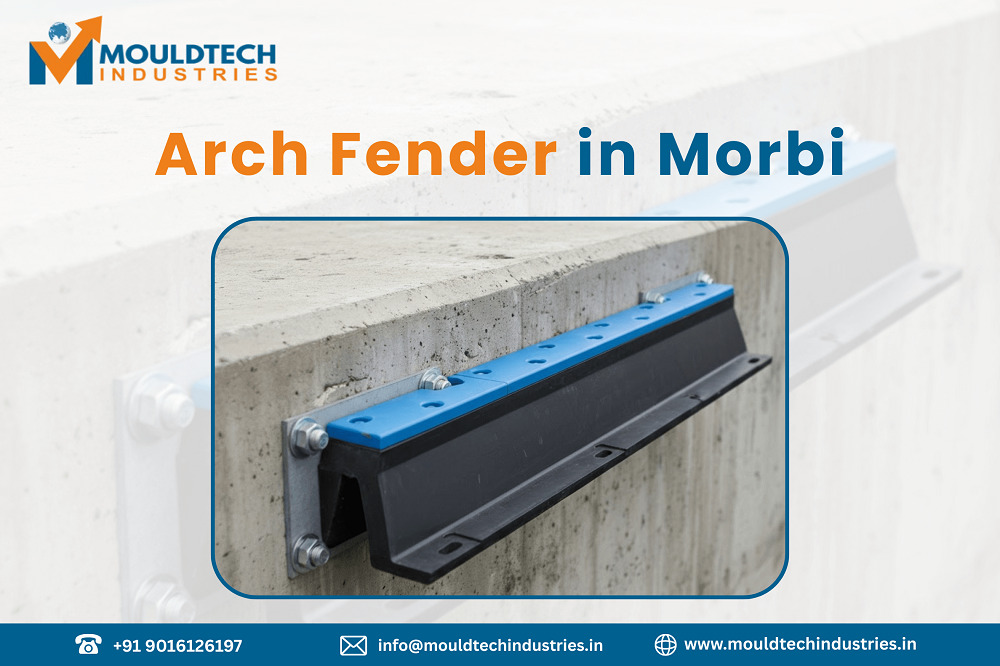
Arch Fender Manufacturer, Supplier And Exporter in India: Mouldtech Industries
Mouldtech Industries is a Manufacturer of Arch fenders in Morbi.
Our Manufacturing Unit is in Vadodara, Gujarat, India.
Mouldtech Industries is a Manufacturer of Arch Fender, Ball Mill Rubber Lining, Arch Fender, Resistant Rubber Liner, Embedded Rubber Liners, Conveyors Solutions, Ceramic Lagging Sheet, Belt Cleaners, Arch Fender, Ceramic Rubber Lagging Services, and Ceramic Rubber Lagging Sheet.
Arch Fender Safeguards for Severe Industrial Deterioration Defence
Introduction
In demanding industrial settings such as excavation, metalwork, concrete production, ceramics, and large-volume cargo management, machinery is subjected to continuous mechanical strain. Wear from unprocessed materials, recurrent shock forces, corrosive atmospheres, and non-stop operation expose plant dependability to daily tests. For facility engineers and maintenance personnel, the real apprehension involves operational continuity, safety, and the forecasting of maintenance planning, beyond mere equipment performance.
As global industrial needs grow, particularly in rapidly evolving manufacturing centres in India and other emerging economies, sectors are straining existing infrastructure. This trend highlights the growing importance of effective wear defence systems capable of cushioning strikes, minimising structural damage, and prolonging machinery lifespan without introducing operational complications.
One such vital safeguard is the Arch Fender—a sturdy, rubber-based protective element engineered to withstand high-impact and recurring forces where standard rigid materials quickly degrade. Though often linked to maritime applications or high-shock environments, Arch Fenders are gaining traction across industrial material-handling and processing systems.
Industrial Hurdles Fueling Arch Fender Demand
Industrial activities across mining belts, ceramic clusters, steel facilities, and cargo terminals face similar challenges, regardless of location.
- Surface Wear: The uninterrupted flow of materials—ores, clinker, aggregates, coal, or ceramic feedstock—causes surface degradation that erodes metallic structures over time.
- Impact Forces: Delivery locales, loading zones, and steep drop areas encounter sudden peak forces, resulting in fissures, warping, and fastener failure.
- Corrosion: Exposure to moisture, chemicals, and dust accelerates material degradation, especially in coastal facilities, wet processing zones, and power stations.
- Production Halts: Unscheduled stoppages due to deterioration-related damage frequently result in output losses that far exceed the cost of the part itself.
- Upkeep Outlay: Frequent resurfacing, structural mending, and labour-intensive maintenance schedules burden operational budgets.
In extraction and metal fabrication activities across India—from iron ore stretches in Odisha to concrete factories in Rajasthan and steel centres in Maharashtra—these issues consistently drive the need for shock-resistant, flexible defence mechanisms such as Arch Fenders.
Defining the Arch Fender
An Arch Fender is a contoured, force-dissipating rubber assembly intended to scatter impact energy while safeguarding machinery, framework, or interface junctions. Unlike rigid defence systems that transmit shock straight into supporting structures, Arch Fenders absorb and spread loads, lessening peak stresses.
From a design viewpoint, the curved shape permits controlled yielding under load, followed by elastic springing back. This behaviour makes Arch Fenders appropriate for settings with repeated impacts where structural soundness must be maintained over extended operational intervals.
Significantly, an Arch Fender is not a conventional abrasion barrier—it functions as a buffer for force management, vibration damping, and alignment forgiveness in taxing uses.
Sector-Specific Deployments
- Mining Category: In extraction activities, Arch Fenders are routinely fitted at transfer conveyors, loading docks, railcar impact locations, and material descent points. They assist in shielding metal framework from ore shocks while dampening vibrations passed to nearby hardware.
- Concrete Factories: Concrete complexes experience constant jarring at clinker-handling points and large-scale material-transfer zones. Arch Fenders help manage shock energy, lessening fatigue wear on supporting frameworks and conveyor systems.
- Metal & Steel Facilities: In steel processing units, handling massive slabs, billets, and scrap generates high-impact forces. Arch Fenders provide controlled padding that secures loading platforms and material-contact surfaces.
- Ceramic Manufacturing: Ceramic components are both wear-resistant and lightweight. In ceramic clusters across Gujarat, Rajasthan, and Andhra Pradesh, Arch Fenders bolster material handling systems by reducing mechanical jolts at transfer points.
- Power Stations: Coal conveyance schemes in thermal power plants benefit from Arch Fenders at hopper mouths and transfer chutes, where repeated impact can otherwise distort metal sheeting.
- Bulk Cargo Movement: Ports, depots, and industrial logistics hubs utilise Arch Fenders to shield apparatus subjected to repeated loading and unloading cycles.
Material Science & Engineering Aspects
From a materials engineering standpoint, the effectiveness of an Arch Fender heavily relies on its rubber blend and structural configuration.
- Rubber Characteristics: High-grade industrial rubber provides elasticity, tear resistance, and fatigue endurance. The mixture must retain suppleness across a range of temperatures and resist cracking under cyclical stress.
- Impact Quenching: Unlike ceramic shielding tiles, which prioritise hardness and wear deflection, rubber excels at absorbing kinetic energy without shattering.
- Wear Resilience Principles: Although Arch Fenders aren’t primarily designed for sliding friction like ball mill rubber liners or ceramic wear options, their durability against surface abrasion under repeated contact remains vital.
Seasoned facility engineers frequently note that incorrect rubber selection results in premature stiffening or ripping—underscoring the necessity of proper compound formulation.
Design & Customisation Requirements
Industrial hardware rarely follows a uniform design. Effective Arch Fender solutions must account for:
- Compatibility between the component and the existing framework
- Custom dimensions to suit specific impact zones
- Force assessments based on material mass and drop elevation
- Anchoring limitations and positional leeway
Application-tailored design ensures the Fender functions as intended without creating secondary tension points or setup hurdles.
Production Excellence & Process Oversight
Producers with extensive industry tenure understand that sameness is more crucial than theoretical functionality.
Precise Arch Fender fabrication entails:
- Regulated rubber blending
- Accurate shaping
- Dimensional confirmation
- Quality checks per production batch
Process governance guarantees that every piece behaves reliably under stress, which is crucial for industrial purchasers managing numerous installations across sites.
Fitting & Servicing Directives
From a servicing perspective, Arch Fenders are valued for:
- Simple mounting procedures
- Minimal complexity in alignment
- Reduced need for structural alterations
Correct fitting ensures even load dispersion. Once mounted, service intervals are typically broad, with visual inspections integrated into routine stoppages rather than frequent replacement schedules.
Safety & Operational Dependability
Worker security and facility reliability are closely linked to equipment protection. By soaking up impact energy, Arch Fenders decrease:
- Structural collapses
- Sudden part fracturing
- Uncontrolled oscillations
This directly contributes to safer working environments in high-risk areas, such as loading docks and transfer zones.
Economic Viability Across Equipment Lifespan
While initial part selection holds weight, sustained performance defines true worth.
Arch Fenders contribute to:
- Fewer structural repair demands
- Fewer unexpected service interruptions
- Optimised upkeep scheduling
Throughout the entire equipment lifecycle, these advantages translate to quantifiable operational efficiency without concentrating on short-term cost comparisons.
Export Readiness & Global Acceptance
International industrial purchasers anticipate:
- Uniform quality standards
- Engineering documentation
- Familiarity with global material specifications
Manufacturers prepared for export harmonise their production methods with these expectations, allowing Arch Fenders to achieve acceptance across varied industrial markets.
Why Seasoned Producers Matter
Mere catalogue specifications cannot replace engineering expertise. Manufacturers with practical experience in mining, cement, metal, and ceramic sectors comprehend:
- Variations in real-world load intensity
- Installation constraints
- Maintenance realities
- This background directly impacts product dependability.
About Mouldtech Industries
Mouldtech Industries is an experienced industrial fabricator serving markets across India, supporting sectors spanning resource extraction areas, ceramic clusters, cement production lines, metal processing districts, and large-scale cargo handling operations. With a focus on engineered rubber products, deterioration defence solutions, and use-specific fabrication, the firm supports both domestic and international industrial requirements.
Further details are accessible at https://www.mouldtechindustries.in/
Summary
Arch Fenders fulfil a vital function in contemporary industrial processes by governing impact forces, safeguarding structural elements, and bolstering operational assurance. When correctly designed and deployed in suitable settings, they sustain long-term facility efficiency without adding operational intricacy. For industries prioritising uptime, safety, and predictable maintenance, Arch Fenders remain a sensible and proven solution.
Core Learnings
- Effective impact defence boosts apparatus longevity.
- Arch Fenders absorb energy rather than transferring strain
- Suitable for mining, concrete, metal, ceramic, and power industries
- Promotes safer facility functioning
- A globally recognised industrial resource
Trending FAQs
1. What is the typical lifespan of an Arch Fender?
Lifespan depends on load frequency, impact severity, and rubber compound selection.
2. Are Arch Fenders suitable for abrasive environments?
They are best for impact absorption rather than sliding abrasion; ceramic or rubber liners handle abrasion separately.
3. How often do Arch Fenders require maintenance?
Routine visual inspections during planned shutdowns are usually sufficient.
4. How do Arch Fenders differ from ceramic wear solutions?
Rubber absorbs impact energy, while ceramics resist surface abrasion through hardness.
5. Are Arch Fenders used globally?
Yes, they are widely accepted worldwide for industrial material handling.
Contact Mouldtech Industries today to discuss Arch Fender solutions designed for impact protection, improved plant safety, reliable performance, and long-term durability in demanding industrial environments.
#ArchFender #IndustrialFenders #RubberFender #ImpactProtection #WearProtection #RubberEngineering #HeavyDutyRubber #MaterialHandlingSolutions #MiningEquipment #BulkHandlingSystems #IndustrialRubberProducts #PlantReliability #EquipmentProtection #MouldtechIndustries