
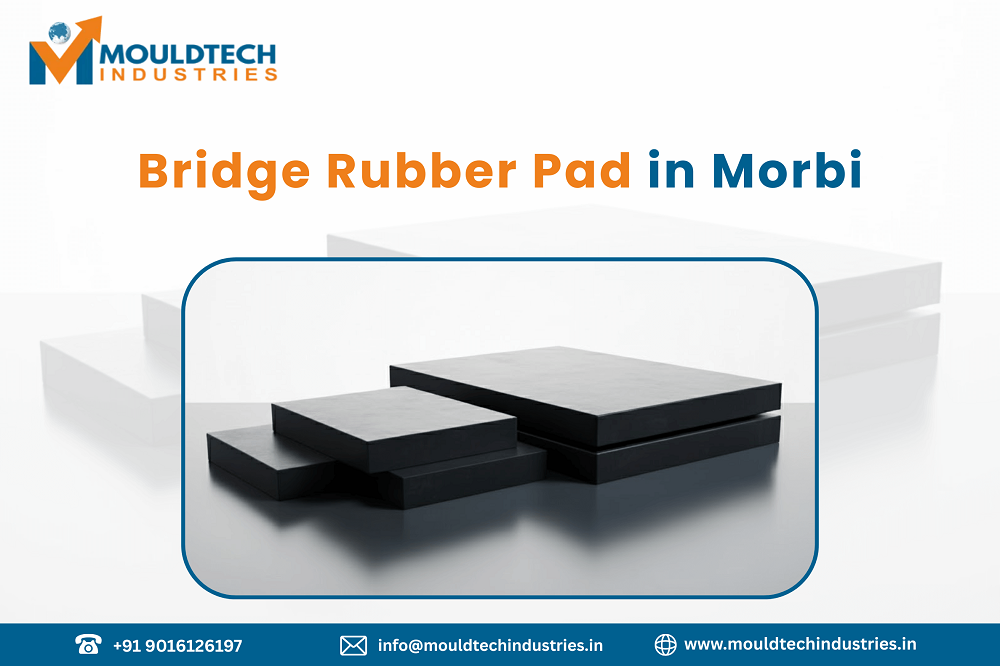
Bridge Rubber Pad Manufacturer, Supplier And Exporter in India: Mouldtech Industries
Mouldtech Industries is a Manufacturer of Bridge Rubber pads in Morbi.
Our Manufacturing Unit is in Vadodara, Gujarat, India.
Mouldtech Industries is a Manufacturer of Bridge Rubber Pad, Ball Mill Rubber Lining, Bridge Rubber Pad, Resistant Rubber Liner, Embedded Rubber Liners, Conveyors Solutions, Ceramic Lagging Sheet, Belt Cleaners, Bridge Rubber Pad, Ceramic Rubber Lagging Services, and Ceramic Rubber Lagging Sheet.
Bridge Rubber Pad for Robust Industrial Frameworks
Introduction
In demanding industrial settings like extraction, metalworking, cement production, ceramics, and handling bulk materials, equipment dependability is paramount—it directly impacts security, output, and operational expenditure. These sectors endure relentless mechanical strain, vibration, fluctuating loads, harsh weather, and demanding conditions.
A consistent hurdle in industrial facilities and construction projects involves managing fluctuating forces while safeguarding structural elements. Excessive shaking, uneven force distribution, and repeated striking can gradually weaken concrete bases, steel frameworks, and attached machinery, leading to early failures and unscheduled pauses.
As worldwide industrial requirements escalate—particularly in resource hubs, cement centres, steel corridors, and ceramic manufacturing zones—there is a heightened focus on resilient, low-maintenance load separation methods. In this setting, the Bridge Rubber Pad has surfaced as a crucial element for structural stability, tremor mitigation, and sustained operational dependability.
Industrial Difficulties Spur Demand for Rubber Support Pads
Industrial frameworks are subject to a mix of mechanical and environmental pressures:
- Rubbing and surface weakening from constant minor shifts
- Impact forces from heavy machinery, vehicles, cranes, conveyor systems, and material transfer setups
- Deterioration from moisture, chemicals, and temperature variances
- Threats of inactivity stemming from fractured bases or misaligned structures
- Increasing upkeep expenditures when vibration is not dampened correctly
Seasoned plant supervisors often observe that structural breakdowns are rarely sudden. They develop slowly, beginning with cracks induced by vibration, unbalanced force transmission, and fatigue damage. Bridge rubber pads are engineered to absorb, spread, and isolate forces, lessening these dangers at the foundation level.
In mining and metal processing operations, where machinery weights are substantial and cycles are nonstop, these force-management components move from optional to vital.
What Defines a Bridge Rubber Pad?
A Bridge Rubber Pad is a crafted elastomeric piece situated between structural sections—usually between concrete and steel—to take up force, permit managed shift, and reduce vibration transfer.
Unlike rigid separators or metal shims, these rubber supports offer:
- Controlled flexibility
- Force distribution over a set area
- Resistance to compression fatigue
- Accommodation for thermal expansion and contraction
They are typically made from natural rubber, neoprene, or composite elastomers, based on load demands and environmental exposure. The design prioritises function over looks, making them an unseen yet vital part of industrial construction.
Uses Across Sectors
- Mining Sector: Deployed under crushers, screens, conveyor supports, and heavy equipment foundations to soak up vibration and ease structural strain.
- Cement Facilities: Fitted beneath rotating equipment, material transfer spans, preheater setups, and hefty platforms to minimise vibration transmission.
- Metal & Steel Mills: Utilised in rolling mill decks, furnace bases, and material handling bridges where dynamic loads are constant.
- Ceramic Production: In ceramic centres, bridge rubber pads support kiln constructions, batching units, and conveyor spans dealing with persistent shaking.
- Power Generation Facilities: Used in turbine halls, coal handling setups, and structural supports to manage thermal and mechanical displacement.
- Bulk Material Handling: Essential in conveyor trestles, transfer junctions, and elevated walkways where load fluctuation and vibration are frequent.
Material Science & Engineering Aspects
The efficiency of a bridge rubber pad largely relies on material composition and engineering layout.
Rubber characteristics such as:
- Elasticity measure
- Resistance to set under pressure
- Strength against tearing
- Endurance in the environment
- directly influence long-term service.
While ceramic wear protection centres on hardness and abrasion resilience, rubber elements are engineered for energy absorption and controlled shape change. The correct equilibrium between rigidity and pliability ensures forces are conveyed without damaging linked structures.
Producers with extensive industry background recognise that rubber that is too complex causes stress buildup, while rubber that is too soft results in excessive yielding. Therefore, proper compound selection is crucial.
Design & Customisation Necessities
Industrial installations seldom lend themselves to a universal solution. Bridge rubber pads must be designed considering:
- Machinery load ratings
- Structural interface measurements
- Environmental exposure
- Static and dynamic load cycles
Bespoke sizing, thickness adjustments, and compound choices guarantee suitability for specific tasks. In numerous projects, pads are integrated into existing frameworks rather than forcing on-site changes.
Manufacturing Quality & Process Control
Precise manufacturing is key to consistent performance. Controlled blending, accurate moulding, and dimensional checks ensure uniform force behaviour across production runs.
Quality-focused manufacturers employ:
- Verification of incoming materials
- Testing for compression and hardness
- Tracking per production batch
- Visual and dimensional verification
Such oversight ensures that the performance observed during fitting remains consistent throughout the product’s service life.
Fitting & Upkeep Notes
Bridge rubber pads are intended for straightforward mounting with minimal on-site modifications. Proper surface preparation and alignment are vital for balanced force transmission.
Post-installation, upkeep demands are minimal. Periodic visual checks during routine shutdowns are generally adequate, reducing facility downtime and labour costs.
Safety & Operational Dependability
Worker protection and facility reliability are closely tied to structural soundness. By lessening vibration transmission and absorbing impact forces, bridge rubber pads:
- Reduce the chance of structural fracturing
- Improve equipment alignment
- Boost operational safety around heavy apparatus
This contributes to a safer workplace and more predictable plant functions.
Cost Effectiveness Over Equipment Lifespan
While bridge rubber pads represent a small fraction of total project outlay, their effect on lifecycle efficiency is substantial. Less structural damage, fewer stoppages, and extended equipment life result in long-term savings without sacrificing safety or output.
Export Readiness & International Acceptance
Global industrial acquirers expect:
- Consistent quality
- Adherence to engineering benchmarks
- Clear documentation
- Predictable supply schedules
Indian producers catering to international markets harmonise production and quality assurance to satisfy these expectations, making bridge rubber pads appropriate for both internal and export deployment.
Why Experienced Producers Matter
Manufacturers with established industrial track records provide:
- Engineering insight specific to applications
- Knowledge of actual operational settings
- Stable material recipes
- Dependable long-term supply
This background ensures that products succeed not just in lab tests, but in active plants.
About Mouldtech Industries
Mouldtech Industries is a seasoned Indian provider specialising in industrial rubber and wear defence solutions, including components for grinding mills, ceramic defence systems, rubber lining options, and bridge rubber pads. Serving industrial clientele throughout India and overseas markets, the company centres on engineering dependability, uniform quality, and practical site-level fixes.
Discover more at https://www.mouldtechindustries.in/
Conclusion
Bridge rubber pads serve a vital role in modern industrial systems by managing forces, vibrations, and movement at key structural interfaces. Their appropriate selection and deployment directly improve safety, extend equipment life, and enhance facility productivity. For industries operating under constant pressure, these components are a quiet yet essential part of sustainable functioning.
Key Points
- Bridge rubber pads enhance force spreading and tremor control
- Crucial for mining, cement, metal, ceramic, and bulk handling sectors
- Bolster structural defence and operational reliability
- Require little upkeep with extended service periods
- Appropriate for Indian and worldwide industrial settings
Trending FAQs
Q1. What is the typical lifespan of a bridge rubber pad?
Service life depends on load and environment, but properly selected pads last several years under industrial conditions.
Q2. Are bridge rubber pads suitable for heavy mining equipment?
Yes, when designed for appropriate load ratings and vibration profiles.
Q3. How often do bridge rubber pads require maintenance?
Minimal maintenance is required; periodic inspection during shutdowns is sufficient.
Q4. How do rubber pads differ from ceramic wear solutions?
Rubber absorbs energy and vibration, while ceramic focuses on abrasion resistance.
Q5. Are these pads used globally in industrial projects?
Yes, they are widely used in mining, cement, steel, and infrastructure projects worldwide.
For inquiries about Bridge Rubber Pad or other wear protection solutions, contact Mouldtech Industries today. Expert support is available across India and global industrial markets.
#BridgeRubberPad #BallMillRubberProducts #RubberLiningSystems #CeramicWearProtection #IndustrialRubber #WearProtectionSolutions #MiningEquipment #CementPlantEquipment #SteelPlantSolutions #BulkMaterialHandling