
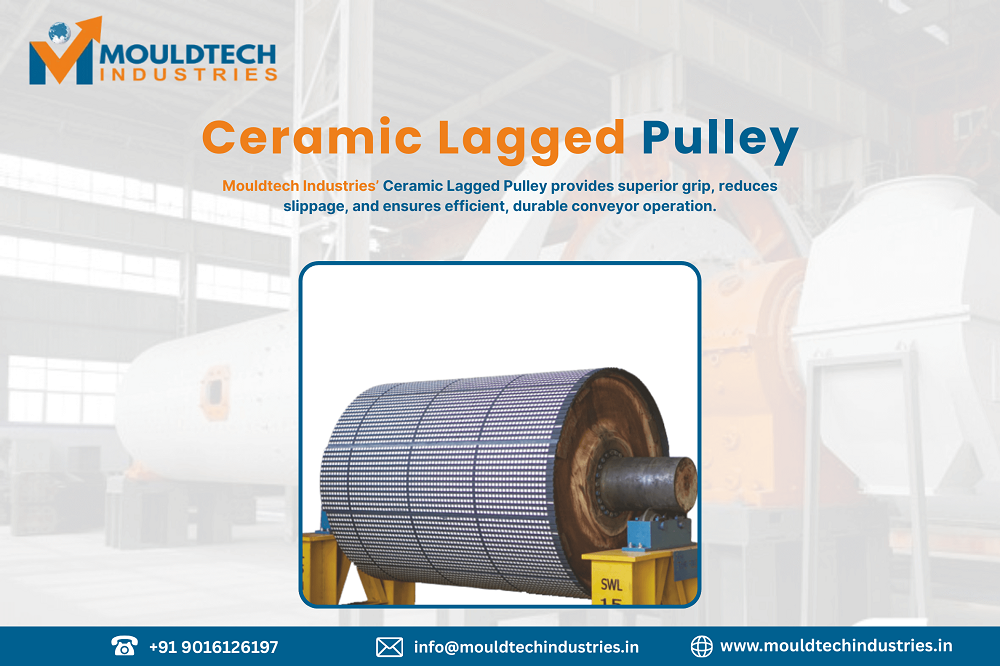
Ceramic Lagged Pulley Manufacturer in India: Mouldtech Industries
Mouldtech Industries is a Manufacturer, Supplier, and Exporter of Ceramic Lagged pulleys.
Our Manufacturing Unit is in Vadodara, Gujarat, India.
Mouldtech Industries is a Manufacturer of Ball Mill Solutions, Ball Mill Rubber Lining, Wear Protection Line, Resistant Rubber Liner, Embedded Rubber Liners, Conveyors Solutions, Impact Bed Assembly and Impact Pads, Belt Cleaners, Pulley Lagging, Ceramic Rubber Lagging Services, and Ceramic Rubber Lagging Sheet.
Ceramic Lagged Pulley: Ensuring Equipment Reliability in Heavy-Duty Industrial Operations
Introduction
In heavy-duty industrial environments such as mining, metal processing, cement production, ceramics manufacturing, and bulk material handling, equipment reliability is critical to maintaining operational efficiency. Abrasive materials, impact loads, corrosive environments, and continuous high-capacity operations pose constant challenges to machinery. Unexpected downtime, frequent maintenance, and premature wear can significantly affect productivity and operational costs.
Wear protection solutions play a pivotal role in mitigating these challenges. Among these, Ceramic Lagged Pulleys have emerged as a reliable choice for industries that require robust conveyor systems capable of handling harsh materials while minimizing wear, energy losses, and maintenance interruptions.
Global industrial demand for wear-resistant solutions continues to grow. Mining hubs in Australia, Canada, South Africa, and India’s own mineral-rich regions, such as Odisha, Jharkhand, Karnataka, and Chhattisgarh, rely heavily on advanced conveyor and pulley technologies. Similarly, cement plants in Maharashtra, Tamil Nadu, and Rajasthan, steel plants in Chhattisgarh, Odisha, and Karnataka, and ceramic manufacturing clusters in Gujarat, Rajasthan, and Andhra Pradesh are actively seeking solutions to enhance equipment longevity.
In this context, the Ceramic Lagged Pulley is not just a component; it is a critical solution that protects equipment while ensuring smooth material transport.
Industrial Challenges That Drive Demand for Ceramic Lagged Pulley
Industrial operations in mining, metal, cement, and ceramics face several recurring challenges that drive the adoption of ceramic lagged pulleys:
- Abrasion: Conveyed materials such as iron ore, bauxite, coal, clinker, and ceramic granules are highly abrasive. In traditional steel or rubber pulleys, prolonged exposure to abrasive materials can lead to surface wear, reduced traction, and eventual pulley failure. Ceramic lagging provides a hard, wear-resistant surface that significantly reduces pulley wear, extending service life.
- Impact Loads: Heavy lumps of raw material or large particle sizes often strike pulleys at high velocity. Repeated impact loads can deform pulleys, causing operational misalignment or conveyor belt slippage. Ceramic-lagged surfaces, combined with resilient rubber backing, absorb and distribute impact energy, protecting both the pulley shell and conveyor belt.
- Corrosion: In cement, chemical mineral processing, and ceramic industries, pulleys are exposed to moisture, lime, alkaline compounds, and chemical reagents. These conditions accelerate corrosion in conventional pulleys. Ceramic tiles are chemically inert, providing a protective barrier that prolongs equipment life.
- Downtime: Experienced plant engineers often observe that pulley failures are a leading cause of conveyor downtime. Repairing or replacing pulleys disrupts production schedules and may require specialized labor. Properly engineered ceramic-lagged pulleys can reduce unplanned downtime and improve operational continuity.
- Maintenance Costs: High maintenance frequency in traditional pulleys increases labor and spare-part costs. Ceramic-lagged pulleys minimize wear and damage, reducing the need for frequent maintenance interventions and enabling predictable maintenance cycles.
These challenges are observed not only in Indian industrial hubs such as Gujarat, Maharashtra, Tamil Nadu, Karnataka, Odisha, Rajasthan, and West Bengal, but also in global operations across Australia, Canada, South Africa, and the Middle East. Manufacturers with long-term industry experience understand that addressing these operational challenges requires reliable, engineered wear-protection solutions.
What Is a Ceramic Lagged Pulley?
A Ceramic Lagged Pulley is an industrial conveyor pulley where the shell is covered with high-hardness ceramic tiles mounted on a rubber or composite backing. This combination creates a pulley that offers:
- High wear resistance for abrasive materials
- Enhanced impact absorption to protect the conveyor system
- Improved traction for conveyor belts in heavy-load applications
Unlike plain steel or rubber pulleys, ceramic-lagged pulleys balance hardness and elasticity through engineered design. In mining and metal processing operations, the lagging reduces belt slip, prevents premature wear, and maintains efficient material flow.
Applications Across Industries
- Mining: In mining operations, conveyor systems transport ore, coal, or aggregates over long distances. Ceramic lagged pulleys minimize wear on both the pulley and the belt while resisting the high impact of heavy ore fragments.
- Cement Plants: Cement plants handle abrasive clinker and raw materials. Lagged pulleys reduce equipment wear, prevent belt slippage in high-humidity or dusty environments, and improve operational reliability.
- Metal & Steel Plants: Steel manufacturing involves transporting slag, hot metal, and ores. Ceramic lagging protects pulleys from abrasion and chemical exposure, which is critical for continuous operations.
- Ceramic Manufacturing: In ceramic plants, tiles, powders, and granules are highly abrasive. Ceramic-lagged pulleys provide a durable interface that reduces wear and contamination risk, extending equipment life.
- Power Plants: Coal-handling in thermal power plants exposes pulleys to abrasive coal dust. Ceramic lagging improves belt traction, reduces maintenance frequency, and ensures steady material transport.
- Bulk Material Handling: Ports, storage facilities, and industrial warehouses rely on conveyors for handling grains, minerals, fertilizers, and cement. Lagged pulleys improve safety, reliability, and operational efficiency in high-capacity environments.
Material Science & Engineering Considerations
- Rubber Properties: The rubber base of the lagging provides impact absorption, flexibility, and adhesive bonding to the pulley shell. Hardness, elasticity, and chemical resistance are critical design parameters.
- Ceramic Hardness: Industrial-grade ceramics, such as alumina or zirconia tiles, offer extreme hardness (typically 8–9 Mohs scale) to resist abrasion and maintain a consistent surface profile.
- Wear Resistance Principles: In abrasive environments, wear occurs through micro-cutting, deformation, and surface fatigue. Ceramic lagging’s hard, chemically stable tiles reduce these effects while maintaining the pulley’s structural integrity.
- Impact Absorption: By combining ceramic tiles with rubber backing, the pulley distributes impact forces, protecting both the belt and the pulley shell. Experienced plant engineers often note that this hybrid approach significantly prolongs the life of conveyor systems in high-impact zones.
Design & Customization Requirements
Design ceramic lagged pulleys to match each plant’s specific operational and material handling requirements.
- Equipment Compatibility: Pulleys should fit conveyor shafts, bearings, and support structures accurately.
- Custom Sizing: Diameters, face widths, and shaft specifications are tailored to plant requirements.
- Application-Specific Design: Engineers may vary tile hardness, pattern, or rubber thickness based on the material’s abrasiveness, moisture content, and impact potential.
Manufacturers with long-term industry exposure understand that minor design misalignments can compromise belt tracking and overall conveyor efficiency.
Manufacturing Quality & Process Control
Precision manufacturing and rigorous quality control ensure reliable ceramic-lagged pulleys.
- Tile Bonding & Alignment: Proper adhesion ensures tiles remain in place under operational stress.
- Dimensional Accuracy: Precision tolerances prevent misalignment and vibration.
- Batch Consistency: Standardized processes ensure repeatable performance across multiple pulleys.
Industrial-grade quality checks, such as hardness testing, adhesion testing, and visual inspections, are standard in reputable manufacturing setups.
Installation & Maintenance Considerations
Ceramic lagged pulleys are designed for ease of installation:
- Pre-lagged pulleys can be mounted directly onto shafts with minimal downtime.
- Proper installation ensures belt tracking and prevents slippage.
- Maintenance cycles are predictable, with tile replacement or rubber refurbishing only after significant operational hours.
This predictability reduces unplanned shutdowns, a common challenge observed in mining and cement plants.
Safety & Operational Reliability
Conveyor equipment performance directly impacts worker safety and plant reliability.
- Ceramic lagging prevents belt slippage, reducing the risk of sudden material spills.
- Impact-resistant design safeguards operators from pulley breakage or fragment ejection.
Consistent operational performance ensures plant processes remain uninterrupted, critical in heavy industrial environments.
Cost Efficiency Over Equipment Life Cycle
While ceramic-lagged pulleys may have higher upfront costs than standard pulleys, they deliver measurable savings over the equipment life cycle:
- Reduced downtime translates to higher production output.
- Fewer maintenance interventions lower labor and spare-part expenses.
- An extended pulley and belt life enhances overall plant cost efficiency.
In large-scale operations, this long-term benefit outweighs initial capital investment, a fact recognized by experienced procurement and maintenance managers across Indian industrial hubs.
Export Readiness & Global Acceptance
Industries worldwide demand pulleys that comply with international standards:
- Manufacturers must provide material certifications, dimensional drawings, and performance documentation.
- Countries like Australia, South Africa, and Canada emphasize rigorous quality assurance in mining operations.
Ceramic lagged pulleys from reputable manufacturers meet these global industrial requirements, ensuring acceptance in export markets.
Why Experienced Manufacturers Matter
Manufacturers with decades of industrial exposure understand the challenges of high-volume, abrasive, and corrosive operations:
- Engineering expertise ensures pulleys are designed for specific plant conditions.
- Long-term industry experience guarantees a reliable supply and consistent quality.
Knowledge of plant-level operations ensures practical, real-world solutions rather than theoretical designs.
About Mouldtech Industries
Mouldtech Industries is an established manufacturer of Ball Mill Rubber Liners, Ceramic Wear Protection Solutions, Rubber Lining Systems, Ball Mill Rubber Products, and Conveyor Solutions. Serving industrial clients across India—including Gujarat, Maharashtra, Tamil Nadu, Karnataka, Odisha, Rajasthan, Chhattisgarh, West Bengal, and Andhra Pradesh—and global industrial markets, Mouldtech Industries focuses on precision engineering and durable wear protection systems. Learn more about their offerings at https://www.mouldtechindustries.in/.
Conclusion
In mining, cement, steel, ceramics, and bulk material handling operations, equipment reliability is paramount. Ceramic Lagged Pulleys provide a balanced combination of wear resistance, impact absorption, and operational longevity, addressing key challenges of abrasive materials, heavy impact loads, and corrosive environments.
For plant engineers, maintenance teams, and procurement managers, understanding the role of ceramic lagging can help optimize production, reduce downtime, and extend equipment life. Partnering with experienced manufacturers ensures these solutions meet rigorous industrial requirements through precise design and reliable delivery.
Key Takeaways
- Ceramic-lagged pulleys provide superior wear protection in heavy-duty applications.
- Enhance operational reliability and reduce downtime
- Suitable for mining, cement, metal, steel, ceramic, and bulk handling industries
- Engineered for long-term performance in abrasive and high-impact conditions
- Globally recognized solution with export readiness and industrial compliance
Trending FAQs
1. What is the typical lifespan of a ceramic lagged pulley?
Depending on material abrasiveness, operational load, and maintenance, pulleys last 5–10 years in heavy-duty industrial environments.
2. Which industries are most suitable for ceramic lagged pulleys?
The mining, cement, steel, ceramics, power generation, and bulk material-handling industries benefit the most.
3. How often should maintenance be performed?
Conduct routine inspections every 6–12 months, and replace tiles and rubber backing after extensive operational hours.
4. How does rubber lagging compare to ceramic lagging?
Rubber absorbs impact and reduces noise but offers lower abrasion resistance. Ceramic lagging provides superior wear protection for highly abrasive materials.
5. Are ceramic lagged pulleys used globally?
Yes. Mining hubs in Australia, Canada, South Africa, and industrial clusters in India rely on ceramic-lagged pulleys for operational efficiency.
For detailed inquiries about Ceramic Lagged Pulleys, Ball Mill Rubber Liners, Rubber Lining Systems, or Conveyor Solutions, connect with the experts at Mouldtech Industries. Our engineering team provides practical, plant-level guidance to help you select and customize.
#BallMillRubberLiner #CeramicWearProtection #RubberLining #MiningSolutions #BulkMaterialHandling #ConveyorSolutions #MouldtechIndustries #WearProtection #IndustrialManufacturing #MouldtechIndustries