
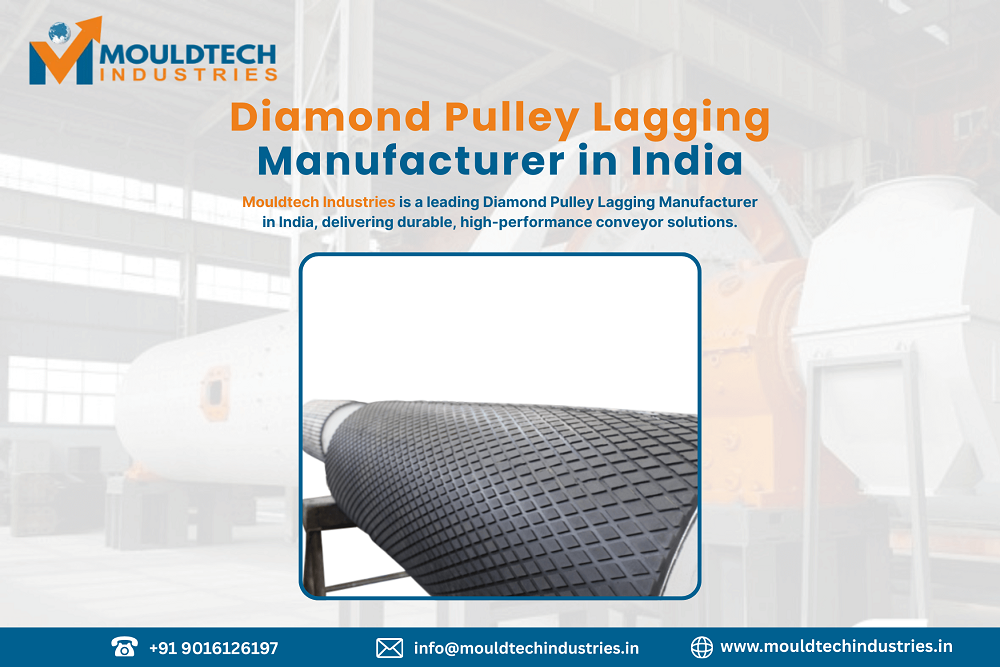
Top Diamond Pulley Lagging Manufacturer and Supplier in India: Mouldtech Industries Pvt. Ltd.
Mining, metal processing, cement manufacturing, ceramic production, and bulk material handling industries operate in some of the harshest mechanical environments. Continuous material flow, abrasive ores, high moisture, temperature fluctuations, and heavy impact loads put extreme stress on conveyor systems. Among all components, drive and tail pulleys are critical, as traction loss, slippage, and accelerated wear can directly impact plant productivity. As a leading Diamond Pulley Lagging Manufacturer in India, we provide high-quality solutions to enhance pulley performance and extend equipment life.
Across the globe, industrial operators are prioritizing dependable performance, reduced downtime, and improved conveyor throughput over immediate cost reductions alone. This shift has increased the need for specially designed wear protection that functions reliably across different operational settings.
Diamond Pulley Lagging has become a proven industrial product, engineered to boost pulley grip, safeguard pulley surfaces, and enhance overall conveyor system reliability in challenging environments.
Industrial Issues Boosting the Need for Diamond Pulley Lagging
Conveyor pulleys in mineral extraction and bulk material facilities contend with various simultaneous problems:
- Friction: Constant rubbing against moving belts carrying minerals, processed materials, coal, rock, or ceramic inputs causes surface deterioration. Over time, unprotected pulley exteriors lose their exact shape, lessening belt traction.
- Shock Forces: In mining and metal-refining processes, varying loads and sudden belt tension during start-ups create sudden forces that damage pulley surfaces and the belt interface.
- Exposure to Corrosion & Dampness: Damp ores, washing procedures, and seaside or high-humidity settings accelerate rust on metal pulley shells, particularly in fertilizer operations, power stations, and material-handling terminals at ports.
- Service Interruptions & Repair Expenses: Sliding belts generate more heat, lead to belt deterioration, and waste energy. Maintenance teams frequently note that pulley-related issues are a common cause of unplanned halts.
Throughout industrial settings globally—from open-pit mines to enclosed cement factories—these issues have made pulley lagging a functional necessity rather than merely an optional enhancement.
What is Diamond Pulley Lagging?
Diamond Pulley Lagging is a textured surfacing made of rubber or rubber with ceramic elements, attached permanently or mechanically to conveyor pulley exteriors. The diamond-shaped channel design is intentional to:
- Increase the friction between the belt and the pulley
- Allow water and fine particles to drain away
- Keep grip steady under changing load circumstances
Unlike flat lagging, the diamond texture helps prevent water build up when moisture is present. It is commonly used on drive, bend, and tail pulleys where reliable traction is essential.
This solution isn’t intended to “exceed performance limits” but rather to maintain steady, predictable conveyor functioning over long service durations.
Uses Throughout Different Sectors
Diamond Pulley Lagging is practically applied across numerous industrial areas:
- Mining: Utilized in conveyors for iron ore, coal, bauxite, and limestone extraction, where abrasive materials and dampness are constant hurdles.
- Cement Factories: Applied on conveyors for processed material, raw mill feed, and coal transport to lessen belt sliding and pulley wear.
- Metal & Steel Factories: In processing units, fuel-handling systems, and material-transfer conveyors, the lagging improves grip during heavy-duty operations.
- Ceramic Production: In ceramic facilities processing materials like feldspar, quartz, and clay, a consistent belt hold is vital to prevent material escape and belt misalignment.
- Power Plants: Coal transport and ash removal systems gain from better pulley safeguarding and reduced belt strain.
Material Science & Design Factors
Producers with extensive industry background recognize that pulley lagging effectiveness heavily relies on material choice and the quality of the attachment.
Characteristics of Rubber
Industrial-grade rubber chosen for diamond lagging offers:
- Controlled stiffness (Shore A measurements)
- Resistance to tearing
- Defence against wear and aging
Design & Customization Needs
No two conveyor setups function identically. Successful diamond pulley lagging demands tailoring based on:
- Pulley size and width
- Belt materials and tension levels
- Characteristics of the conveyed material
- Operational speed and load fluctuations
Custom dimensions guarantee even contact force and avoid early edge deterioration. Groove depth and rubber thickness are chosen specifically for the site conditions.
Manufacturing Excellence & Process Governance
Accurate manufacturing is crucial for lagging performance. Key control points involve:
- Uniform rubber mixture preparation
- Managed heating cycles
- Precise groove profiling
- Robust adhesive joining systems
Consistency between production batches ensures that replacement lagging will perform similarly to installed units—a key factor for upkeep scheduling.
Fitting & Servicing Notes
Knowledgeable plant engineers often note that the quality of installation directly impacts operational lifespan.
- Fitting Process
- Can be done using cold adhesive application or mechanical fastening
- On-site fitting often avoids the need to remove the pulley
Safety & Operational Stability
A better grip reduces belt movement, reducing the risk of belt damage and sudden breakdowns. Stable conveyor function contributes to:
- Safer working environments
- Less urgent repair work
- Lower risk of material spills
Protecting the machinery directly supports worker safety and plant dependability.
Value Through Equipment Lifespan
While the initial outlay is an investment cost, the true benefit of diamond pulley lagging appears over the equipment’s service life:
- Extended lifespan for the pulley shell
- Reduced need for belt replacements
- Fewer interruptions
- Maximized upkeep resources
This perspective aligns with modern asset management, which focuses on total ownership costs rather than short-term savings.
Preparedness for Export & Worldwide Acceptance
Industrial purchasers in global marketplaces expect:
- Consistent quality standards
- Technical support documentation
- Standardized production methods
- Awareness of regulatory compliance
Diamond pulley lagging solutions used in mining centers, cement complexes, and metal processing regions worldwide conform to established engineering norms rather than designs specific to a single area.
Why Manufacturer Experience Matters?
Pulley lagging is more than just a replaceable component—it is a carefully engineered link between the belt and the pulley.
Manufacturers with a long history in the sector understand:
- Ways in which failures occur
- Challenges specific to different uses
- How materials behave under actual plant settings
This accumulated knowledge yields dependable solutions that perform consistently in demanding conditions.
About Mouldtech Industries
Mouldtech Industries is an established industrial manufacturer specializing in wear protection and conveyor equipment for the mining, cement, metal, ceramic, and bulk material handling industries and serving across India in industrial areas, including with operational bases in cities such as Vadodara, Ahmedabad and many more industrial centers.
Discover more at 👉 https://www.mouldtechindustries.in/
Summary:
Diamond Pulley Lagging plays an essential role in boosting conveyor grip, protecting pulleys, and ensuring steady plant operation. In the mining, cement, metal, ceramic, and bulk-handling sectors, it underpins reliability, safety, and efficiency in the long run.
Choosing the correct lagging option—and the appropriate manufacturing collaborator—directly contributes to smoother activities and lasting asset performance.
Key Takeaways
- Boosts traction and curbs belt slippage
- Improves conveyor dependability
- Suited for abrasive and damp settings
- Supports long-term equipment functionality
- Widely recognized across global industrial domains
FAQS
1. What is the usual service duration for diamond pulley lagging?
- Its service life varies based on load, material harshness, and operating environment, but it typically performs significantly longer than pulleys without lagging.
2. Is a diamond pulley lagging appropriate for wet conditions?
- Yes, the diamond groove layout helps shed moisture and maintain friction.
3. How often does pulley lagging require servicing?
- Standard checks are usually adequate; primary upkeep is infrequent when installed correctly.
4. Rubber versus ceramic lagging—how to decide?
- Rubber is better for absorbing impacts, while ceramic inserts are preferred where abrasion is severe.
#BallMillRubberLiner #SecondaryBeltCleaner #RubberLining #MiningSolutions #BulkMaterialHandling #ConveyorSolutions #MouldtechIndustries #WearProtection #IndustrialManufacturing