
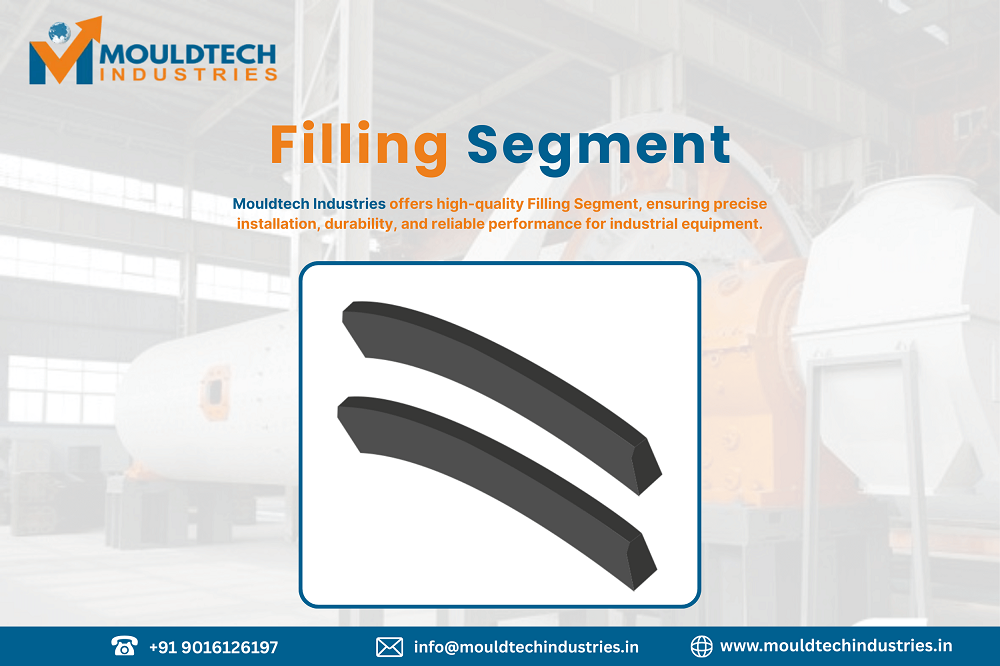
Filling Segment Manufacturer in India: Mouldtech Industries
Mouldtech Industries is a Manufacturer, Supplier and Exporter of the Filling Segment.
Our Manufacturing Unit is in Vadodara, Gujarat, India.
Mouldtech Industries is a Manufacturer of Ball Mill Solutions, Ball Mill Rubber Lining, Wear Protection Line, Resistant Rubber Liner, Embedded Rubber Liners, Conveyors Solutions, Impact Bed Assembly and Impact Pads, Belt Cleaners, Pulley Lagging, Ceramic Rubber Lagging Services and Ceramic Rubber Lagging Sheet.
Filling Segment: Engineering Wear Protection for Heavy-Duty Industrial Operations
Introduction
Across mining, metal processing, cement manufacturing, ceramics, and bulk material handling industries, equipment reliability is not theoretical—it directly affects plant uptime, worker safety, and operating cost. In heavy-duty industrial environments, machines run under constant exposure to abrasion, impact loads, corrosive slurries, dust, moisture, and temperature variations.
Global industrial demand has increased due to higher production targets, tighter delivery schedules, and rising expectations of equipment performance. Plant managers and maintenance teams are under pressure to extend equipment life without increasing maintenance frequency or risking unplanned shutdowns.
Wear protection systems are therefore no longer optional components. They are core engineering elements that determine how long mills, chutes, hoppers, conveyors, and processing equipment can operate reliably.
Industrial Challenges That Drive Demand for the Filling Segment
In mining and metal processing operations, equipment faces some of the harshest working conditions in any industry. Similar stress is seen in cement plants, ceramic clusters, and bulk material handling terminals across global industrial regions.
Abrasion
Continuous movement of ore, clinker, coal, sand, and ceramic raw materials causes aggressive surface wear. Experienced plant engineers often observe that abrasion alone is responsible for most liner and chute failures.
Impact Loads
Large lumps of material drop onto equipment surfaces during loading and transfer. These impact forces can crack brittle materials or deform weak linings.
Corrosion
Moisture, chemicals, and process water create corrosive conditions, especially in mineral processing and chemical handling plants.
Downtime
Even minor liner failures can force shutdowns, leading to production loss and rushed repairs.
Maintenance Cost
Frequent replacement of worn components increases labour, spares inventory, and overall maintenance expense.
These challenges exist across mining belts of India, Africa, Australia, South America, as well as cement and metal clusters in Asia and the Middle East. The growing demand for reliable wear protection solutions has made the Filling Segment a necessary part of modern industrial design.
What Is a Filling Segment?
Filling Segment is an engineered wear protection component designed to shield industrial equipment from abrasion, impact, and chemical attack. It is commonly manufactured using rubber, ceramic, or composite materials, depending on application conditions.
In simple terms, the Filling Segment acts as a sacrificial layer. Instead of allowing expensive structural equipment to wear out, the Segment absorbs wear and is replaced at planned maintenance intervals.
Key characteristics of a well-designed filling segment include:
- Controlled hardness and elasticity
- Resistance to sliding and impact wear
- Secure fixing method
- Compatibility with parent equipment
It is not a performance booster—it is a protection system that allows equipment to work as intended for longer periods.
Applications Across Industries
Mining
In mining plants, the Filling Segment is used in ball mills, chutes, hoppers, slurry pipelines, and material transfer points. It protects against sharp ore, heavy impact, and abrasive fines.
Cement
Cement plants use filling segments in mills, clinker handling systems, elevators, and conveyor transfer points where clinker and raw meal cause heavy abrasion.
Metal & Steel
Steel plants apply wear segments in sinter plants, coke handling systems, slag conveyors, and raw material bunkers where hot, heavy, and abrasive materials move continuously.
Ceramic
Ceramic manufacturers use wear protection inside ball mills, mixers, and slurry handling systems to manage abrasive feldspar, quartz, and clay mixtures.
Power Plants
Coal handling systems, ash slurry lines, and bunkers require wear segments to resist continuous erosion.
Bulk Material Handling
Ports, logistics yards, and industrial warehouses handling minerals, fertilizers, grains, and aggregates rely on wear protection to keep conveyors and chutes operational.
Material Science & Engineering Considerations
Manufacturers with long-term industry exposure understand that material selection determines wear life more than thickness alone.
Rubber Properties
Rubber offers flexibility, impact absorption, and noise reduction. Its elasticity allows it to absorb energy from falling material rather than cracking. Rubber performs well under moderate abrasion and high impact conditions.
Ceramic Hardness
Ceramic materials provide extremely high hardness and abrasion resistance. They are ideal for sliding wear but need support from rubber or steel backing to handle impact.
Wear Resistance Principles
Wear is influenced by:
- Particle hardness
- Particle shape
- Sliding speed
- Impact angle
- Moisture and chemical content
Engineering wear protection means matching material behaviour to real plant conditions rather than using one material everywhere.
Impact Absorption
In areas with heavy impact, softer materials or composite designs are preferred. In areas with pure sliding abrasion, hard ceramic-based solutions perform better.
Design & Customization Requirements
No two plants operate in the same way. Design of the Filling Segment must consider:
- Equipment dimensions and geometry
- Flow direction and impact zones
- Mounting system compatibility
- Maintenance access
Custom sizing ensures proper coverage without gaps or misalignment. Application-specific design prevents stress concentration that can lead to early failure.
Manufacturing Quality & Process Control
Precision manufacturing is essential for reliable wear parts. This includes:
- Accurate moulding or cutting
- Consistent material mixing
- Controlled curing or sintering
- Dimensional inspection
Quality checks ensure:
- Hardness consistency
- Bond strength between layers
- Surface finish accuracy
- Batch-to-batch repeatability
Poorly controlled manufacturing leads to unpredictable wear life and premature failures.
Installation & Maintenance Considerations
Ease of installation is important in real plants where shutdown windows are limited. Good designs allow:
- Simple bolting or bonding
- Quick alignment
- Safe handling by maintenance crews
Maintenance cycles should be predictable. Planned replacement during scheduled shutdowns is far better than emergency repairs.
Safety & Operational Reliability
Wear protection directly impacts worker safety. Damaged liners can expose sharp metal edges, cause material leakage, and create unstable structures.
Properly designed Filling Segment contributes to:
- Safer working conditions
- Reduced risk of structural damage
- More stable material flow
- Predictable equipment behaviour
In heavy-duty industrial environments, safety and reliability always move together.
Cost Efficiency Over Equipment Life Cycle
The true value of wear protection is seen over the full equipment life cycle.
- Longer equipment service life
- Fewer emergency shutdowns
- Lower repair frequency
- Better maintenance planning
Instead of focusing on individual part replacement, experienced plant engineers often observe that reliable wear systems reduce the total ownership cost of major equipment.
Export Readiness & Global Acceptance
Industrial buyers worldwide expect:
- Consistent quality
- Dimensional accuracy
- Material traceability
- Proper documentation
Export-ready manufacturers understand international standards, packaging needs, logistics challenges, and technical communication. Wear protection components must perform equally well in mining belts of Africa, cement plants of Southeast Asia, and steel plants of the Middle East.
Why Experienced Manufacturers Matter
Manufacturers with long-term industry exposure understand real plant problems. They know:
- Why some liners fail early
- How flow patterns affect wear
- Where impact zones actually occur
- What maintenance teams need on-site
Engineering experience, stable supply chains, and consistent quality are more important than flashy claims.
About Mouldtech Industries
Mouldtech Industries is an experienced manufacturer of industrial wear protection solutions, including ball mill rubber liners, ceramic wear protection systems, rubber lining systems, ball mill rubber products, and conveyor solutions.
Serving Pan India—covering all States and Union Territories such as Gujarat, Maharashtra, Rajasthan, Odisha, Jharkhand, Chhattisgarh, West Bengal, Tamil Nadu, Karnataka, Andhra Pradesh, Telangana, Kerala, Punjab, Haryana, Himachal Pradesh, Uttarakhand, Uttar Pradesh, Bihar, Madhya Pradesh, Assam, Meghalaya, Manipur, Mizoram, Nagaland, Tripura, Arunachal Pradesh, Sikkim, Goa, Delhi, Chandigarh, Puducherry, Jammu & Kashmir, Ladakh, Andaman & Nicobar Islands, Dadra & Nagar Haveli and Daman & Diu, and Lakshadweep—Mouldtech supports industrial clusters in cities such as Ahmedabad, Surat, Rajkot, Bhavnagar, Mumbai, Pune, Nagpur, Jamshedpur, Rourkela, Durgapur, Bokaro, Raipur, Bilaspur, Bhubaneswar, Angul, Salem, Coimbatore, Chennai, Bengaluru, Ballari, Visakhapatnam, Vijayawada, Hyderabad, Tirupati, Kochi, Trissur, Alwar, Udaipur, Jaipur, Kota, Panipat, Faridabad, Ludhiana, Mandi Gobindgarh, Durgapur, Haldia, Kharagpur, and many more industrial centers.
With engineering-driven design and controlled manufacturing processes, the company supplies wear solutions to mining, cement, metal, ceramic, power, and bulk material handling industries in India and global markets.
Website: https://www.mouldtechindustries.in/
Conclusion
Filling Segment is not an accessory—it is a fundamental engineering component that protects equipment, stabilizes operations, and supports safe working conditions.
When designed correctly and manufactured with control, it helps plants reduce downtime, manage maintenance, and extend equipment life. In industries where every hour of operation matters, reliable wear protection directly supports productivity and safety.
For plant engineers, maintenance teams, and project consultants, choosing the right wear solution is an engineering decision—one that affects the entire life cycle of industrial equipment.
Key Takeaways
- Wear protection is essential in heavy-duty industrial environments
- Filling Segment protects equipment from abrasion, impact, and corrosion
- Proper material selection improves wear life
- Custom design ensures better performance
- Reliable manufacturing ensures consistency
- Long-term benefits include reduced downtime and safer operations
- Suitable for mining, cement, metal, ceramic, power, and bulk handling industries
Trending FAQs
1. What is the typical lifespan of a Filling Segment?
Lifespan depends on material type, impact severity, abrasion level, and operating hours. It is usually defined in operating cycles rather than calendar time.
2. Is the Filling Segment suitable for high-impact zones?
Yes, when designed using rubber or composite structures that can absorb impact energy.
3. How often does it require maintenance?
Inspection is usually done during scheduled shutdowns. Replacement depends on the wear rate observed during inspections.
4. Rubber vs ceramic wear solutions – which is better?
Rubber is better for impact absorption. Ceramic is better for extreme sliding abrasion. Many applications use composites.
5. Is the Filling Segment used globally?
Yes, similar wear protection systems are used in mining and processing plants worldwide.
6. Does installation require special tools?
Most systems use standard industrial tools, but lifting aids may be required for heavy segments.
7. Can it be customized for specific equipment?
Yes, customization is common and often necessary for best performance.
Contact us to discuss your wear protection requirements with experienced engineers delivering reliable solutions for mining, cement, metal, ceramic, and bulk material handling industries.