
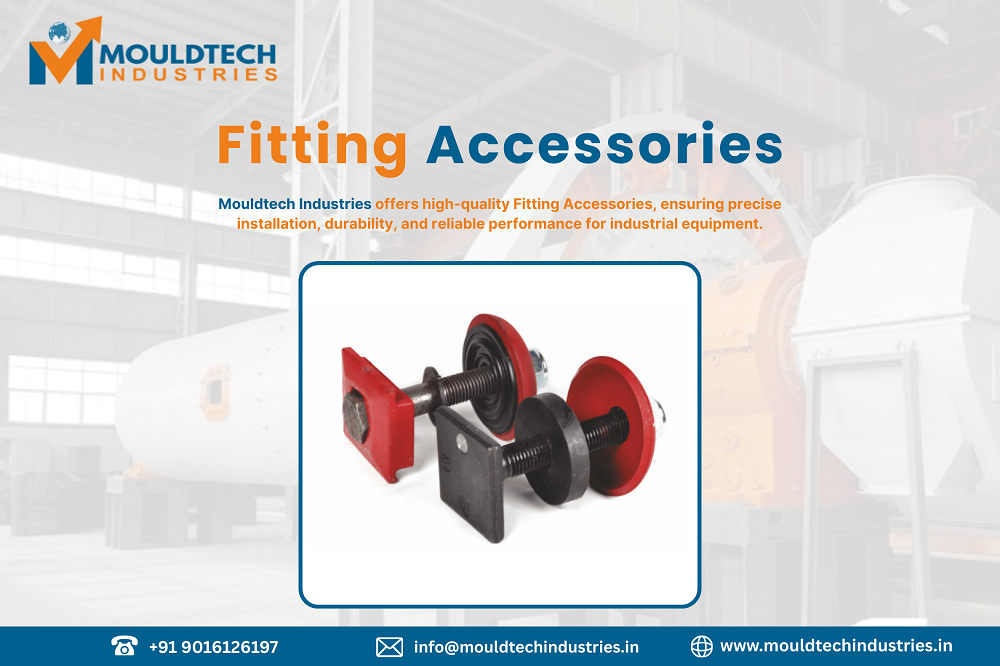
Fitting Accessories Manufacturer in India: Mouldtech Industries
Mouldtech Industries is a Manufacturer, Supplier and Exporter of Fitting Accessories.
Our Manufacturing Unit is in Vadodara, Gujarat, India.
Mouldtech Industries is a Manufacturer of Ball Mill Solutions, Ball Mill Rubber Lining, Wear Protection Line, Resistant Rubber Liner, Embedded Rubber Liners, Conveyors Solutions, Impact Bed Assembly and Impact Pads, Belt Cleaners, Pulley Lagging, Ceramic Rubber Lagging Services and Ceramic Rubber Lagging Sheet.
Fitting Accessories for Wear-Intensive Industrial Equipment: Engineering Reliability in Demanding Plant Conditions
Introduction
In heavy-duty industrial environments, equipment reliability directly influences plant productivity, safety, and operating cost. Industries such as mining, cement, metal processing, ceramics, and bulk material handling operate under constant exposure to abrasion, impact loading, corrosion, and thermal variation. These conditions steadily degrade equipment surfaces, joints, and interfaces, leading to unplanned downtime and rising maintenance effort.
Across global industrial markets, there is a growing emphasis on predictable equipment life, planned maintenance, and wear-controlled operations rather than reactive repairs. As production volumes increase and shutdown windows shrink, plant engineers are re-evaluating how even small components contribute to overall system reliability.
Within this context, Fitting Accessories used in ball mills, wear-lined chutes, rubber-lined vessels, ceramic protection systems, and conveyor assemblies play a critical role. Though often overlooked, these accessories ensure correct alignment, secure fixing, controlled load transfer, and long-term integrity of wear protection systems.
Industrial Challenges That Drive Demand for Fitting Accessories
Industrial plants across India and global markets face similar mechanical and operational challenges:
- Abrasion and Sliding Wear: In mining and metal processing operations, continuous movement of ore, clinker, slag, and raw materials causes severe surface abrasion. Poorly designed or incompatible fittings accelerate liner failure and structural wear.
- High Impact Loads: Ball mills, transfer chutes, and crushers experience repeated impact energy. Accessories must absorb shock without loosening, cracking, or transmitting stress to parent equipment.
- Corrosion and Chemical Exposure: Cement plants, power stations, and ceramic facilities often expose equipment to moisture, alkaline dust, and chemical agents. Fitting components must resist corrosion to maintain integrity over time.
- Downtime Sensitivity: Experienced plant engineers often observe that minor component failures can escalate into extended shutdowns. Incorrect fasteners, worn fixing systems, or incompatible fittings frequently cause liner movement or premature wear.
- Maintenance Cost Pressure: As maintenance budgets tighten, industries seek solutions that extend inspection intervals and reduce emergency repairs without compromising safety.
These challenges are common across industrial environments in India, the Middle East, Africa, and Southeast Asia, where mining hubs, ceramic clusters, and metal plants operate at high utilization levels.
What Are Fitting Accessories?
Fitting Accessories refer to the engineered components used to install, secure, align, and support wear protection systems such as rubber liners, ceramic tiles, rubber lining sheets, conveyor components, and mill internals.
In industrial terms, these accessories include:
- Fixing and fastening systems
- Backing and support elements
- Alignment and spacing components
- Interface parts between wear liners and steel structures
Their primary function is not to carry process material, but to ensure correct load distribution, secure positioning, and long-term stability of wear-resistant systems under dynamic operating conditions.
Applications Across Industries
- Mining Industry: In mining operations, fitting accessories are used in ball mills, slurry pipelines, chutes, and hoppers. Correctly designed fittings prevent liner movement under impact and vibration.
- Cement Plants: Cement mills, separators, cyclones, and material transfer points rely on secure liner installation. Accessories ensure liners remain stable during thermal expansion and heavy material flow.
- Metal & Steel Plants: In steel handling systems, sinter plants, and ash handling areas, fittings support ceramic and rubber wear solutions exposed to abrasive fines and elevated temperatures.
- Ceramic Manufacturing: Ceramic plants use wear protection systems in mills and conveyors handling hard raw materials. Precision fitting ensures tile alignment and controlled wear patterns.
- Power Plants: Coal handling and ash disposal systems depend on reliable fittings to maintain liner integrity in corrosive and abrasive environments.
- Bulk Material Handling: Conveyor transfer points, loading zones, and belt cleaning systems require accessories that maintain alignment and reduce secondary wear.
Material Science & Engineering Considerations
From an engineering perspective, fitting accessories must complement the wear material they support.
- Rubber Properties: Rubber components provide elasticity, impact absorption, and vibration damping. Accessories must accommodate rubber’s flexibility without causing stress concentration.
- Ceramic Hardness: Ceramic wear tiles offer high hardness and abrasion resistance. Fittings must ensure uniform load transfer to avoid localized cracking.
- Wear Resistance Principles: Wear occurs due to micro-cutting, impact fatigue, and surface erosion. Properly designed fittings help distribute forces evenly, extending liner service life.
- Impact Absorption: In dynamic systems, fittings act as intermediaries that absorb energy rather than transmitting it directly to steel structures.
Design & Customization Requirements
Manufacturers with long-term industry exposure understand that fitting accessories cannot be standardized blindly.
Key design considerations include:
- Equipment geometry and tolerances
- Liner thickness and material type
- Operating temperature and load
- Ease of replacement during shutdowns
Custom sizing and application-specific designs ensure compatibility with ball mills, chutes, conveyors, and vessels across different plant configurations.
Manufacturing Quality & Process Control
Precision manufacturing is essential for fitting accessories because dimensional accuracy affects liner stability.
Quality-focused manufacturers emphasize:
- Controlled molding or machining processes
- Material traceability
- Batch consistency
- Inspection at critical stages
These controls ensure that accessories perform consistently across large installations and multiple supply cycles.
Installation & Maintenance Considerations
From a maintenance standpoint, well-engineered fittings simplify installation and reduce downtime.
Benefits include:
- Faster liner change-outs
- Reduced need for re-tightening
- Predictable maintenance cycles
Maintenance teams value accessories that integrate smoothly with existing plant practices and tools.
Safety & Operational Reliability
Safety is a direct outcome of reliable wear protection systems.
Proper fitting accessories:
- Prevent liner dislodgement
- Reduce risk of sudden failures
- Protect maintenance personnel during inspections
Stable systems contribute to safer working conditions and improved plant confidence.
Cost Efficiency Over Equipment Life Cycle
Rather than focusing on initial component cost, industrial decision-makers evaluate life-cycle efficiency.
Reliable fitting accessories:
- Extend liner life
- Reduce frequency of shutdowns
- Optimize maintenance planning
Over time, these factors contribute to measurable operational savings.
Export Readiness & Global Acceptance
Global industrial buyers expect:
- Consistent quality
- Documentation support
- Awareness of international operating standards
Export-ready manufacturers design accessories suitable for diverse mining, cement, and ceramic environments worldwide.
Why Experienced Manufacturers Matter
Engineering expertise matters in wear protection systems.
Experienced manufacturers:
- Understand plant-level challenges
- Design for real operating conditions
- Provide consistent supply support
This experience reduces risk for EPC contractors, OEMs, and end users.
About Mouldtech Industries
Mouldtech Industries is an experienced Indian manufacturer specializing in ball mill rubber liners, ceramic wear protection solutions, rubber lining systems, conveyor solutions, and associated fitting accessories. Serving Pan India—including industrial regions across Maharashtra, Gujarat, Rajasthan, Odisha, Chhattisgarh, Jharkhand, West Bengal, Tamil Nadu, Andhra Pradesh, Telangana, Karnataka, Kerala, Madhya Pradesh, Uttar Pradesh, Punjab, Haryana, Himachal Pradesh, Uttarakhand, Bihar, Assam, Meghalaya, Manipur, Mizoram, Nagaland, Tripura, Arunachal Pradesh, Sikkim, Goa, and all major industrial cities—Mouldtech Industries also supports global industrial markets.
More information is available at https://www.mouldtechindustries.in/
Conclusion
Fitting Accessories may not be the most visible components in industrial systems, but their role in wear protection, safety, and reliability is critical. In demanding operating environments, correctly engineered accessories ensure that rubber and ceramic wear solutions perform as intended throughout their service life. For industries focused on long-term efficiency, attention to these details makes a measurable difference.
Key Takeaways
- Critical support for wear protection systems
- Improves operational reliability
- Suitable across mining, cement, metal, ceramic, and power sectors
- Enhances long-term equipment performance
- Relevant for domestic and global industrial markets
Trending FAQs
Q1. What is the typical lifespan of fitting accessories?
Lifespan depends on operating conditions, liner material, and installation quality, typically matching liner service cycles.
Q2. Are fitting accessories suitable for both rubber and ceramic systems?
Yes, but designs differ based on material behavior and load characteristics.
Q3. How often should fittings be inspected?
Inspection is usually aligned with scheduled maintenance shutdowns.
Q4. Rubber vs ceramic wear systems—do fittings differ?
Yes. Rubber systems require flexibility, while ceramic systems demand precise load distribution.
Q5. Are these accessories used globally?
They are widely used in mining, cement, and bulk handling industries worldwide.
Q6. Do fittings affect installation time?
Well-designed accessories generally reduce installation time and rework.
For technical discussions, project requirements, or application-specific wear protection solutions, connect with the engineering team at Mouldtech Industries. Our specialists work closely with plant engineers, maintenance teams.
#FittingAccessories #IndustrialFittings #DurableParts #MechanicalAccessories #SeamlessInstallation #ReliablePerformance #IndustrialTools #MachineryParts #EfficientOperation #MoudtechIndustries