

Bridge Rubber Pad Manufacturer and Supply Guide in India
Bridge structures face continuous load, vibration, temperature changes, and harsh weather conditions daily. Poor-quality pads can cause cracking, uneven load distribution, costly maintenance, and structural damage over time. Bridge Rubber Pad Solves Heavy Load Pressure Issues by improving stability, shock absorption, and load transfer efficiency. This guide explains how to select the right bridge rubber pad, important manufacturing quality checks, supplier comparison methods, and reliable sourcing solutions from Mouldtech Industries designed specifically for demanding Indian bridge and infrastructure project conditions.
For many civil contractors and infrastructure consultants in Vadodara, Ahmedabad, Mumbai, Delhi, Hyderabad, Chennai, and Bangalore, the main concern is simple: the pad should perform reliably for years, not just pass dispatch. That is where material consistency, mould precision, bonding quality, dimensional accuracy, and documented inspection make a real difference on site.
Why Choose Mouldtech Industries for Bridge Rubber Pad
The practical answer is experience backed by process discipline. Mouldtech Industries, established in 2007, works from Nayakpura Estate, Opp. New Timber Market Nilamber Aangan Lane, Near Soma Talav Char Rasta, Dabhoi Rd, Pratap Nagar, Vadodara, Gujarat 390025, India. The company is led by an experienced team of rubber technology and engineering professionals with deep expertise in wear protection solutions and custom industrial rubber manufacturing.
Yes, buyers looking for bridge pads also often compare vendors who make heavy-duty wear components for mining and cement. That comparison is fair because process capability matters. A manufacturer experienced in industrial rubber products Vadodara, custom rubber liner India, and demanding plant applications usually understands compression behaviour, abrasion handling, moulding tolerance, and long-term service conditions more clearly.
In actual procurement discussions, I often hear one question: can the supplier handle custom sizes without delaying dispatch? Here, the strength lies in advanced manufacturing infrastructure and controlled production planning. The same operational discipline used for wear resistant rubber liner, ceramic-backed products, impact pads, conveyor belt cleaners, and rubber lagging supports reliable pad manufacturing as well.
If you want broader company details, you can review Mouldtech Industries directly. The company has served 200+ clients across mining, cement, and heavy industries, and that matters because repeat industrial work usually comes only when dimensional consistency and after-sales support are dependable.
A small example: one contractor working on an approach bridge package near Surat had earlier sourced lower-cost pads from an unverified vendor. On inspection, thickness variation forced rechecking and slowed installation. After switching to a more controlled supply process, site fitment became smoother and documentation was easier for consultant approval. So the real benefit is not only the product. It is fewer site surprises.
Our Bridge Rubber Pad Manufacturing Capabilities
Here’s how Mouldtech Industries approaches bridge rubber pad production: start with application load, movement range, drawing requirement, rubber grade, and approval documentation. Only after that should production planning begin. This is basic engineering discipline, but in many small units, it gets skipped.
What we manufacture and support
Bridge rubber pad requirements can vary by:
- shape and size
- load-bearing requirement
- elastomer grade
- plain or laminated design need
- tolerance requirement
- project documentation and inspection level
This manufacturing mindset is similar to how one handles ball mill rubber liner manufacturers level work, where mill specification accuracy matters more than generic stock supply. The same logic applies here: one drawing error can create a site issue later.
For related application understanding, readers can also check Bridge Rubber Pad Manufacturer in India for additional context on usage and supply requirements.
Material and shop-floor quality matters
The best bridge rubber pads are not about hardness alone. They depend on:
- rubber compound consistency
- proper curing cycle
- mould finish
- dimensional repeatability
- load-bearing performance
- resistance to aging, water, and environmental stress
In Indian conditions, especially across Kolkata, Pune, Jaipur, and Indore, temperature variation and storage conditions can affect product handling before installation. That is why packing, marking, and batch traceability matter more than many buyers first assume.
A mini client success story is worth sharing. A project intermediary from Chandigarh needed urgent replacement pads for a small bridge maintenance package. The issue was not huge volume. It was matching dimensions correctly and dispatching fast enough to avoid labour idle time. After drawing confirmation and production scheduling, the material moved with proper identification, and the site team avoided a second measurement cycle. Small jobs also need disciplined execution.
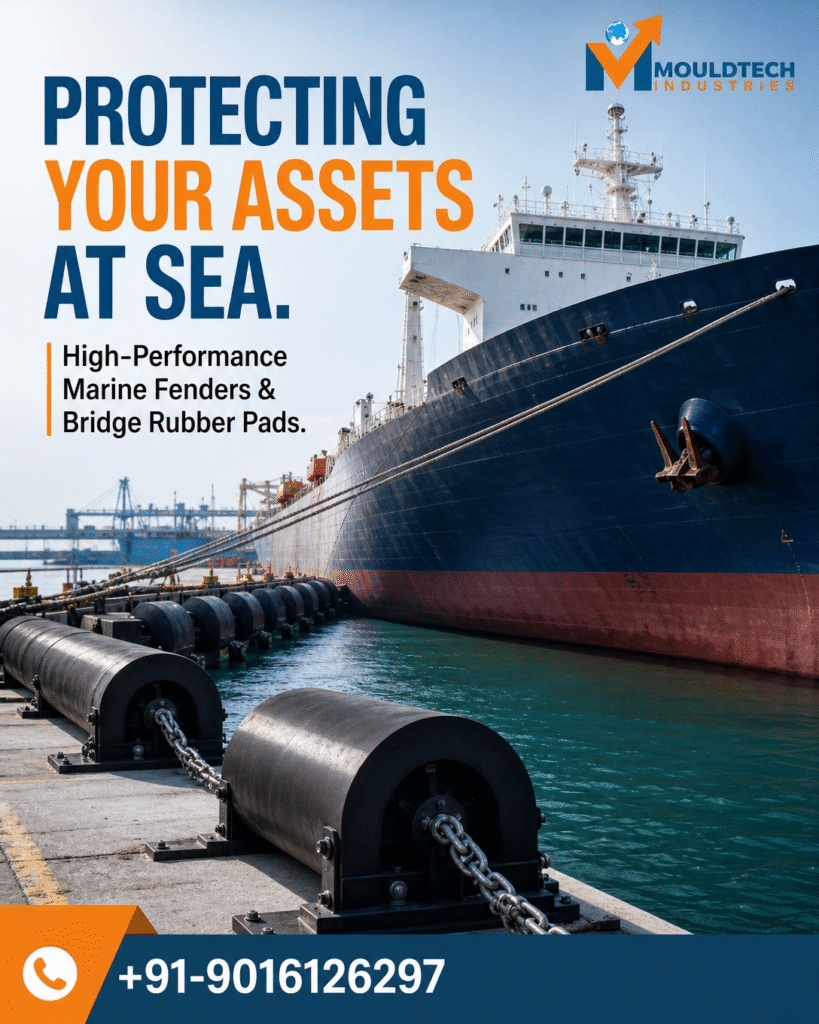
For users comparing related marine and heavy-duty rubber products, these pages may help: Cylindrical Fender Manufacturer and Supplier in India and Arch Fender Manufacturer and Supplier in Vadodara India.
Midway through evaluation, many buyers ask for budget clarity and dispatch time.
Get a Quote for [Bridge Rubber Pad]
Navigating Quality Standards & ISO 9001:2015 Certification
Yes, quality certification matters, but only when it reflects actual process control. Mouldtech Industries is ISO 9001:2015 certified, and that gives buyers a structured basis for document control, inspection processes, traceability, and quality management consistency. In practical terms, this helps when consultants, EPC teams, or government-linked contractors ask for manufacturing records and standard quality documentation.
External references to ISO 9001:2015 are often misunderstood in industrial buying. The standard does not say a product is automatically superior. It means the manufacturer follows a defined quality management system. For bridge rubber pads, that supports:
- controlled incoming material checks
- process monitoring during production
- final inspection records
- complaint handling and corrective action systems
This is the same kind of production seriousness expected from Rubber Liner Manufacturers in Vadodara serving mining and cement plants, where downtime has real cost. In those sectors, buyers look for abrasion resistant liner, ceramic embedded rubber liner, cement mill liners, and low maintenance rubber liners because maintenance windows are tight. Infrastructure buyers may use a different product, but they value the same manufacturing discipline.
If you want location-specific insight, a useful supporting page is Bridge Rubber Pad in Morbi. It helps show how regional project demand and supply planning work in Gujarat.
Local Manufacturers vs Mouldtech Industries
Here’s the practical comparison buyers usually need before finalizing a supplier.
| Comparison Point | Typical Local Manufacturer | Mouldtech Industries |
|---|---|---|
| Experience Base | May focus on limited standard-size production | 18+ years of industrial rubber manufacturing experience since 2007 |
| Customization | Often limited to common sizes | Custom production as per drawing and project requirement |
| Quality System | May not have formal documentation depth | ISO 9001:2015 certified process discipline |
| Related Engineering Capability | Narrow product understanding | Broader expertise in mining equipment rubber solutions, wear parts, and heavy-duty elastomer products |
| Documentation Support | Basic invoice and dispatch paperwork | Structured communication for inspection, specification, and dispatch coordination |
| Service Reach | Local or regional only | Pan-India supply and export ready approach |
So what does this mean for a buyer? Simple. If your project is standard and low-risk, many suppliers may quote. If your job needs custom dimensions, reliable records, and smoother execution, process capability matters far more than a low initial price.
Step-by-Step Process – How We Deliver Bridge Rubber Pad
Here’s how the delivery process should work when handled properly.
1. Requirement review
The buyer shares drawing, dimensions, quantity, load details, and timeline. If information is incomplete, the engineering team raises questions first instead of making assumptions.
2. Technical confirmation
Material grade, tolerances, and usage conditions are aligned. This step reduces future mismatch risk, especially for contractors handling multiple packages across cities like Ahmedabad, Mumbai, and Chennai.
3. Production planning
Tooling, moulding schedule, curing cycle, and inspection checkpoints are fixed. This is where experienced industrial teams save time because they know which variation can create rework.
4. Inspection and documentation
Dimensions, finish, and batch readiness are checked before dispatch. Buyers who also source from Ball Mill Rubber Liner Suppliers India often appreciate this step because they already know poor inspection causes shutdown cost in other industrial sectors too.
5. Dispatch and support
Material is packed, labelled, and shipped with coordination support. For direct enquiry and quick response, use Contact Us.
Lead support is also practical, not flashy:
- Free Rubber Liner Consultation
- Download Ball Mill Liner Cost Guide
- WhatsApp for drawing review and quick coordination
Real Client Case Study
Here’s how a realistic project situation looked. An anonymized Gujarat infrastructure contractor, let us call them Client R, needed bridge rubber pads for a regional road connectivity package. The challenge was mixed quantity, drawing-specific dimensions, and pressure from the consultant for timely documentation.
The first issue was timeline. The second was confidence. The buyer had already faced one delay from another vendor due to poor dimensional consistency. After technical review, production was planned in batches, not in one rushed lot. That reduced the chance of avoidable rejection.
During dispatch coordination, the client’s team also asked questions related to other heavy-duty rubber components because they were evaluating long-term vendor support. This often happens in real industry. A supplier may begin with one product and later support broader maintenance needs, from mining equipment rubber solutions to engineered elastomer components.
The result was straightforward: approved dimensions, cleaner delivery sequence, and no last-minute site confusion. That is the real value in bridge rubber pad supply. Not marketing claims. Predictable execution.
FAQs
1. What is a bridge rubber pad used for?
A bridge rubber pad helps transfer load, absorb movement, reduce stress concentration, and support controlled structural movement between bridge elements.
2. How do I choose the right bridge rubber pad size?
Use project drawings, load data, bearing requirement, and consultant specifications. Never select only on visual size.
3. Does ISO 9001:2015 certification matter for bridge rubber pad suppliers?
Yes. It supports process consistency, inspection control, traceability, and better quality documentation.
4. Can bridge rubber pads be made in custom sizes?
Yes, custom production is common when drawings, dimensions, and technical details are clearly shared.
5. Do you supply outside Gujarat?
Yes, supply can be arranged across India, including Delhi, Hyderabad, Bangalore, Kolkata, and other industrial regions.
6. What buyers should check before placing an order?
Check dimensions, rubber grade, tolerance, documentation, delivery timeline, inspection method, and packing details.
7. Can one supplier support bridge pads and other industrial rubber products?
Yes. Many experienced manufacturers also handle related heavy-duty products used in infrastructure, mining, cement, and material handling sectors.
If you need practical guidance, drawings review, or budget planning, contact +91-9925618287, +91-7600030602, +91-9427444465, or +91-9016126297. You can also write to mouldtechindia@gmail.com or acc.mouldtech@gmail.com, ask for a WhatsApp discussion, request a Free Rubber Liner Consultation, or Download Ball Mill Liner Cost Guide before finalizing your purchase.