
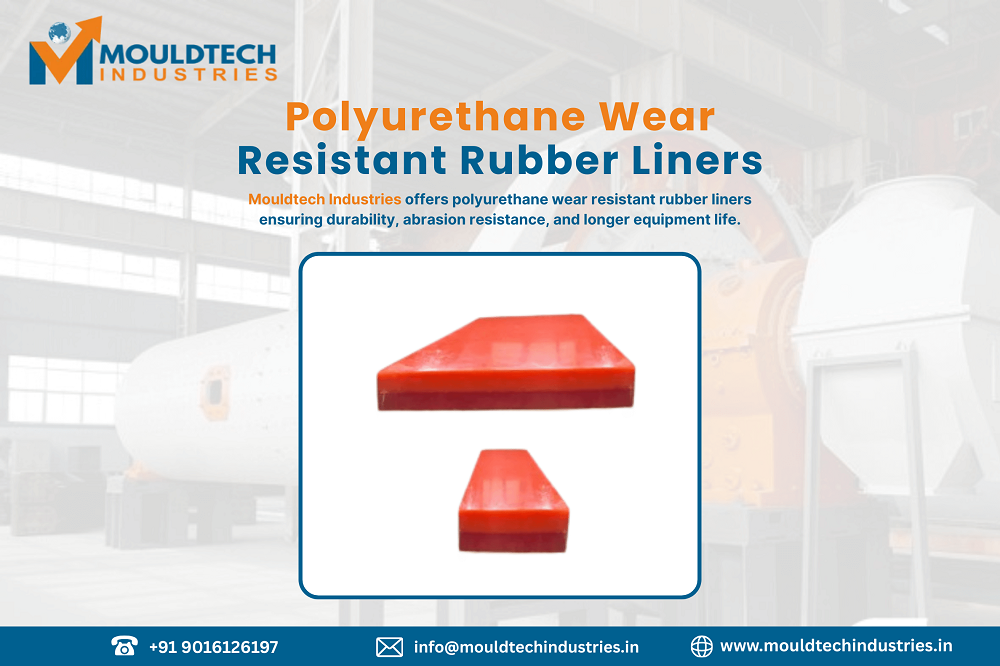
Polyurethane Wear-Resistant Rubber Liners Manufacturer in India: Mouldtech Industries
Mouldtech Industries is a Manufacturer, Supplier, and Exporter of Polyurethane Resistant Rubber Liners.
Our Manufacturing Unit is in Vadodara, Gujarat, India.
Mouldtech Industries is a Manufacturer of Ball Mill Solutions, Ball Mill Rubber Lining, Wear Protection Line, Resistant Rubber Liner, Embedded Rubber Liners, Conveyors Solutions, Impact Bed Assembly and Impact Pads, Belt Cleaners, Pulley Lagging, Ceramic Rubber Lagging Services, and Ceramic Rubber Lagging Sheet.
Polyurethane Wear-Resistant Rubber Liners: Designing Dependability for Tough Industrial Settings
Introduction
In sectors such as mining, metal fabrication, cement production, ceramics, and bulk material logistics, maintaining equipment dependability is a constant operational challenge. Heavy cargo, gritty substances, powerful forces, dampness, chemicals, and non-stop use impose severe strain on machinery. In harsh industrial settings, unchecked material loss directly impacts output, safety, and long-term running expenses.
Seasoned plant supervisors frequently see that unforeseen stoppages due to liner failure, chute deterioration, or conveyor wear hold up entire production sequences. As worldwide industrial needs continue to grow—particularly in mining conveyors, cement facilities, steel complexes, and ceramic hubs—the need for effective defence against wear has increased significantly.
Polyurethane wear-resistant rubber Liners have surfaced as a key industrial remedy for handling rubbing, shock, and material flow issues while enhancing equipment lifespan and stable operation. These linings are now commonly deployed across industries in India, from mineral processing sites to power stations and bulk logistics hubs.
Industrial Issues Driving the Need for Polyurethane Wear-Resistant Rubber Liners
In mining and metal processing, wear results from multiple operating stresses acting simultaneously.
- Rubbing: Constant contact with ores, clinker, coal, aggregates, or ceramic dust progressively wears down equipment surfaces. Material high in silica or with sharp particles speeds up this process.
- Shock Loads: Transfer points, mill intake areas, hoppers, and chutes endure recurring blows from falling material. Stiff materials often fracture under such pressure.
- Rust & Dampness: Wet processing setups and chemical exposure further degrade metal surfaces, necessitating more frequent servicing.
- Stoppages & Servicing Expenses: Frequent liner substitutions lead to shutdowns, labourlabour costs, and lost output—often exceeding the initial cost of the part.
These problems are widespread across mining territories, cement corridors, steel centres, ceramic manufacturing zones, and bulk-handling depots throughout India and similar industrial markets worldwide.
What Are Polyurethane Wear-Resistant Rubber Liners?
Polyurethane Wear-Resistant Rubber Liners are specifically engineered covering systems meant to shield equipment faces from rubbing, impact, and material sticking. They merge the flexibility of rubber with polyurethane’s resistance to wear, offering balanced performance on challenging tasks.
Unlike standard metal coverings, polyurethane rubber linings absorb impact energy rather than passing it directly to the equipment structure. This lessens cracking, shaking, and structural stress. Based on the task requirements, these linings might be pure polyurethane, rubber-polyurethane blends, or ceramic-enhanced for superior wear protection.
Their function is practical and protective—not cosmetic or marketing-driven—and their effectiveness heavily relies on picking the correct materials and design.
Uses Across Sectors
Mining Sector
In mining activities, Polyurethane Wear Resistant Rubber Liners are often utilised in:
- Ball mills and SAG mills
- Chutes and transition points
- Hoppers and feed boxes
- Screening apparatus
They assist in managing high rubbing while keeping impact resilience in ore transport systems.
Cement Plants
Cement manufacturing involves continuous handling of clinker, limestone, and additives. Linings are fitted in:
- Raw mill and coal mill systems
- Cyclones and tubing
- Material transfer chutes
Metal & Steel Plants
Steel facilities use wear linings in:
- Slag handling setups
- Material containers and carriers
- Mixing drums and exit points
Ceramic Sector
Ceramic makers dealing with powders and small pieces depend on linings to:
- Avoid impurities
- Keep material moving smoothly
- Lessen dust buildup
Power Plants & Bulk Material Handling: Coal-handling sites, ports, and large depots use polyurethane linings on conveyors, storage bunkers, and silos to reduce wear and reduce service requirements.
Material Science & Engineering Aspects
From an engineering viewpoint, guarding against wear is dictated by material science rather than mere claims.
- Rubber Qualities: Rubber offers bendability, shock absorption, and vibration dampening. It shields equipment from sudden stress and lowers noise.
- Polyurethane Features: Polyurethane offers greater resistance to abrasion than standard rubber while maintaining some flexibility. It works well against sliding wear.
- Ceramic Hardness (When Included): Ceramic parts supply extreme toughness against grinding materials. When properly attached to rubber or polyurethane, they combine shock protection with long operational periods.
- Wear Resistance Fundamentals: No lining is entirely “wear-proof.” Performance hinges on particle size, speed, impact angle, warmth, and material chemistry. Manufacturers with extensive industry background grasp these variables and design accordingly.
Design & Customisation Needs
Effective lining performance starts with the right design.
- Equipment Fit: Linings must match the shape of mills, chutes, and conveyors.
- Tailored Dimensions: Thickness, tile arrangement, and securing methods differ by use.
- Task-Specific Design: Areas requiring high impact require different lining setups than those with sliding wear.
Off-the-shelf linings rarely work best in all situations; personalisation is vital.
Production Excellence & Process Oversight
Precise manufacturing directly impacts how long a lining lasts.
- Controlled blending of rubber and polyurethane
- Careful moulding and hardening phases
- Reliable adhesive strength
- Accurate sizing for simple fitting
Consistency across batches is crucial, especially for large industrial sites running numerous units simultaneously.
Fitting & Servicing Notes
Well-conceived polyurethane rubber linings are built for practical mounting.
- Modular lining setups lessen fitting duration.
- Mechanical or glued attachment methods suit different settings
- Lighter lining weight aids handling safety
Servicing schedules become more predictable, allowing facilities to plan outages rather than react to breakdowns.
Safety & Operational Dependability
Safety is a direct result of dependable wear defence.
- Lowered risk of liner rupture
- Reduced the probability of material spilling
- Safeguarding structural metal and equipment shells
In rigorous industrial settings, improved liner reliability contributes to safer working conditions and smoother plant operations.
Value Over Equipment Life Cycle
Looking at the entire life cycle, Polyurethane Wear-Resistant Rubber Liners contribute to:
- Longer stretches between replacements
- Fewer unexpected shutdowns
- Lower repair costs for structures
- Optimised servicing schedules
Value is achieved through dependability, not through short-term cost cuts.
Export Readiness & Global Acceptance
Global industrial buyers expect:
- Uniform quality benchmarks
- Correct documentation
- Trackable production sequences
- Awareness of international standards
Producers providing export-ready wear solutions must grasp these expectations beyond just local demands.
Why Seasoned Producers Are Important
Wear defence isn’t a general product class. Engineering skill, use-case understanding, and manufacturing rigour define actual performance.
Manufacturers with lengthy industry exposure know how linings behave in actual plant settings—not just in lab trials. Dependable supply, technical backing, and application advice become key factors for machinery makers, engineering firms, and plant managers.
About Mouldtech Industries
Mouldtech Industries is an experienced industrial fabricator specialising in Polyurethane Wear Resistant Rubber Liners, rubber covering systems, ceramic wear protection fixes, ball mill rubber items, and conveyor solutions. Serving industrial markets across India and worldwide, the company supports the mining, cement, metal, ceramic, and bulk material-handling sectors with practical wear-protection solutions.
Further details on their engineering capabilities and product range are available at https://www.mouldtechindustries.in/.
Conclusion
Polyurethane Wear-Resistant Rubber Liners serve a key role in safeguarding industrial equipment against abrasion, impact, and operational strain. Their merit goes beyond safeguarding parts—supporting plant dependability, safety, and predictable servicing plans.
For sectors operating under constant, high-demand conditions, choosing the correct wear protection solution remains a calculated engineering choice rather than just a procurement task.
Key Points
- Effective wear defence boosts equipment life and reliability
- Polyurethane linings balance wear resistance and shock absorption
- Suitable for mining, cement, metal, ceramic, and bulk handling sectors
- Correct design and mounting are vital for performance
- A globally accepted remedy for demanding industrial settings
Trending FAQs
1. What is the typical lifespan of polyurethane wear-resistant rubber liners?
Lifespan depends on material characteristics, operating conditions, and impact severity. Properly selected liners often outlast conventional rubber solutions.
2. Are polyurethane liners suitable for high-impact applications?
Yes, when correctly designed, they absorb impact energy effectively while resisting abrasion.
3. How often do these liners require maintenance?
Maintenance frequency varies by application, but predictable wear patterns allow planned inspections rather than emergency replacements.
4. How do polyurethane liners compare with ceramic wear solutions?
Polyurethane handles impact and flexibility better, while ceramics provide higher abrasion resistance. Hybrid systems combine both advantages.
5. Are these liners used globally?
Yes, polyurethane wear liners are widely used across the mining, cement, steel, and bulk-handling industries worldwide.
Contact Mouldtech Industries today to discuss your wear protection needs and receive reliable engineering support for Polyurethane Wear-Resistant Rubber Liners designed for demanding industrial applications across mining, cement, and bulk-handling plants.
#BallMillRubberLiner #CeramicWearProtection #RubberLining #MiningSolutions #BulkMaterialHandling #ConveyorSolutions #MouldtechIndustries #WearProtection #IndustrialManufacturing