
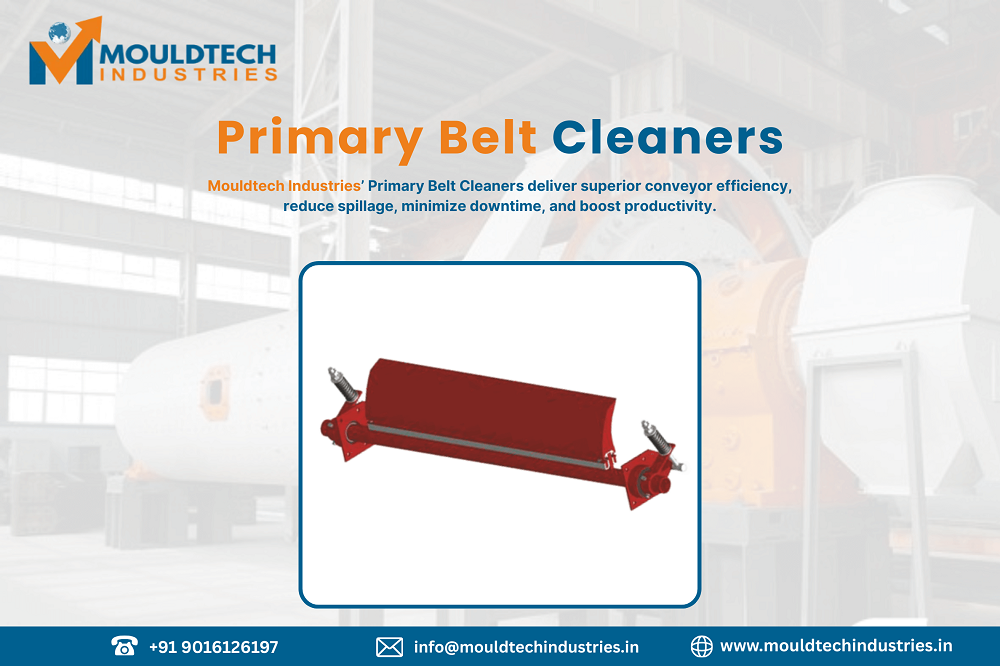
Primary Belt Cleaners Manufacturer in India: Mouldtech Industries
Mouldtech Industries is a Manufacturer, Supplier, and Exporter of Primary Belt Cleaners.
Our Manufacturing Unit is in Vadodara, Gujarat, India.
Mouldtech Industries is a Manufacturer of Ball Mill Solutions, Ball Mill Rubber Lining, Wear Protection Line, Resistant Rubber Liner, Embedded Rubber Liners, Conveyors Solutions, Impact Bed Assembly and Impact Pads, Belt Cleaners, Pulley Lagging, Ceramic Rubber Lagging Services, and Ceramic Rubber Lagging Sheet.
Primary Belt Cleaners: Engineering Wear Protection for Heavy‑Duty Industrial Systems
In heavy‑duty industrial environments such as mining, metal processing, cement manufacturing, ceramic production, and bulk material handling, equipment reliability isn’t optional. It is fundamental to plant uptime, safety, and cost‑effectiveness. These sectors operate under intense abrasion, impact loads, corrosive atmospheres, and continuous cycling. Under such conditions, component wear and material buildup create chronic maintenance challenges. One industrial solution that directly mitigates these challenges is Primary Belt Cleaners.
From the outset, industrial engineers, maintenance teams, and plant operators recognize that unchecked material carryback on conveyor belts undermines belt health, increases idler and pulley wear, contributes to spillage, and elevates safety risks. Primary Belt Cleaners play a crucial role in protecting conveyors and supporting systems, reducing unplanned downtime and long‑term lifecycle costs.
This blog draws on real plant experience, materials engineering principles, and practical field considerations to explain what Primary Belt Cleaners are, why they matter, how they are designed and selected, and where they deliver tangible benefits in industrial operations across India and globally.
Industrial Challenges That Drive Demand for Primary Belt Cleaners
In heavy‑duty industrial environments, conveyor systems are the arteries of material movement. Whether transporting ore in a mine, clinker in a cement works, billets in a steel mill, or raw materials in a ceramic facility, conveyors are subject to several relentless operational forces:
- Abrasion: Highly abrasive materials such as iron ore, bauxite, clinker, and silica sand cause progressive wear on belt surfaces, pulleys, idlers, and cleaning components. Material particles trapped between the belt and the idlers rapidly abrade surfaces. Primary belt cleaners reduce the volume of residual material on the belt, lowering abrasive wear on downstream components.
- Impact Loads: Bulk materials discharged from hoppers, chutes, or transfer points strike belt surfaces with considerable energy. Over time, impact forces degrade belt edges and deform the conveyor structure. Effective belt cleaning minimizes standing material, which magnifies impact.
- Corrosion: Moist, chemically active materials common in mining (e.g., sulfide ores) and cement processing can accelerate corrosion on unprotected surfaces. Corrosive environments intensify the wear process and shorten service intervals if material carryback is not kept in check.
- Downtime: Unplanned stops to clear carryback, repair belts, or replace worn idlers result in direct production losses. Experienced plant engineers often observe that poorly maintained belts create exponential downstream failures.
- Maintenance Cost: Labor, replacement parts, and reactive repairs add up. Reducing belt carryback is not a luxury; it is a practical lever to decrease maintenance budgets and improve plant reliability.
Across the globe, from steel clusters in Jharkhand and Odisha to cement plants in Rajasthan and Karnataka, these challenges are ubiquitous. They demand engineering solutions that integrate material science, robust mechanical design, and field serviceability.
What are Primary Belt Cleaners?
Primary Belt Cleaners are engineered components installed typically immediately after the head pulley of a conveyor system. Their purpose is to remove residual material adhered to the belt surface after discharge, preventing it from accumulating on idlers, skirting, pulleys, and the structure beneath the belt.
Unlike secondary or tertiary cleaners positioned further along the return strand, primary cleaners engage the belt as the first line of defense. They are designed to:
- Make direct contact with the belt surface under controlled pressure
- Scrape off carryback and sticky residues
- Minimize belt damage through material‑specific blade selection
- Operate in continuous duty conditions with predictable replacement intervals
Primary belt cleaners are not a “one‑size‑fits‑all” part. Their effectiveness depends on appropriate material selection, blade geometry, mounting configuration, and compatibility with belt speed and tension.
Operational benefit is not about unrealistic performance claims but about consistent removal of carryback at the source, reducing the risk of damage and cleaning requirements downstream.
Applications Across Industries
- Mining: In open‑pit and underground mining, bulk materials such as iron ore, copper, coal, and aggregates are transferred at high tonnages. Primary belt cleaners in these settings are exposed to high abrasivity and moisture. They must withstand continuous impact while maintaining cleaning efficiency. Installation at strategic transfer points reduces material buildup and protects costly conveyor components.
- Cement Plants: Cement raw materials and clinker are abrasive and often sticky due to partial hydration. Efficient primary belt cleaning prevents clinker fines from accumulating on return idlers and conveyors servicing kilns, silos, and mills. Over time, this reduces idler failures and dust generation.
- Metal & Steel: Steel plants use conveyors to transport fluxes, ore, slabs, billets, and scrap. Ceramic wear protection systems and primary belt cleaners work in tandem here: ceramics provide localized surface protection where impact and abrasion are acute. In contrast, belt cleaners manage carryback that could otherwise damage expensive electrical drive components and belt fabric.
- Ceramic Manufacturing: Ceramic body mixtures and frits are dusty and cling to belt surfaces. Residual material on belts may generate dust explosions or contamination. Primary cleaners reduce this risk and support air quality and housekeeping standards.
- Power Plants: Coal handling systems require reliable cleaning at high throughputs. Primary cleaners reduce coal fines sticking to belts, limit idler wear, and improve combustion efficiency by ensuring consistent feed rates.
- Bulk Material Handling: Port terminals, fertilizer plants, and distribution hubs manage diverse materials. Primary belt cleaners help maintain conveyor cleanliness, reducing the risk of spillage in environmentally sensitive zones and logistics bottlenecks.
Material Science & Engineering Considerations
Selecting and engineering primary belt cleaners requires a grounding in material science, particularly when integrated with other products such as Ball Mill Rubber Liners, Ceramic Wear Protection Solutions, Rubber Lining Systems, Ball Mill Rubber Products, and Conveyor Solutions.
- Rubber Properties: Rubber compounds used in belt cleaners deliver flexibility, abrasion resistance, and energy absorption. Rubber is suitable where moderate abrasivity and impact forces are present, and where it conforms to belt irregularities to ensure consistent cleaning without damaging the belt carcass.
Properties to consider:
- Tear resistance
- Durometer (hardness)
- Temperature tolerance
- Environmental resistance (ozone, UV, chemicals)
Experienced plant engineers understand that improper rubber durometer or formulation can accelerate wear and cause belt surfaces to gouge.
- Ceramic Hardness: Ceramic cleaning elements, often alumina or silicon carbide-based, are selected for extremely abrasive environments. Their hardness resists wear significantly better than rubber but requires careful interface engineering to avoid belt damage.
- Wear Resistance Principles: In primary cleaners, the goal is not the most rigid material, but the right balance between hardness and belt compliance. Engineers must match material wear characteristics with belt speed, material type, and conveyor operating conditions.
- Impact Absorption: Rubber absorbs transient loads that could otherwise tear belts or damage mounting brackets. Ceramic elements resist abrasion but must be supported by shock‑absorbing housings or backing layers to mitigate fracture under impact.
Design & Customization Requirements
Primary belt cleaners should not be generic cast‑off products. Real industrial systems demand tailored designs:
- Equipment Compatibility: Mounting structures vary by conveyor type. Primary belt cleaners should accommodate a range of head pulley diameters, belt widths, and tensioning arrangements.
- Custom Sizing: Belt widths in India span from narrow feeder belts (300–600 mm) to heavy mainline conveyors (>1,200 mm). Cleaners must be sized for complete belt surface contact without creating undue local pressure points.
- Application‑Specific Design: Factors such as material stickiness, moisture, particle size, and operation speed dictate blade angle, tensioning method, and whether ceramic or rubber elements are optimal. Field engineers must evaluate these parameters rather than default to off‑the‑shelf units.
Manufacturing Quality & Process Control
Industrial components succeed or fail based on manufacturing discipline.
- Precision Manufacturing: Primary belt cleaners are fabricated with attention to tolerances, blade straightness, mounting hole accuracy, and uniformity of the resilient compound. Poorly made components wear unevenly, accelerating belt damage.
- Quality Checks: Batch testing for hardness, tensile strength, and dimensional conformity ensures predictable performance. Quality control underpins reliability in heavy industrial use.
- Batch Consistency: Industries with multiple conveyor systems benefit when replacement cleaners exhibit minimal variation between batches. This predictability supports planning and reduces variation in maintenance cycles.
Installation & Maintenance Considerations
Primary belt cleaners should be as easy to install as possible while minimizing production disruption.
- Ease of Installation: Mounting systems that allow blade replacement without major disassembly save labor hours. Quick‑release tensioners and accessible brackets support efficient maintenance.
- Reduced Downtime: Well‑designed cleaners lessen the frequency of complete conveyor shutdowns for cleaning and repair. Regular inspections and simple blade swaps keep systems running.
- Maintenance Cycles: Maintenance teams must plan based on wear rates observed in specific service conditions. Scheduling inspections during planned outages prevents unexpected stops.
Safety & Operational Reliability
In mining and metal processing operations, safety standards are stringent. Primary belt cleaners contribute to safety in several ways:
- Worker Safety: Reduced carryback reduces material accumulation under conveyors, decreasing slip-and-trip hazards. It also mitigates the risk of fires from accumulated fines.
- Equipment Protection: Cleaning components reduces abrasive wear on pulleys and idlers. This helps maintain belt tracking and prevents misalignment failures that can lead to dangerous belt-edge fraying.
- Plant Reliability: Consistent conveyor performance supports steady throughput. Engineers measure reliability in MTBF (Mean Time Between Failures) and MTTR (Mean Time To Repair). Effective belt cleaning improves both metrics.
Cost Efficiency Over Equipment Life Cycle
Primary belt cleaners contribute to lifecycle cost reduction in tangible ways:
- Lower extended maintenance costs by reducing component wear
- Fewer unplanned shutdowns and associated production losses
- Prolonged belt life through reduced abrasion and impact damage
- Optimized maintenance planning with predictable wear patterns
Rather than being an upfront cost center, belt cleaners integrated thoughtfully into plant systems deliver measurable value over years of operation.
Export Readiness & Global Acceptance
Manufacturers aiming for export markets must meet international expectations:
- Documentation & Standards Awareness: Export customers in APAC, the Middle East, Africa, Europe, and the Americas require technical datasheets, material certifications, and quality inspection records. Component traceability is often a contractual necessity.
- Global Buyer Requirements: Industrial buyers assess vendor reliability based on delivery performance, engineering support, and compliance with standards such as ISO 9001. Primary belt cleaners sourced from reliable manufacturers must meet these criteria.
Why Experienced Manufacturers Matter
In industrial plant environments where failure costs accrue rapidly, manufacturers with proven experience and engineering depth are indispensable.
- Engineering expertise ensures components are fit for purpose, not just spec‑boxed.
- Industry experience informs material selection, mounting design, and serviceability.
- Reliable supply prevents critical spares shortages that can halt production.
Manufacturers with long‑term industry exposure understand plant constraints and work with maintenance teams to deliver solutions that endure.
About Mouldtech Industries
Mouldtech Industries is an industrial manufacturer with deep expertise in wear protection and conveyor system solutions. With extensive experience serving plants across Pan India including major industrial cities and states such as Jamshedpur (Jharkhand), Bhilai (Chhattisgarh), Rourkela (Odisha), Pune (Maharashtra), Bengaluru (Karnataka), Ahmedabad (Gujarat), Delhi NCR, Chennai (Tamil Nadu), and Hyderabad (Telangana) Mouldtech Industries understands the real operational challenges faced by mining companies, metal and steel plants, cement works, ceramic manufacturers, bulk material handling companies, and project engineers.
The company’s engineering approach spans Ball Mill Rubber Liners, Ceramic Wear Protection Solutions, Rubber Lining Systems, Ball Mill Rubber Products, Conveyor Solutions, and Primary Belt Cleaners designed for durability, serviceability, and operational value. Visit the official site https://www.mouldtechindustries.in/ to review specifications and technical resources.
Conclusion
In heavy‑duty industrial environments, Primary Belt Cleaners are not auxiliary add‑ons; they are essential components that preserve conveyor integrity, support operational safety, and lower lifecycle costs. By understanding material behavior, design principles, manufacturing quality, and field maintenance realities, plant engineers and procurement professionals can make informed decisions that enhance system reliability.
When properly selected and maintained, primary belt cleaners directly contribute to plant efficiency and uptime. It is this practical engineering insight rather than marketing claims that should guide industrial equipment choices.
Key Takeaways
- Wear protection benefits: Reduces material carryback and abrasive wear on conveyors.
- Operational reliability: Supports continuous plant operation with fewer unscheduled stops.
- Industry suitability: Applicable across mining, cement, metal, ceramic, and bulk handling.
- Long‑term performance: Engineered for predictable wear and maintenance planning.
- Global industrial relevance: Meets standards expected in export and domestic industrial markets.
Trending FAQs
1. What is the typical lifespan of primary belt cleaners in industrial use?
Lifespan depends on material abrasivity, belt speed, and environmental conditions. In heavy mining applications, cleaners may require replacement every few months; in less abrasive settings, intervals extend to six months or more.
2. Are primary belt cleaners suitable for all conveyor systems?
Yes, but they must be selected based on belt width, material characteristics, speed, and impact loads. Customization ensures optimal performance.
3. How often should primary belt cleaners be maintained or inspected?
Routine inspections during scheduled maintenance, typically monthly, allow teams to monitor wear and adjust tensioning before performance degradation occurs.
4. When should a plant choose rubber versus ceramic elements?
Rubber suits moderate abrasion with frequent impact; ceramic is preferred where severe abrasion dominates. Engineers balance belt compliance with wear resistance.
5. Are primary belt cleaners used globally in industrial sectors?
Yes. They are standard in mining, metals, cement, and bulk handling operations across Asia, Europe, North America, and Africa due to consistent operational challenges.
6. What installation considerations should engineers account for?
Allow adequate access for blade replacement, proper tensioning mechanisms, and alignment with pulleys to avoid uneven wear and belt damage.
Ready to optimize your conveyor and wear protection systems with durable Primary Belt Cleaners? Mouldtech Industries is here to provide reliable, high-performance solutions for all your industrial material-handling and equipment-protection needs.
#BallMillRubberLiner #CeramicWearProtection #RubberLining #MiningSolutions #BulkMaterialHandling #ConveyorSolutions #MouldtechIndustries #WearProtection #IndustrialManufacturing