
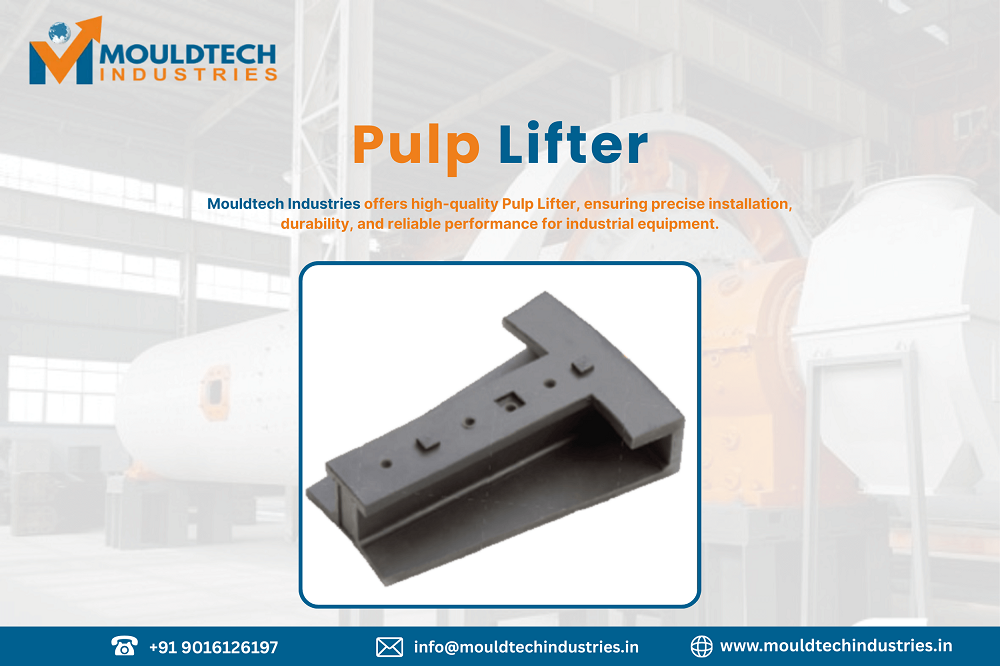
Pulp Lifter Manufacturer in India: Mouldtech Industries
Mouldtech Industries is a Manufacturer, Supplier and Exporter of Pulp Lifter.
Our Manufacturing Unit is in Vadodara, Gujarat, India.
Mouldtech Industries is a Manufacturer of Ball Mill Solutions, Ball Mill Rubber Lining, Wear Protection Line, Wear Resistant Rubber Liner, Ceramic Embedded Rubber Liners, Conveyors Solutions, Impact Bed Assembly and Impact Pads, Belt Cleaners, Pulley Lagging, Ceramic Rubber Lagging Services and Ceramic Rubber Lagging Sheet.
Pulp Lifter: Enhancing Wear Protection and Operational Reliability in Heavy-Duty Industrial Environments
Introduction
In heavy-duty industrial environments such as mining, metal and steel production, cement manufacturing, ceramic processing, and bulk material handling, equipment reliability is not a theoretical concern—it directly impacts operational efficiency, safety, and production cost. Abrasion, high-impact loads, and corrosion are daily challenges that degrade machinery performance, increase maintenance cycles, and shorten equipment life.
Global industrial trends indicate a steady rise in demand for wear-resistant solutions across Asia, Europe, and North America. In India, mining hubs in Jharkhand, Odisha, Chhattisgarh, and Rajasthan; cement clusters in Gujarat, Andhra Pradesh, and Tamil Nadu; steel plants in Chhattisgarh and Maharashtra; and ceramic manufacturing centers in Gujarat and Rajasthan are driving the adoption of advanced wear protection systems. Manufacturers and plant engineers now prioritize solutions that reduce downtime, optimize energy consumption, and enhance operational reliability.
Industrial Challenges That Drive Demand for Pulp Lifter
Industrial machinery faces multiple operational challenges:
- Abrasion: Constant contact with ore, clinker, steel scrap, and ceramic raw materials causes surface wear. Experienced plant engineers often observe that even minor abrasive damage can accelerate equipment fatigue and reduce operational efficiency.
- Impact Loads: Heavy material falling into ball mills or onto conveyor surfaces generates high-impact forces. Without adequate protection, liners, lifters, and conveyor beds can crack or deform, leading to unplanned shutdowns.
- Corrosion: Mining chemicals, cement slurries, and moisture-laden materials can corrode metallic surfaces, necessitating additional protective measures.
- Downtime: Maintenance shutdowns for worn components disrupt production schedules and increase operational costs. In mining and metal processing operations, unplanned downtime can cost millions per day.
- Maintenance Costs: Frequent replacement of worn liners, lifters, or conveyor components adds to operational expenditure, emphasizing the need for durable solutions.
Globally, industrial operators face similar challenges, particularly in heavy mining regions in South Africa, Australia, Chile, and Brazil. Solutions like the Pulp Lifter address these problems by combining durable material science with application-specific engineering.
What Is Pulp Lifter?
A Pulp Lifter is a wear protection component designed for ball mills and other rotating machinery. It is engineered to improve material handling efficiency while protecting the internal surfaces of industrial equipment. Unlike generic liners, pulp lifters are designed to withstand both abrasive and impact loads, ensuring continuous material flow and reducing the risk of damage to the mill shell or conveyor surfaces.
In practical terms, a pulp lifter:
- Redirects material flow for optimal grinding and mixing in ball mills.
- Reduces direct impact on vulnerable mill surfaces.
- Minimizes material buildup and blockages in conveyors or chutes.
By integrating material science with practical plant-level design, pulp lifters extend operational life while reducing maintenance needs.
Applications Across Industries
Mining
In mining operations, pulp lifters are critical for ball mills, SAG mills, and slurry handling systems. They mitigate abrasion from ore particles and improve grinding efficiency. Mining engineers in Jharkhand, Odisha, Chhattisgarh, and Rajasthan have increasingly adopted pulp lifters to maintain throughput while reducing maintenance frequency.
Cement Industry
Cement clinker is highly abrasive, and ball mills or vertical roller mills are susceptible to wear. Experienced plant engineers observe that pulp lifters help manage material flow, reduce impact loads on mill shells, and prevent premature liner failure, especially in major cement clusters like Gujarat, Tamil Nadu, and Andhra Pradesh.
Metal & Steel
In steel plants, pulp lifters protect grinding mills used for slag, ore, and refractory materials. They reduce damage from abrasive metal particles and support consistent grinding operations, critical for production scheduling and quality control.
Ceramic Manufacturing
Ceramic powders and tiles require precise grinding in ball mills. Pulp lifters with ceramic or rubber composite materials reduce wear, maintain particle size consistency, and prevent material build-up in rotary mills. Ceramic clusters in Gujarat and Rajasthan particularly benefit from these solutions.
Power Plants & Bulk Material Handling
Coal-fired power plants and bulk handling facilities deal with abrasive fuels and materials. Pulp lifters minimize wear in mills and conveyors, helping maintain continuous operation and reducing unplanned downtime.
Material Science & Engineering Considerations
Rubber Properties
High-quality rubber offers impact absorption and elasticity, which protects mill shells from severe impact loads. Rubber compounds must balance hardness and flexibility to resist deformation while mitigating stress on the underlying metal.
Ceramic Hardness
Ceramic tiles or composite inserts provide superior abrasion resistance. With hardness values often exceeding 1,000 HV, ceramics maintain surface integrity in high-wear zones, particularly in metal grinding or mineral processing operations.
Wear Resistance Principles
Material wear is influenced by particle size, velocity, and load. Experienced engineers emphasize that combining rubber and ceramic components in pulp lifters offers a balanced approach: rubber absorbs impact, while ceramics resist abrasion.
Impact Absorption
In rotating machinery, impact forces can fracture liners or damage shells. Engineering pulp lifters with shock-absorbing profiles extends component life and reduces maintenance cycles.
Design & Customization Requirements
Effective pulp lifters must consider:
- Equipment Compatibility: Mill size, shell geometry, and rotational speed dictate lifter dimensions and placement.
- Custom Sizing: Engineers can design lifters to optimize material flow and minimize dead zones within mills.
- Application-Specific Design: Mining, cement, steel, and ceramic applications have different wear profiles, requiring tailored rubber hardness, ceramic inserts, or composite configurations.
Manufacturers with long-term industry exposure understand that design precision directly impacts operational efficiency and safety.
Manufacturing Quality & Process Control
Pulp lifters must meet rigorous industrial standards to ensure consistent performance:
- Precision Manufacturing: CNC machining and molding processes ensure accurate tolerances.
- Quality Checks: Hardness testing, impact resistance verification, and dimensional inspections confirm compliance with design specifications.
- Batch Consistency: Each batch of pulp lifters undergoes process control to ensure uniform performance across installations.
In heavy-duty industrial environments, inconsistent components can accelerate equipment wear, leading to costly shutdowns.
Installation & Maintenance Considerations
Ease of installation and predictable maintenance cycles are key for industrial operations:
- Reduced Downtime: Pulp lifters are engineered for quick installation and replacement, minimizing production disruption.
- Maintenance Cycles: Experienced plant engineers often schedule inspections and replacements based on wear patterns rather than arbitrary time intervals.
- Operational Safety: Properly installed pulp lifters prevent material blockages and reduce manual handling risks for workers.
Safety & Operational Reliability
Pulp lifters contribute directly to worker safety and plant reliability:
- Protect personnel from material rebound or dust exposure during maintenance.
- Safeguard mill shells and conveyor surfaces from damage.
- Support predictable operations in high-throughput environments.
Reliable wear protection is essential in preventing catastrophic equipment failure, particularly in mining and metal processing operations.
Cost Efficiency Over Equipment Life Cycle
While initial procurement of pulp lifters is a capital investment, the long-term benefits include:
- Reduced Shutdowns: Less frequent replacement lowers operational interruptions.
- Maintenance Optimization: Fewer unplanned repairs allow maintenance teams to focus on preventive tasks.
- Extended Equipment Life: Proper wear protection reduces wear on costly mill shells and conveyor structures.
Manufacturers with experience in industrial engineering stress that total life-cycle costs are a more meaningful metric than upfront price.
Export Readiness & Global Acceptance
Pulp lifters designed for industrial export must meet global standards:
- Documentation of material composition, hardness, and manufacturing processes.
- Compliance with international safety and performance standards.
Capability to serve industrial buyers in Africa, South America, and Southeast Asia where mining and bulk material handling operations are expanding.
These factors ensure that components can be reliably used in international industrial environments without operational risk.
Why Experienced Manufacturers Matter
Selecting an experienced manufacturer is critical for operational success:
- Engineering Expertise: Experienced manufacturers understand stress distribution, wear patterns, and material compatibility.
- Industry Experience: Knowledge of plant-level challenges allows for design optimization that generic products cannot achieve.
- Reliable Supply: Consistent production and quality control prevent disruptions in the supply chain.
About Mouldtech Industries
Mouldtech Industries has decades of experience in designing and manufacturing industrial wear protection solutions, serving clients across India and global industrial markets. Their portfolio includes ball mill rubber liners, ceramic wear protection solutions, rubber lining systems, ball mill rubber products, and conveyor solutions. With an emphasis on precision manufacturing and material engineering, Mouldtech Industries has earned trust in mining, metal, cement, ceramic, and bulk material handling operations.
Learn more at: https://www.mouldtechindustries.in/
Conclusion
In modern industrial operations, wear protection is not optional—it is a critical factor in maintaining production efficiency, equipment longevity, and worker safety. The Pulp Lifter addresses challenges like abrasion, impact, and corrosion, making it a vital component in ball mills, conveyors, and bulk material handling systems.
By combining material science, precision engineering, and application-specific design, pulp lifters help industrial operators in India—from mining hubs in Jharkhand and Odisha to cement plants in Gujarat and Tamil Nadu—achieve consistent, reliable performance.
Plant engineers and procurement managers can rely on experienced manufacturers like Mouldtech Industries to deliver quality solutions that enhance operational reliability and reduce total lifecycle costs.
Key Takeaways
- Pulp lifters provide critical wear protection in abrasive and high-impact industrial environments.
- Enhance operational reliability and reduce unplanned downtime.
- Suitable for mining, cement, metal, steel, ceramic, and bulk material handling industries.
- Improve long-term performance of ball mills, conveyors, and grinding equipment.
- Recognized in global industrial markets for durability and precision engineering.
Trending FAQs
1. What is the typical lifespan of a pulp lifter?
Depending on material composition and operational conditions, pulp lifters last 2–5 years, with routine inspections by plant engineers recommended for maximum life.
2. Can pulp lifters be used in all ball mill types?
Yes, they can be customized for SAG mills, rod mills, or traditional ball mills based on equipment diameter, rotational speed, and material flow requirements.
3. How frequently should pulp lifters be maintained?
Experienced plant engineers recommend visual inspections every 3–6 months and replacement when wear reduces performance or impacts mill operation.
4. Rubber vs. ceramic pulp lifters—what is the difference?
Rubber lifters absorb impact and reduce noise, while ceramic lifters offer superior abrasion resistance. Often, a composite approach is used for optimal performance.
5. Are pulp lifters used in global industrial operations?
Yes, they are widely used in mining, cement, and metal processing industries across Africa, South America, and Southeast Asia, where heavy-duty grinding and handling operations are common.
6. Is professional installation required?
Yes, proper installation ensures optimal material flow, reduces downtime, and prevents equipment damage. Experienced maintenance teams typically handle installation following manufacturer guidelines.
7. Can pulp lifters improve plant safety?
Absolutely. By controlling material flow and reducing rebound, pulp lifters minimize risks to personnel and safeguard equipment integrity.
Get in touch with Mouldtech Industries for customized Pulp Lifter, rubber lining, and conveyor solutions across India and global markets.