
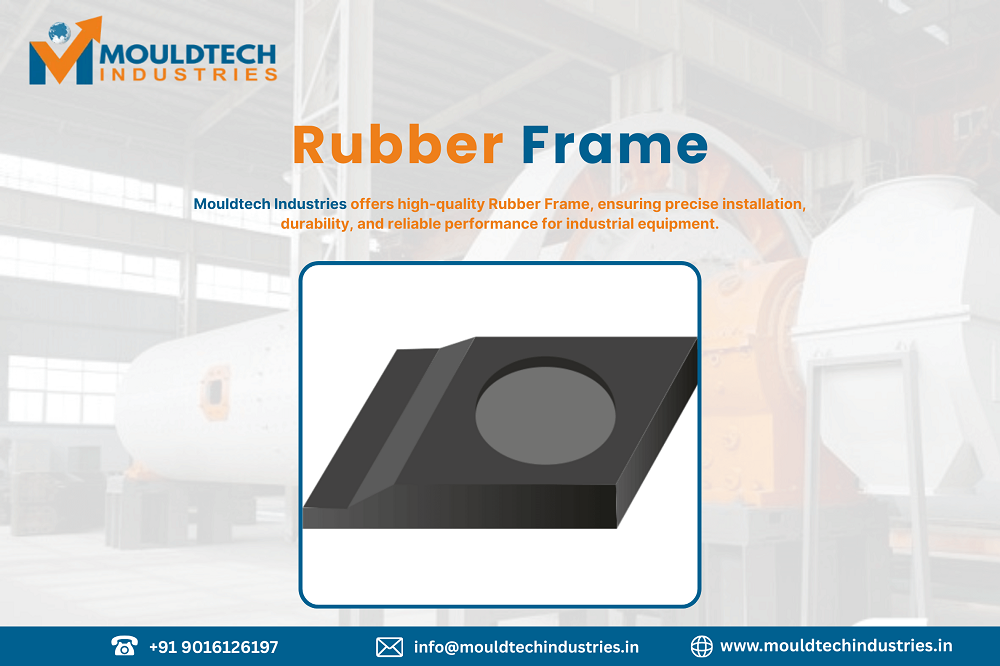
Rubber Frame Manufacturer in India: Mouldtech Industries
Mouldtech Industries is a Manufacturer, Supplier and Exporter of Rubber Frame.
Our Manufacturing Unit is in Vadodara, Gujarat, India.
Mouldtech Industries is a Manufacturer of Ball Mill Solutions, Ball Mill Rubber Lining, Wear Protection Line, Resistant Rubber Liner, Embedded Rubber Liners, Conveyors Solutions, Impact Bed Assembly and Impact Pads, Belt Cleaners, Pulley Lagging, Ceramic Rubber Lagging Services and Ceramic Rubber Lagging Sheet.
Rubber Frame: Enhancing Wear Protection and Operational Efficiency in Industrial Plants
Introduction
In heavy-duty industrial environments, such as mining, metal and steel production, cement, ceramic, and bulk material handling, equipment reliability is critical to maintaining uninterrupted operations. These industries operate under extreme conditions where abrasion, impact loads, corrosion, and high throughput can significantly reduce the life of plant equipment. Any unplanned downtime not only affects production schedules but also escalates maintenance costs and operational risks.
Wear protection systems, including liners, frames, and specialized rubber or ceramic solutions, have become a cornerstone for industrial plants seeking operational efficiency. Among these solutions, the Rubber Frame plays a pivotal role in mitigating wear and extending equipment life. Engineered for high-impact and abrasive conditions, it is increasingly in demand across India and globally in industrial sectors that rely on robust bulk material handling.
Industrial Challenges That Drive Demand for Rubber Frame
Industries dealing with raw materials, minerals, cement, or metallic ores frequently confront a combination of mechanical and chemical stresses. Key challenges include:
- Abrasion: Continuous contact with hard, granular, or sharp materials can rapidly degrade metal components, leading to premature failure.
- Impact Loads: Heavy material falling from conveyors or chutes generates dynamic forces that can deform or crack unprotected equipment surfaces.
- Corrosion: Moisture, chemicals, and abrasive slurries in mining or metal processing plants accelerate corrosion of exposed steel surfaces.
- Downtime: Equipment failure due to wear leads to costly plant stoppages, affecting production targets.
- Maintenance Costs: Frequent replacements or repairs of worn-out parts increase operational expenditure and require careful planning.
Experienced plant engineers often observe that facilities lacking proper wear protection experience a compounding cycle of frequent maintenance and reduced output. To counter these challenges, robust solutions like the Rubber Frame are essential, particularly in environments demanding consistent performance under high-stress conditions.
What Is Rubber Frame?
A Rubber Frame is an engineered lining or support structure made from high-grade industrial rubber, designed to protect machinery surfaces from abrasion, impact, and corrosion. Unlike conventional metal-only frames, rubber frames combine flexibility and resilience, absorbing shocks while preventing direct wear on structural surfaces.
These frames are commonly used to:
- Line chutes, hoppers, and conveyors.
- Support ball mill liners or other heavy-duty grinding equipment.
- Reduce noise, vibration, and operational stresses in bulk material handling.
In mining and metal processing operations, Rubber Frame systems are preferred for their adaptability and ability to maintain integrity under continuous mechanical stress.
Applications Across Industries
Mining: Mining operations involve the extraction and processing of ores, minerals, and aggregates. Conveyor systems, chutes, and crushers face constant abrasion from hard, angular materials.
Rubber frames installed in these areas:
- Protect chute walls and conveyor supports.
- Minimize metal fatigue caused by repetitive impact.
- Reduce noise and vibration in high-capacity operations.
Cement: In cement plants, raw material handling and clinker grinding generate extreme wear conditions.
Rubber frames are used:
- Inside feed chutes, silo linings, and grinding mills.
- To safeguard equipment surfaces from abrasive cement clinker.
- To extend maintenance cycles and reduce downtime.
Metal & Steel: Metal production involves heavy-duty equipment like ball mills, crushers, and conveyors exposed to high-impact materials.
Rubber frames in this sector:
- Absorb shock loads in ore and slag handling.
- Protect against abrasive wear in metallic environments.
- Reduce operational interruptions, ensuring continuous material flow.
Ceramic: Ceramic manufacturers face challenges from fine powders and high-friction processing.
Rubber frames:
- Protect kiln feeders, chute linings, and hoppers.
- Provide cushioning to reduce material breakage.
- Extend the lifespan of metallic support structures in high-friction processes.
Power Plants & Bulk Material Handling
Coal-fired power plants, biomass, and bulk material handling systems use rubber frames to:
- Safeguard conveyors and feeders.
- Reduce wear in high-velocity material flow systems.
- Maintain operational reliability over prolonged service periods.
Material Science & Engineering Considerations
Rubber Properties: Industrial rubber offers elasticity, energy absorption, and resistance to tearing, making it ideal for high-impact environments. Key parameters include:
- Hardness (Shore A/B): Determines flexibility vs. durability.
- Tear Strength: Critical for long-term wear resistance.
- Compression Set Resistance: Ensures frame maintains shape under continuous load.
- Ceramic Hardness: While ceramics provide exceptional hardness and abrasion resistance, they are brittle. In areas prone to impact, a combination of rubber and ceramic liners optimizes performance.
- Wear Resistance Principles: The effectiveness of a rubber frame depends on proper material selection and thickness. Engineers calculate expected wear based on material hardness, impact velocity, and abrasive particle size.
- Impact Absorption: Rubber frames act as shock absorbers, reducing stress transmitted to equipment metal surfaces and supporting structures, which enhances the overall equipment life.
Design & Customization Requirements
Designing an effective rubber frame requires:
- Equipment Compatibility: Accurate measurements ensure the frame fits precisely over chutes, mills, or conveyors.
- Custom Sizing: Industrial setups vary widely; frames must be tailored to specific equipment geometries.
- Application-Specific Design: Rubber frames in high-impact zones differ from those used in low-wear applications, considering material flow, temperature, and chemical exposure.
Manufacturers with long-term industry exposure understand that one-size-fits-all solutions are rarely effective in heavy-duty operations.
Manufacturing Quality & Process Control
Precision in manufacturing is critical:
- Precision Manufacturing: Frames are molded or fabricated to exact dimensions to prevent gaps or misalignment.
- Quality Checks: Rigorous inspection of rubber hardness, thickness, and bonding ensures consistency.
- Batch Consistency: Uniform material properties across multiple frames prevent uneven wear and operational discrepancies.
In heavy-duty industrial environments, manufacturing quality directly impacts operational reliability and safety.
Installation & Maintenance Considerations
Proper installation is key to realizing the full benefits:
- Ease of Installation: Modular or pre-assembled frames reduce installation time and minimize plant disruption.
- Reduced Downtime: Quick replacement systems allow maintenance teams to service equipment without extended shutdowns.
- Maintenance Cycles: Rubber frames are designed for predictable wear patterns, enabling engineers to plan scheduled replacements efficiently.
Experienced plant engineers often observe that well-maintained rubber frames can significantly reduce unplanned downtime in continuous operations.
Safety & Operational Reliability
Rubber frames contribute to:
- Worker Safety: Reduced vibration and noise improve the working environment.
- Equipment Protection: Frames shield critical components from abrasive and impact damage.
- Plant Reliability: Continuous operation is maintained even in demanding processing environments.
Cost Efficiency Over Equipment Life Cycle
While initial investment is necessary, the long-term benefits are evident:
- Long-Term Savings: By reducing frequent part replacements, plants achieve cost optimization.
- Reduced Shutdowns: Fewer interruptions lead to improved productivity.
- Maintenance Optimization: Predictable wear patterns allow planned maintenance, avoiding emergency repairs.
In mining and metal processing operations, lifecycle cost efficiency is often a decisive factor in material selection.
Export Readiness & Global Acceptance
For manufacturers and plant operators aiming at international standards:
- Industrial Export Expectations: Compliance with ISO, ASTM, or DIN standards ensures global acceptance.
- Documentation & Standards Awareness: Material certifications and quality records are critical for international projects.
- Global Buyer Requirements: Rubber frames are used worldwide in regions with mining, cement, and bulk material industries, including Africa, Southeast Asia, and the Middle East.
Why Experienced Manufacturers Matter
Manufacturers with long-term industry exposure understand:
- The nuances of rubber formulation for different industrial stresses.
- The need for precise design customization to match plant requirements.
- The importance of reliable supply for ongoing plant operations.
Choosing experienced manufacturers reduces the risk of poor-performing solutions and ensures consistent operational support.
About Mouldtech Industries
Mouldtech Industries is a trusted manufacturer of rubber frames, ball mill liners, ceramic wear protection solutions, and conveyor systems. With decades of experience serving industrial clients across Pan India—including mining hubs, steel plants, cement factories, and ceramic clusters—Mouldtech Industries combines engineering expertise with precision manufacturing to deliver reliable wear protection solutions. Learn more at https://www.mouldtechindustries.in/
Conclusion
In modern industrial operations, the Rubber Frame is more than a protective accessory—it is a critical component ensuring operational efficiency, equipment longevity, and worker safety. Its application across mining, metal, cement, ceramic, and bulk handling industries illustrates its versatility and reliability. By integrating well-designed rubber frames into plant operations, companies can achieve consistent performance while optimizing maintenance and lifecycle costs.
Key Takeaways
- Provides effective wear protection in high-impact, abrasive environments.
- Enhances operational reliability and equipment lifespan.
- Suitable for mining, cement, steel, ceramic, and bulk material handling industries.
- Reduces downtime and maintenance intervention.
- Recognized globally for industrial relevance and performance.
Trending FAQs
1. What is the typical lifespan of a rubber frame?
Lifespan varies based on material grade, operating conditions, and maintenance. In heavy-duty environments, rubber frames can last several years with proper care.
2. Is a rubber frame suitable for high-impact areas?
Yes. Rubber frames are designed to absorb impact loads, reducing stress on equipment while protecting surfaces from abrasion.
3. How frequently should rubber frames be inspected or replaced?
Experienced plant engineers recommend periodic visual inspections every 6–12 months, with replacements based on measured wear thickness.
4. How does a rubber frame compare to ceramic wear protection?
Rubber absorbs impact and vibration, whereas ceramic provides higher hardness and abrasion resistance. Often, a combination is used for optimized performance.
5. Are rubber frames used globally in industrial plants?
Yes. Industries in Africa, Southeast Asia, and the Middle East adopt rubber frames for mining, cement, and bulk material handling applications.
For inquiries regarding Rubber Frames, wear protection solutions, or custom industrial applications, reach out to Mouldtech Industries. Our experienced engineering team can assist with product selection, technical guidance.
RubberFrame #IndustrialRubber #RubberComponents #VibrationControl #HeavyDutyRubber #IndustrialParts #RubberSolutions #MachinerySupport #DurableRubber #MoudtechIndustries