
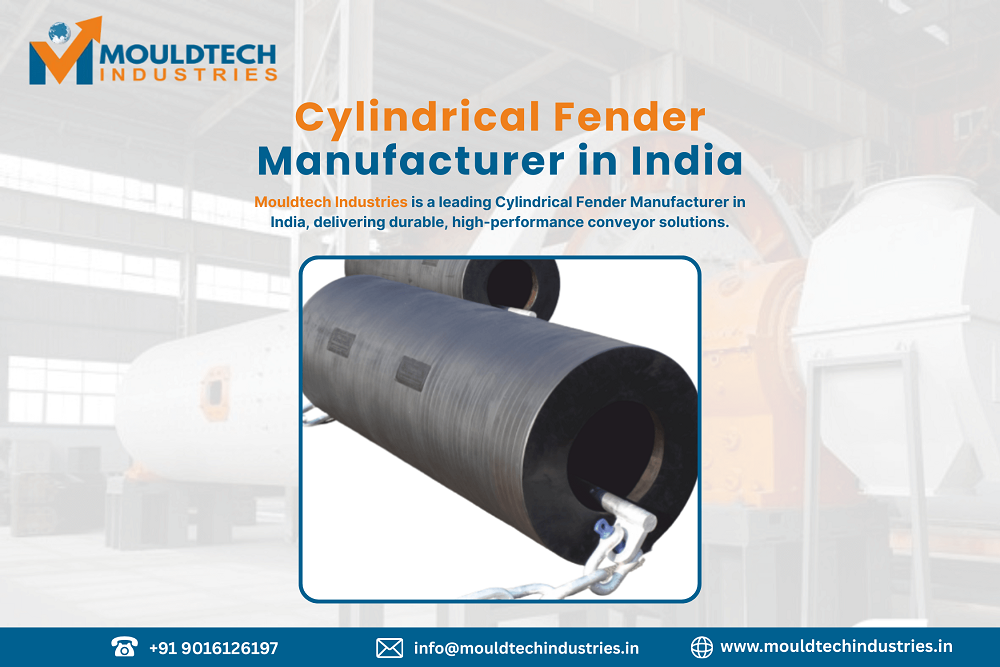
Mouldtech Industries: Expert Cylindrical Fender Solutions for Industrial Use
In heavy-duty industrial environments such as mining, metal and steel processing, cement production, ceramics manufacturing, and bulk material handling, equipment reliability and wear protection are critical to operational efficiency. Abrasive materials, impact forces, and continuous operation place tremendous stress on machinery, making durability a top priority. Equipment downtime, high maintenance costs, and reduced productivity are constant challenges for plant engineers. To address these issues, a trusted Cylindrical Fender Manufacturer in India provides robust, precision-engineered fender solutions that protect equipment, enhance operational lifespan, and ensure consistent performance in the harshest conditions.
To tackle these issues, components such as the Cylindrical Fender are of significant importance. Engineered to cushion impacts, withstand rubbing, and safeguard underlying frameworks, Cylindrical Fenders help keep conveyors, chutes, and material transfer points functioning smoothly. Makers with extensive background in the sector recognise that such answers not only prolong machinery lifespan but also cut down on unexpected halts, particularly in industrial centres across India—from mining areas in Jharkhand and Chhattisgarh to steel mills in Odisha, cement facilities in Rajasthan and Gujarat, and ceramic clusters in Tamil Nadu and West Bengal. Worldwide, areas involved in mining, metalwork, or bulk material handling also depend on sturdy fender systems to sustain plant output.
Industrial Hurdles Driving the Need for Cylindrical Fenders
Industrial processes face numerous difficulties that make wear defence systems essential:
- Abrasion: In mining and metal refining, materials like iron ore, coal, and broken rock are highly abrasive. Constant contact with conveyor belts, chutes, and linings can rapidly wear away metal surfaces, resulting in equipment deterioration. Cylindrical Fenders, crafted from specialized rubber or mixed rubber-ceramic compounds, lessen abrasive wear at key locations.
- Impact Forces: Heavy bulk materials often drop from heights or are discharged rapidly. This creates concentrated impact stress that can warp or break standard metal linings. Seasoned plant engineers frequently note that repeated impacts without proper fendering lead to frequent upkeep and potential safety risks. Cylindrical Fenders effectively absorb these impacts, spreading forces and shielding equipment.
- Corrosion: Metal parts are susceptible to dampness, chemicals, and acidic byproducts, especially in cement, chemical, or metal processing plants. Rubber-based fenders provide corrosion resistance while maintaining flexibility and impact resilience, thereby extending service life.
- Outages and Repair Expenses: Frequent liner swaps due to wearout increase downtime and operational costs. By strategically employing Cylindrical Fenders, facilities can reduce maintenance frequency and streamline production plans.
- Worldwide Industrial Settings: Across industrial zones in India, including Jharkhand, Chhattisgarh, Odisha, Karnataka, Gujarat, Rajasthan, Tamil Nadu, West Bengal, and Andhra Pradesh, mining and processing sites report similar problems. Internationally, bulk-handling setups in Australia, South Africa, Brazil, and the Middle East also rely on advanced fender solutions to maintain uninterrupted operations.
What Constitutes a Cylindrical Fender?
A Cylindrical Fender is a purpose-built protective element intended for high-impact and abrasive industrial uses. Typically made from wear-resistant rubber, sometimes bolstered with ceramic components, it provides a flexible cushion between moving parts and essential structural surfaces.
Unlike typical flat linings or rigid panels, the cylindrical form facilitates:
- Even impact dampening
- Lowered stress buildup on attachment points
- Effective redirection of materials
In mining and metal processing, Cylindrical Fenders are often fitted at conveyor discharge points, chutes, and feeder mechanisms to prevent early wear and lower operational hazards.
Uses Across Various Sectors
Mining: Cylindrical Fenders safeguard transfer points where ore, coal, or other extracted materials fall onto conveyors. In demanding settings, these fenders prevent structural damage and minimize unexpected shutdowns.
- Cement Plants: In cement production, raw materials such as limestone and clinker can quickly wear down chutes and hoppers. Cylindrical Fenders absorb impact and rubbing, ensuring smoother material transit and longer equipment life.
- Metal & Steel Plants: Steel and metal processing involve high-density, sharp-edged materials. Cylindrical Fenders lessen wear on conveyor setups, hoppers, and discharge chutes, protecting both machinery and workers.
- Ceramic Manufacturing: In ceramic facilities, abrasive powders and granular raw substances can erode standard liners. Fenders sustain fluid flow, minimize product impurities, and shorten maintenance cycles.
- Power Plants & Bulk Material Handling: Coal-fired power stations and large bulk handling sites experience heavy abrasion at feed inlets. Cylindrical Fenders help maintain operational dependability by reducing wear and preventing structural damage.
Material Science & Engineering Aspects
The effectiveness of Cylindrical Fenders hinges on material traits and engineering concepts:
- Rubber Qualities: Highly elastic rubber absorbs impact energy, lessens vibration, and offers chemical resistance in corrosive surroundings.
- Ceramic Toughness: In hybrid fenders, ceramic inserts resist wear, extending service life in high-wear areas.
- Wear Resistance Ideas: Materials are selected based on hardness, tensile strength, and elasticity to balance durability and suppleness.
- Impact Absorption: The cylindrical form spreads forces uniformly, preventing stress buildup and reducing structural fatigue.
Makers with a long-standing sector presence know that precise material selection is vital for effective wear defence.
Design & Tailoring Needs
Cylindrical Fenders are not one-size-fits-all. Key design elements to consider include:
- Equipment Suitability: Aligning fender dimensions and mounting connections with conveyors, chutes, and feeders guarantees operational dependability.
- Custom Sizing: Fenders are shaped to fit facility-specific measurements, material flow rates, and impact zones.
- Application-Specific Configuration: Some applications require reinforced cores, ceramic inlays, or composite rubber mixes to meet heavy-duty requirements.
Custom design ensures the fender integrates smoothly with existing gear, easing modification difficulties.
Production Quality & Process Oversight
Precise manufacturing is vital for uniformity and performance:
- Dimensional Precision: Cylindrical Fenders must adhere to tight limits to prevent inconsistent wear and mechanical strain.
- Material Evaluation: Rubber firmness, tensile strength, and impact resistance are confirmed under controlled settings.
- Batch Uniformity: Production methods are tracked to ensure consistent performance across multiple fender units.
These stages are crucial in heavy-duty industrial settings, where failure can lead to costly stoppages.
Mounting & Upkeep Points
Correct setup and care directly impact performance:
- Set up Simplicity: Cylindrical Fenders are designed for easy attachment and removal, minimizing production disruption.
- Reduced Outage Time: Fast replacement and modular design enable plant engineers to sustain continuous operations.
- Maintenance Intervals: Periodic inspection and cleaning help prevent material accumulation, ensuring fenders retain their impact-absorption and wear-resistance.
Knowledgeable plant engineers often observe that well-kept fenders can boost machinery life by several years.
Safety & Operational Dependability
Cylindrical Fenders contribute to a safer workplace and more reliable operations:
- Worker Safety: By limiting metal exposure and controlling material diversion, fenders lower accident risks.
- Equipment Shielding: Structural elements stay sound even under heavy material movement.
- Plant Dependability: Fewer unplanned halts mean steady output and productivity.
Cost Effectiveness Across Equipment Lifespan
While the initial outlay for premium Cylindrical Fenders is notable, the long-term operational gains are substantial:
- Long-Term Savings: Reduced wear, fewer replacements, and optimized maintenance schedules lower overall operational expenditures.
- Fewer Shutdowns: Less unplanned downtime improves production efficiency.
- Maintenance Streamlining: Predictable upkeep schedules simplify resource planning and spare parts management.
Export Preparedness & Global Acceptance
For industrial buyers in Australia, South Africa, Brazil, and the Middle East, Cylindrical Fenders must meet export criteria:
- Paperwork: Material attestations, test findings, and compliance papers are essential.
- Standards Awareness: Adherence to ISO and other industry-grade norms confirms reliability.
- Global Buyer Expectations: High-quality fenders satisfy performance needs in varied industrial settings.
Why Experienced Producers Count?
Manufacturers with deep sector insight provide superior fender solutions:
- Engineering Skill: Correct design, material choice, and setup guidance are informed by decades of hands-on background.
- Industry Background: Familiarity with mining, cement, metal, and ceramic processes ensures solutions meet real-world demands.
- Dependable Sourcing: Experienced makers deliver consistent quality, on-time delivery, and technical backing for industrial clientele.
About Mouldtech Industries
Mouldtech Industries is a trusted producer specializing in Ball Mill Rubber Liners, Ceramic Wear Defence Solutions, Rubber Lining Systems, Ball Mill Rubber Goods, and Conveyor Solutions. Serving industrial centres across India, including Jharkhand, Chhattisgarh, Odisha, Rajasthan, Gujarat, Tamil Nadu, West Bengal, and further afield, Mouldtech merges engineering talent with top-tier production methods. The firm also supports international industrial sectors, providing export-ready options for worldwide purchasers. Discover more at 👉 https://www.mouldtechindustries.in/.
Conclusion:
In heavy-duty industrial environments, wear protection and operational reliability are non-negotiable. The Cylindrical Fender is a vital component in mining, metal, cement, ceramic, and bulk material-handling operations. By absorbing impact, resisting abrasion, and reducing maintenance requirements, these solutions enhance plant efficiency and worker safety. Experienced manufacturers like Mouldtech Industries ensure that these solutions meet the demands of both Indian and international industrial markets.
Key Takeaways
- Cylindrical Fenders provide adequate wear protection in heavy-duty industrial environments.
- Enhance operational reliability and reduce unplanned downtime.
- Suitable for mining, cement, metal, ceramic, and bulk-material-handling industries.
- Material selection ensures long-term performance and impact resistance.
- Globally relevant for export-ready industrial solutions.
FAQS
1. What is the typical lifespan of a Cylindrical Fender?
- Lifespan depends on material composition, impact loads, and operational conditions. High-quality rubber and hybrid fenders typically last several years under continuous industrial use.
2. Are Cylindrical Fenders suitable for all bulk material handling applications?
- Yes, they are suitable for conveyors, chutes, hoppers, and transfer points handling abrasive or heavy materials.
3. How often should we maintain Cylindrical Fenders?
- Routine inspections every 3–6 months are recommended. Cleaning and checking for wear ensure optimal performance.
4. When should rubber be chosen over ceramic wear solutions?
- Rubber fenders are ideal for impact absorption and moderate abrasion. Ceramic inserts are preferred in high-abrasion zones requiring extreme wear resistance.
#BallMillRubberLiner #SecondaryBeltCleaner #RubberLining #MiningSolutions #BulkMaterialHandling #ConveyorSolutions #MouldtechIndustries #WearProtection #IndustrialManufacturing