

If you manage a grinding unit in a cement plant or supervise operations at a mineral processing facility, you already know the heavy cost of unscheduled mill downtime. Every hour a mill sits idle due to premature wear or unexpected liner failure directly impacts your monthly production targets. In heavy industries, optimizing mill performance is not just about throughput; it is about extending the lifespan of internal wear parts while safeguarding the outer steel shell. Replacing steel liners with high-grade elastomeric solutions fundamentally shifts how you manage maintenance shutdowns, offering up to 70% noise reduction and significantly longer liner life.
The best approach to wear protection starts with understanding the exact abrasive and impact forces inside your grinding cylinder. By utilizing properly formulated rubber matrices, plant heads can drastically reduce maintenance downtime. When evaluating ball mill rubber liner manufacturers near me, the focus must remain on the specific rubber compounding, the bonding strength of the vulcanization process, and the precision of the fit. Drawing from over 18 years of real shop-floor experience, this guide breaks down the operational realities of sourcing and installing advanced mill wear protection.
Why Choose Mouldtech Industries for Ball Mill Wear Parts Manufacturer?
Managing grinding circuits across diverse terrains—from the heavy mining belts near Hyderabad and Kolkata to cement hubs outside Jaipur and Ahmedabad—requires robust spares. When high-velocity steel balls crush raw materials, the internal lining absorbs massive kinetic energy. If the rubber compound lacks sufficient tensile strength or elasticity, it will tear, leading to slurry ingress and shell wash.
A seasoned maintenance head knows that off-the-shelf liners rarely fit the unique trajectory requirements of an older mill. Led by a highly experienced team of rubber technology and engineering professionals, Mouldtech Industries brings deep expertise in wear protection solutions. We have successfully delivered precision-engineered rubber liners and industrial rubber products to 200+ clients across the mining, cement, and heavy industry sectors since 2007.
To illustrate this, consider a recent mini client success story from a phosphate processing plant near Pune. They faced severe trunnion liner wear, causing monthly operational halts. By analyzing their mill RPM and media charge, we supplied a custom compound that improved their wear life by 40%, drastically reducing their annual maintenance budget. Finding reliable custom rubber liner India solutions requires this level of operational analysis rather than a generic catalogue approach.
Our Ball Mill Wear Parts Manufacturer Manufacturing Capabilities
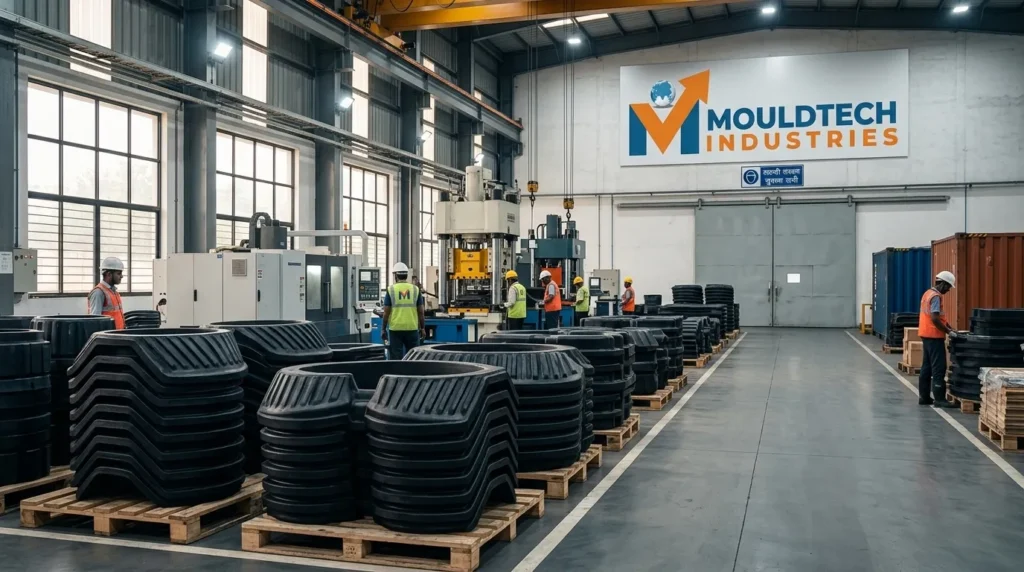
The foundation of extended equipment lifespan lies in advanced manufacturing infrastructure and precise material science. From our state-of-the-art facility located in Nayakpura Estate, Vadodara, Gujarat, we produce an extensive range of wear protection systems tailored to client specifications.
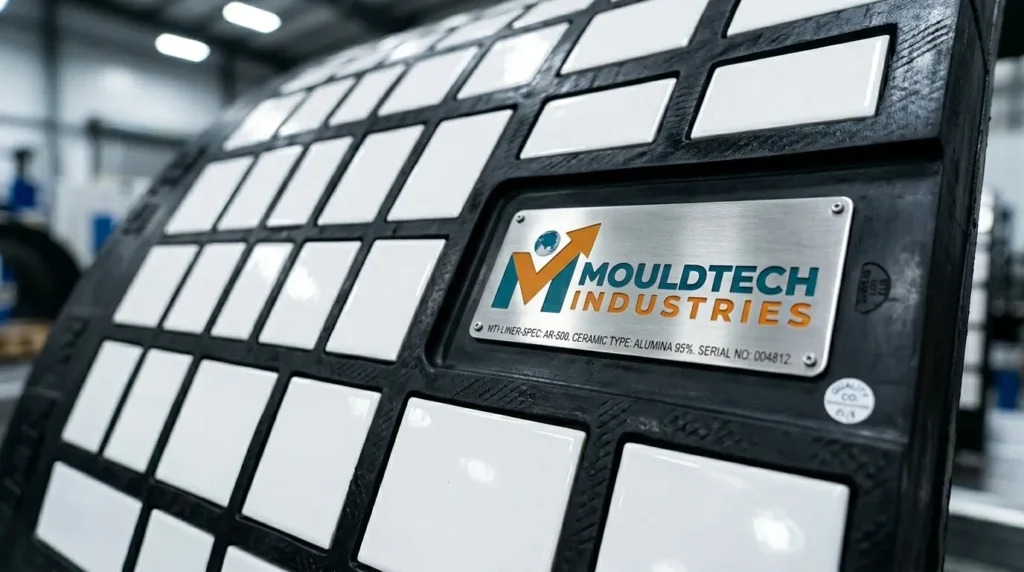
The core of our offering includes heavily reinforced custom ball mill rubber liners engineered for precise customization as per mill specifications. For environments facing extreme sliding abrasion alongside heavy impact, we manufacture specialized ceramic embedded rubber liner modules. These hybrid liners combine the unparalleled hardness of alumina ceramic with the shock-absorbing properties of specialized rubber, offering a dual-action defense mechanism for your grinding mills.
Get a Quote for Ball Mill Wear Parts Manufacturer
Beyond the grinding cylinder, bulk material handling systems demand equal attention. We produce industrial rubber products Vadodara industries rely on, including robust conveyor belt cleaners, heavy-duty rubber lagging sheets, and energy-absorbing impact pads. For plants in Chennai or Indore dealing with sticky materials or high-moisture slurries, our custom abrasion resistant liner designs ensure optimal material flow without clogging the discharge grates. Whether you need complete cement mill liners or targeted replacement parts, our pan-India supply network ensures timely delivery and seamless integration into your existing setups.
Navigating Quality Standards & ISO 9001:2015 Certification
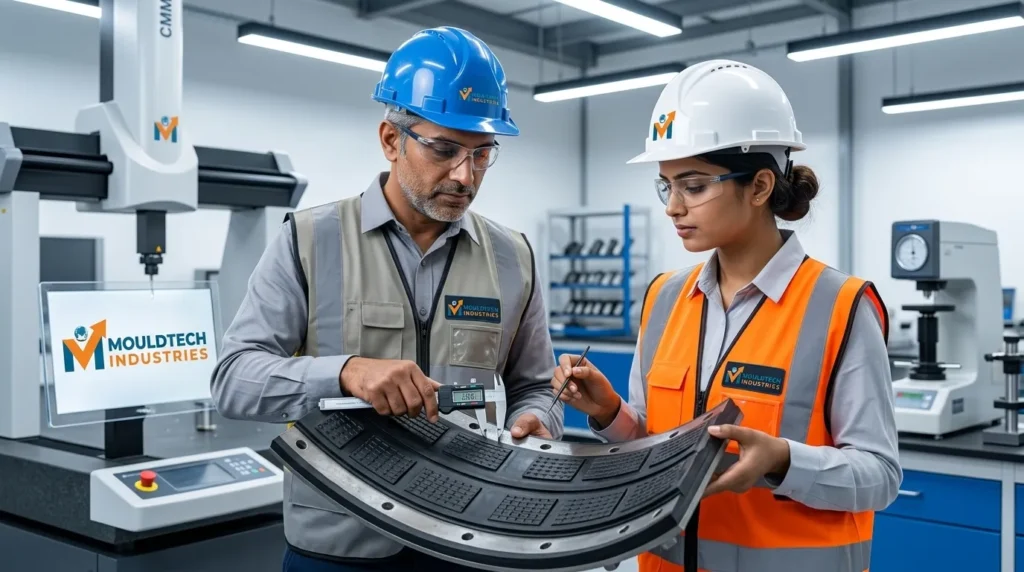
Consistent compounding and dimensional accuracy are critical when a liner needs to fit perfectly against the mill shell without gaps. We maintain strict adherence to globally recognized quality management protocols. As an ISO 9001:2015 Certified facility, every batch of our wear resistant rubber liner goes through rigorous laboratory testing.
Quality assurance begins at raw material procurement and continues through mixing, calendering, and curing. Our testing protocols measure tensile strength, elongation at break, specific gravity, and shore hardness, ensuring the final product matches the severe demands of mineral processing. External quality benchmarks guide our internal SOPs, ensuring that a liner shipped to Bangalore performs identically to one sent to Chandigarh. Plant managers can rely on these consistent, documented parameters when planning their preventative maintenance schedules.
Local Manufacturers vs Mouldtech Industries
When sourcing critical wear parts, procurement teams often weigh local neighborhood suppliers against established specialists. While local vendors might promise rapid turnaround, they frequently lack the compounding expertise required for high-impact ball mill environments.
Below is a technical comparison detailing why specialized engineering is vital for your mill’s integrity:
| Parameter | Typical Local Workshops | Mouldtech Industries Standard |
|---|---|---|
| Material Consistency | Variable compounding; high risk of premature failure. | Lab-tested compounds with precise specific gravity and tensile strength. |
| Customization | Off-the-shelf, standard sizing only. | Precise customization as per mill specifications and operational parameters. |
| Quality Checks | Visual inspection primarily. | Strict adherence to ISO 9001:2015 quality control parameters. |
| Production Capacity | Limited infrastructure, prone to delays. | Advanced manufacturing infrastructure capable of bulk, export-ready orders. |
| Technical Support | Minimal post-installation guidance. | Comprehensive engineering support from seasoned rubber technology experts. |
For heavy industries looking for reliable Ball Mill Rubber Liner Manufacturers, understanding these key differences prevents costly mid-cycle shutdowns.
Step-by-Step Process – How We Deliver Ball Mill Wear Parts Manufacturer
Replacing your mill liners is a strategic project that demands exact planning. Our delivery process has been refined over nearly two decades to ensure perfect fitment and zero on-site modifications.
First, our engineering team initiates a thorough technical consultation. We review your mill drawings, operating speed, media size, and the nature of the slurry. If you are operating out of Delhi or Mumbai, we often coordinate remote video diagnostics or send a field engineer to measure the internal shell mapping. Understanding your specific wear patterns allows us to adjust the lifter bar angles and shell plate thicknesses accurately.
Next comes the compounding and molding phase. Based on the data collected, we formulate the specific rubber matrix. The parts are subjected to high-pressure vulcanization to ensure maximum density and structural integrity.
Finally, every component undergoes a pre-dispatch assembly check at our facility in Vadodara. We physically lay out the lifter bars, shell plates, and head liners to verify dimensional tolerances. Once cleared, the materials are securely crated for safe transit, accompanied by detailed installation drawings and fastening hardware, ensuring your maintenance crew can complete the relining efficiently.
Real Client Case Study
A major iron ore beneficiation plant situated near Surat was struggling with frequent downtime in their primary grinding circuit. They were utilizing traditional steel liners that not only caused immense noise pollution but also resulted in structural fatigue on the mill trunnion due to excessive weight. Furthermore, the high abrasion of the iron ore slurry was wearing out the steel lifters within just five months, causing significant production bottlenecks.
The plant’s maintenance head reached out seeking a low maintenance rubber liners solution. After a comprehensive site visit, our technical team mapped the 3.2m x 4.5m ball mill. We identified that the impact zones required higher resilience, while the discharge end suffered from severe sliding abrasion. We designed a custom rubber lining system featuring optimized lifter bar profiles to enhance the grinding trajectory and reduce direct impact on the shell plates.
Upon installation, the results were highly measurable. The plant achieved an immediate drop in operational noise levels, improving the working environment for floor personnel. More importantly, the new rubber liners operated for 11 months before requiring selective replacement in the highest wear zones, effectively doubling their operational cycle. This specific case highlights why plant operators search for competent Rubber Liner Manufacturers in Vadodara to resolve complex, heavy-duty wear challenges.
Frequently Asked Questions (FAQs)
1. How long do custom rubber liners typically last in a ball mill?
- The lifespan varies significantly based on the material being ground, mill RPM, and ball charge. However, properly engineered rubber linings generally outlast standard steel liners by absorbing impact energy rather than resisting it rigidly, often providing 1.5 to 2 times the operational life.
2. Can rubber liners reduce the noise levels of grinding mills?
- Yes, switching to elastomeric wear parts typically results in up to 70% noise reduction. The rubber matrix dampens the acoustic energy generated by the tumbling steel balls and the grinding media, creating a significantly safer environment for plant operators.
3. Do you provide liners designed specifically for cement grinding?
- We manufacture highly specialized mining equipment rubber solutions and cement mill liners. These are custom-compounded to handle the specific abrasive nature of clinker and limestone, ensuring optimal grinding efficiency and extended wear life.
4. Are ceramic embedded rubber liners better than standard rubber?
- For specific high-wear zones where severe sliding abrasion is present alongside impact, ceramic embedded liners offer superior durability. The alumina ceramic inserts take the abrasive wear, while the rubber backing absorbs the mechanical shock.
5. What information is required to design a custom liner?
- To engineer a precise fit, we typically require your mill’s internal diameter, length, trunnion details, drilling patterns, operating RPM, max ball size, and the type of material being processed.
6. Is your manufacturing process certified?
- Yes, our facility and quality management systems are ISO 9001:2015 Certified. Every batch of rubber products undergoes strict laboratory testing to ensure consistent strength, abrasion resistance, and dimensional accuracy before dispatch.
7. Do you supply wear parts outside of Gujarat?
- We have a robust pan-India supply network and are completely export ready. We regularly ship heavy-duty custom liners, impact pads, and rubber lagging to industrial sites across the country, from major metros to remote mining operations.