

Filling Segment Manufacturer, Supplier, And Exporter in India: Mouldtech Industries
Mouldtech Industries is a Manufacturer of the Filling Segment in Ahmedabad.
Our Manufacturing Unit is in Vadodara, Gujarat, India.
Mouldtech Industries is a Manufacturer of Ball Mill Solutions, Ball Mill Rubber Lining, Wear Protection Line, Resistant Rubber Liner, Embedded Rubber Liners, Conveyors Solutions, Diamond Pulley Lagging, Belt Cleaners, Pulley Lagging, Ceramic Rubber Lagging Services, and Ceramic Rubber Lagging Sheet
Filling Segment: Engineering Durable Protection for Tough Industrial Applications
Introduction
Mining, cement production, metalworking, ceramics, and bulk material transport heavily stress manufacturing industries. Equipment endures constant abrasion from aggregates and processed materials, recurring shocks from milling components, exposure to corrosive fluids, and extended operation with minimal maintenance breaks. In these rigorous settings, these issues directly impact facility uptime, repair budgets, and worker safety.
The need for dependable wear-prevention solutions is increasing as facilities boost output and move toward nonstop operation methods. Seasoned facility engineers frequently observe that liner and wear part failures interconnect, causing lost output, unscheduled stops, and safety hazards during urgent repairs.
In this setting, the Filling Segment (often seen in Ball Mill Rubber Liner Filling Segment) is vital for maintaining liner condition, managing interior material movement within the mill, and shielding shell surfaces from rapid deterioration. While physically small, its role significantly influences liner lifespan, grinding effectiveness, and maintenance scheduling.
Key Industrial Problems Driving the Need for the Filling Segment
Mining and metal processing constantly subject milling and material transport systems to mechanical strain. Demand for the Filling Segment stems from several ongoing difficulties:
- Abrasion: Hard minerals, clinker, slag, and ceramic feedstocks cause steady surface wear on mill liners. Any gaps between liners become focal points for wear if not guarded by a correctly engineered Filling Segment.
- Shock Loads: Grinding media repeatedly strike liner exteriors. Even small gaps between liner plates act as stress multipliers under repeated impacts.
- Corrosion: Wet milling, process chemicals, and water introduce conditions that hasten liner breakdown at exposed seams.
- Outages: Unexpected liner failures lead to shutdowns. In high-volume plants, even brief pauses can result in substantial production losses.
- Repair Expenses: Frequent liner swaps increase labour exposure, crane utilization, and risk during inside-the-vessel maintenance tasks.
These issues are common globally, from primary mining operations in Australia and Chile to industrial hubs in India, Brazil, and South Africa.
Defining the Filling Segment
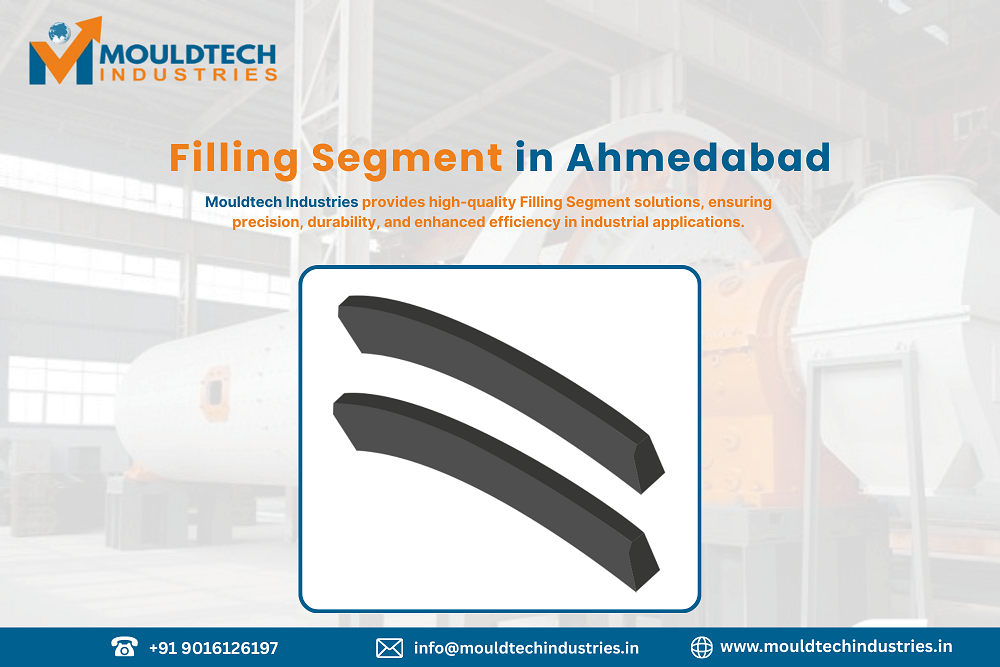
A Filling Segment is a shaped component, usually rubber or rubber-composite, fitted between the main plates of a ball mill liner. Its purpose is to close the spaces between liners, preventing ground material and fine particles from directly attacking the mill shell and liner edges.
From an engineering view, the Filling Segment serves three main functions:
- It maintains a uniform wear surface inside the mill.
- It lessens focused stress points at the liner joints.
- It promotes appropriate load transfer between adjoining liner sections.
Unlike the leading structural liners, Filling Segments are designed as sacrificial wear items. Their operational life is intended to align with or complement the liner replacement schedule, ensuring joint protection throughout service.
Applications Across Sectors
Filling segments are employed anywhere rotating mills or high-wear machinery operate in abrasive environments:
- Mining: Ball mills and SAG mills processing iron ore, copper, and gold ores depend on inserts to safeguard shell joints.
- Cement: Raw material and cement grinding mills experience constant rubbing from clinker and additives. Inserts minimize wear along liner edges.
- Metal & Steel: Slag grinding and mineral processing circuits utilize inserts to stabilize liner arrays.
- Ceramics: Mills grinding alumina and silica benefit from reduced contamination and more stable liner profiles.
- Power Plants: Mills handling coal and ash, and their conveyance systems, use wear liners and filler elements to manage abrasive fines.
- Bulk Material Transport: Rotary equipment in ports and processing hubs requires comparable joint protection concepts to govern wear patterns.
Material Science and Engineering Aspects
The choice of material dictates how a Filling Segment performs under cyclic impact and abrasion. Manufacturers with deep industry experience recognize that no single material can solve every wear challenge.
- Rubber Attributes: Highly resilient rubber absorbs impact energy, reducing stress on liner bolts and mill shells. Natural rubber mixes offer springiness, while synthetic compounds enhance resistance to oils and chemicals.
- Ceramic Hardness: In areas of intense abrasion, ceramic pieces may be integrated into rubber backing material. Ceramics deliver high hardness and resistance to sliding wear, while the rubber absorbs impact forces.
- Wear Resistance Principles: Deterioration is influenced by particle hardness, sliding speed, and contact pressure. Filling Segment must balance abrasion toughness with the flexibility needed to prevent premature cracking.
- Shock Dampening: Rubber-based inserts cushion shock loads, reducing microfractures at liner boundaries and improving overall liner stability.
Design and Customization Needs
Each mill possesses a distinct liner shape, bolt configuration, and shell dimensions. The Filling Segment must be precisely tailored to these specific requirements.
- Equipment Fit: Insert profiles must match the liner’s curve and thickness to prevent abrupt changes in level, which accelerate wear.
- Sizing Variation: Equipment in large mining sites varies considerably from that in smaller cement mills. Standardized sizes often require modification.
- Application-Specific Engineering: Wet milling, dry grinding, and high-temperature settings each impose different material demands.
Manufacturing Quality and Process Control
Uniform quality in wear components leads to predictable facility performance.
- Precision Production: Exact moulding ensures consistent dimensions across production batches.
- Condition Checks: Hardness testing, verification of bond strength in ceramic-rubber composites, and visual inspection eliminate premature part failure.
- Batch Uniformity: Process oversight during mixing and curing guarantees repeatable wear characteristics across production lots.
Fitting and Servicing Considerations
Maintenance teams favour components that minimize installation time and associated risk.
- Ease of Fitting: Well-designed Filling Segment aligns without needing excessive cutting or forced positioning.
- Shorter Outages: Quicker liner replacement reduces the duration of necessary shutdowns.
- Service Intervals: Filling segments are typically replaced during scheduled liner maintenance, simplifying spare parts logistics.
Safety and Operational Dependability
Personnel well-being is directly tied to machinery dependability. Inadequately secured or prematurely failing filling pieces expose sharp edges on liners and heighten the danger of liner shifting.
- Personnel safety: Secure liner setups prevent unexpected liner movement during use and servicing.
- Machinery safeguarding: Constant wear surfaces shield mill casings from direct scraping.
- Facility uptime: Fewer liner malfunctions lead to forecastable service schedules and steady output.
Cost-Effectiveness Throughout Equipment Lifespan
The total cost across its lifespan is determined by how long the wear material lasts, how often upkeep is needed, and the amount of stoppage time. Filling pieces aid cost efficiency by:
- Prolonging the liner utility via joint shielding
- Minimizing unforeseen stoppages
- Enhancing service planning and workforce deployment
The advantages are realized over several maintenance repetitions rather than as a brief, immediate gain.
Export Preparedness and International Acknowledgment
Industrial purchasers in worldwide markets anticipate:
- Thorough technical records
- Source verification for materials
- Knowledge of global norms and safety protocols
- Reliable provision and packaging appropriate for long-haul transit
Export readiness reflects not only product quality but also the maturity of manufacturing and documentation processes.
The Value of Seasoned Producers
Producers with extensive backgrounds in the sector grasp how filling segments interact with liner assemblies, grinding media, and mill mechanics. Engineering insights from active facilities drive gradual improvements in design, material choice, and quality checks. Dependable supply chains and technical backing are equally vital for significant industrial endeavours and ongoing service agreements.
Introducing Mouldtech Industries
Mouldtech Industries is a seasoned manufacturer of wear defence and lining solutions catering to industrial sites across all of India, encompassing mining areas in Odisha and Jharkhand, steel centers in Maharashtra and Chhattisgarh, cement corridors in Rajasthan, Gujarat, Andhra Pradesh, Telangana, Tamil Nadu, Karnataka, and industrial sectors in Uttar Pradesh, West Bengal, and Madhya Pradesh.
The firm supports both domestic and international ventures in the mining, cement, metal refining, ceramics, and bulk material handling industries. Further details are available at 👉 https://www.mouldtechindustries.in/
Summary
Filling segments might seem like a minor element in a ball mill’s lining setup, yet their role in protecting liner connections, stabilizing wear patterns, and ensuring safe operation is crucial. In mining and metal processing activities, consistent wear defence directly boosts facility availability and predictable service intervals.
For facility specialists and maintenance squads, selecting well-designed filling pieces is part of a broader strategy to boost equipment reliability and overall lifespan. Careful design, material selection, and manufacturing excellence remain the cornerstones of enduring operational efficiency.
Principal Conclusions
- Filling segments shield liner joints against friction and impact
- They enhance operational dependability in continuous grinding processes
- Appropriate for mining, cement, metal, ceramic, and power sectors
- Contribute to long-term equipment lifespan performance
- Relevant for worldwide industrial settings and globally focused plants
Current Frequently Asked Questions
Q1. What is the typical lifespan of a filling segment?
Service duration relies on ore hardness, mill rotation speed, and operating conditions. In most facilities, filling segments are swapped out during scheduled liner servicing intervals.
Q2. Are filling segments suitable for mills using either wet or dry grinding methods?
Affirmative. Material composition and bonding systems differ between wet and dry conditions, but the core purpose remains the same.
Q3. How often should filling segments be examined?
They are generally inspected during planned mill shutdowns and assessments of liner condition.
Q4. How do purely rubber-filled segments compare to those combining ceramics and rubber?
Rubber-only pieces offer superior shock absorption, whereas ceramic-rubber variants provide greater wear resistance in heavily used areas.
Q5. Are filling segments utilized worldwide in major mining operations?
Indeed. Large-scale mills in Australia, Chile, and South Africa employ joint protection concepts comparable to those in facilities in India and Brazil.
For technical support and reliable Filling Segment solutions, contact Mouldtech Industries to discuss plant-specific requirements and long-term wear protection needs.
#FillingSegment #BallMillRubberLiner #CeramicWearProtection #RubberLiningSystems #MiningWearParts #IndustrialWearProtection #BulkMaterialHandling #ConveyorSolutions #MouldtechIndustries