
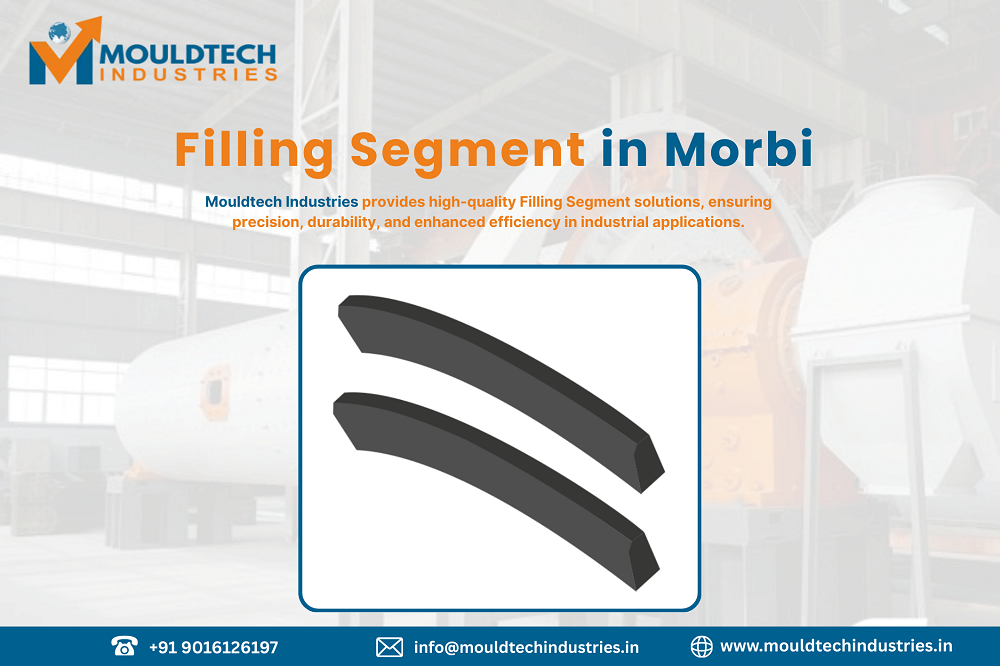
Filling Segment Manufacturer, Supplier, And Exporter in India: Mouldtech Industries
Mouldtech Industries is a Manufacturer of Filling Segment in Morbi.
Our Manufacturing Unit is in Vadodara, Gujarat, India.
Mouldtech Industries is a Manufacturer of Bridge Rubber Pad, Ball Mill Rubber Lining, Bridge Rubber Pad, Resistant Rubber Liner, Embedded Rubber Liners, Conveyors Solutions, Ceramic Lagging Sheet, Belt Cleaners, Bridge Rubber Pad, Ceramic Rubber Lagging Services, and Ceramic Rubber Lagging Sheet.
Filling Segment: A Key Wear Defense Element for Rigorous Industrial Work
Introduction
In sectors like mining, metal processing, cement making, ceramics, and handling large volumes of material, a persistent issue is managing wear while keeping operations dependable. Machinery facing constant rubbing, heavy blows, dampness, and chemical contact will inevitably deteriorate. When wear defense setups break down too soon, facilities face unexpected stoppages, safety hazards, and increasing upkeep expenses.
In tough industrial settings, the focus has slowly moved from fixing things when they break to designing wear protection that makes equipment last longer and production steadier. Around the world, industries require parts that not only resist wear but also fit with current upkeep methods and safety rules.
Seen through this lens, the Gap Filler has become an important industrial answer. Used as part of wear defense systems in mills, chutes, transfer points, and lining setups, gap fillers significantly safeguard equipment surfaces, smooth out material movement, and keep structural soundness under rough conditions.
Industry Problems Driving Gap Filler Need
Industrial activities across India—from major mining belts to cement centers and steel zones—deal with similar operational strains:
- Rubbing: Constant contact with ores, clinker, aggregates, coal, and ceramic substances leads to gradual surface erosion. Fast-moving particle streams speed up wear in equipment areas that are exposed.
- Impact Forces: Drop areas, mill interiors, and chute junctions take repeated hits from large chunks of material. Poor management of these impacts causes liner cracks, fastener failures, and structural stress.
- Rusting: Dampness, slurry exposure, and chemical surroundings create corrosive conditions that weaken metal surfaces and fasteners over time.
- Stoppages: Unforeseen shutdowns due to liner failure disrupt output schedules and cause delays in connected processes.
- Upkeep Expense: Frequent liner swaps increase reliance on labor, spare part inventory needs, and total system costs.
In mining and metal processing sites across India’s industrial centers—like Odisha, Chhattisgarh, Jharkhand, Rajasthan, Maharashtra, Karnataka, Gujarat, Tamil Nadu, Telangana, Andhra Pradesh, and West Bengal—engineers increasingly count on designed gap fillers to stabilize liner setups and lessen wear gaps.
What is a Filling Segment?
A Filling Segment is a precisely made component for wear defense intended to fill spaces, transitions, or openings within lining arrangements. It ensures even surface protection, controlled material flow, and consistent load spreading.
Instead of being a main liner, the gap filler supports the whole wear system by:
- Removing still areas where material can build up
- Stopping impacts from focusing on small spots
- Keeping surfaces smooth between liner pieces
Gap fillers are typically made from rubber, rubber with ceramic inserts, or blended composite materials, depending on how severe the use is. Their role is structural and defensive—not just for looks—and how well they work relies entirely on the material chosen, how accurate the size is, and how well they are installed.
Uses Across Sectors
- Mining Sector: Used in ball mills, chute junctions, hopper sides, and transfer points to help line continuity and slow down wear in specific areas.
- Cement Factories: Applied in clinker handling systems, raw mills, and material feeding zones where impact and rubbing happen together.
- Metal & Steel Plants: Put in place at sinter plants, blast furnace material handling spots, and ore transfer lines to handle heavy impact forces.
- Ceramic Production: Used in slurry handling, grinding units, and tile processing zones where fine rubbing is the main issue.
- Power Plants: Installed in coal handling facilities, storage bins, and ash handling systems to lessen erosion.
- Bulk Material Handling: Used in conveyors, chutes, and loading docks to stabilize liner assemblies and improve flow control.
Seasoned plant experts often note that well-conceived gap fillers significantly reduce damage along liner edges and premature failures.
Material Science & Engineering Aspects
From an engineering standpoint, how well a gap filler performs depends on how the material reacts to combined stresses:
Rubber Traits
- High bounce for absorbing impacts
- Ability to return to shape to spread out energy
- Resistance to breaks from repeated stress
Ceramic Hardness
- Very high resistance to rubbing wear
- Low wear rate when sliding against surfaces
- Great for wear caused by small particles
Wear Resistance Concepts
Resistance to rubbing comes from being hard, while impact resistance relies on being flexible. Gap fillers often combine both ideas through composite construction.
Impact Dampening
Designs with rubber supporting ceramic or reinforced rubber help soak up impact energy while shielding ceramic surfaces from cracking.
Producers with long experience in the field know that balancing materials—not just using the hardest one—is vital for steady performance.
Design & Customization Needs
No two facilities operate under exactly the same conditions. Gap fillers must be engineered based on:
- Equipment shape
- How well they fit with the liner interface
- The direction material moves
- How intense the impact is
Custom sizing ensures a snug fit, preventing tiny movements that cause early wear. Designs specific to the job improve system stability and cut down on how often maintenance is needed.
Manufacturing Quality & Process Checks
Accurate manufacturing is crucial for gap filler performance. Key process checks include:
- Verifying the exactness of dimensions
- Ensuring consistent rubber mixtures
- Testing the strength of the ceramic bond
- Inspection of quality for each production run
Regular manufacturing leads to expected performance across different setups and reduces unpredictability when planning upkeep.
Fitting & Upkeep Notes
Well-designed gap fillers make fitting easier by:
- Making alignment less complicated
- Aiding in swapping out modular liners
- Minimizing the need for welding tasks
Less time spent installing directly results in less shutdown time. Maintenance schedules become predictable, allowing for planned stoppages instead of urgent fixes.
Safety & Operational Dependability
Safety is a top priority in major industrial plants. Gap fillers help by:
- Lowering the chance of liners coming loose
- Improving structural steadiness
- Reducing the time maintenance staff must spend in hazardous areas
Stable wear systems boost overall plant reliability and lower operational risks.
Cost Efficiency Over Equipment Life Cycle
While initial component selection is important, long-term performance determines true cost efficiency:
- Fewer shutdowns
- Extended liner service intervals
- Reduced emergency maintenance
Lifecycle optimization—not upfront cost—defines sustainable plant economics.
Export Readiness & Global Acceptance
Global industrial buyers expect:
- Dimensional consistency
- Documented quality systems
- Material traceability
- Packaging suited for export logistics
Filling segments designed with international standards awareness meet requirements across mining hubs and industrial clusters worldwide.
Why Experienced Manufacturers Matter
Manufacturers with practical exposure across mining, cement, steel, and ceramic industries bring:
- Application-specific engineering insight
- Reliable supply continuity
- Proven material formulations
Such experience directly impacts plant performance and maintenance predictability.
About Mouldtech Industries
Mouldtech Industries is an experienced manufacturer specializing in ball mill rubber liners, ceramic wear protection solutions, rubber lining systems, ball mill rubber products, and conveyor solutions. Serving industrial customers across Pan India and global markets, the company focuses on engineered wear protection designed for real plant conditions.
More details are available at https://www.mouldtechindustries.in/
Conclusion
Filling segments play a critical role in maintaining wear system integrity across heavy-duty industrial operations. When designed and manufactured with engineering discipline, they contribute to improved equipment protection, safer operations, and optimized maintenance cycles.
For plant engineers and operations teams, selecting the right filling segment is not a component decision—it is a system reliability decision.
Key Takeaways
- Filling segments support wear system continuity
- They reduce localized abrasion and impact damage
- Applicable across mining, cement, steel, ceramic, and power sectors
- Improve operational reliability and maintenance planning
- Deliver long-term performance benefits in industrial environments
Trending FAQs
1. What is the typical lifespan of a filling segment?
Lifespan depends on material selection, impact severity, and operating conditions. Properly engineered segments last in line with primary liners.
2. Are filling segments suitable for high-impact zones?
Yes, when designed with appropriate rubber resilience and structural support.
3. How often do filling segments require maintenance?
They are typically inspected during scheduled liner maintenance cycles.
4. Rubber vs ceramic filling segments—what’s the difference?
Rubber offers impact absorption, while ceramic provides superior abrasion resistance. Hybrid designs balance both.
5. Are filling segments used globally?
Yes, they are widely used in mining, cement, and bulk handling industries worldwide.
For inquiries about Ball Mill Rubber Liners, contact Mouldtech Industries today. Our expert team provides solutions for mining, cement, metal, ceramic, and bulk material handling industries.
#BallMillRubberLiner #CeramicWearProtection #RubberLiningSystems #BallMillRubberProducts #ConveyorSolutions #IndustrialWearProtection #MiningEquipment #CementPlantSolutions #MetalProcessingEquipment #BulkMaterialHandling #MouldtechIndustries