

Rubber Plugs in Industrial Equipment: Why the Right Sealing Solution Matters More Than You Think
Introduction
In heavy-duty industrial environments: whether you operate a ball mill in a copper beneficiation plant, manage slurry transport lines in a cement facility, or maintain bulk handling equipment at a thermal power station: small components often carry disproportionate responsibility. Rubber plugs are one such component.
They don’t make headlines. But when a rubber plug fails mid-campaign, the consequences are immediate. Slurry leakage, mill contamination, and unplanned downtime follow quickly. Across India’s mining corridors in Odisha and Jharkhand, the steel belt in Chhattisgarh and Karnataka, the ceramic clusters of Morbi in Gujarat, and the cement hubs of Rajasthan and Andhra Pradesh, plant engineers understand this reality well.
This blog addresses rubber plugs as a functional industrial component. What they do, where plants use them, what drives their performance, and what procurement teams should evaluate before specifying them.
Industrial Challenges That Drive Demand for Rubber Plugs
Across process industries, rubber plugs serve as sealing, blanking, and protection elements in equipment like ball mills, rod mills, pipe systems, and bulk handling machinery. The environments they operate in are punishing.
Abrasion is a constant adversary. In grinding mills and ore processing circuits, plugs face slurry, fine grit, and mineral particles continuously. Any plug material with inadequate abrasion resistance degrades quickly. This allows leakage at liner bolt holes, drain ports, or inspection openings.
Impact loads in ball mills are significant. The cascading and cataracting action of grinding media exerts repeated shock on mill internals. A plug that cannot absorb and distribute impact energy will crack, deform, or displace.
Corrosion compounds the problem. Slurries in mining and metal processing are often chemically aggressive: low pH in copper and gold circuits, alkali conditions in alumina plants. Correctly compounded rubber plugs offer chemical resistance that metallic alternatives cannot match.
Downtime costs are rarely small. In a cement plant running three shifts, every unplanned stoppage carries real cost: labour, lost throughput, and product loss. Experienced maintenance teams in plants across Maharashtra, Tamil Nadu, and West Bengal treat plug selection as a reliability decision, not just a procurement task.
What Is a Rubber Plug?
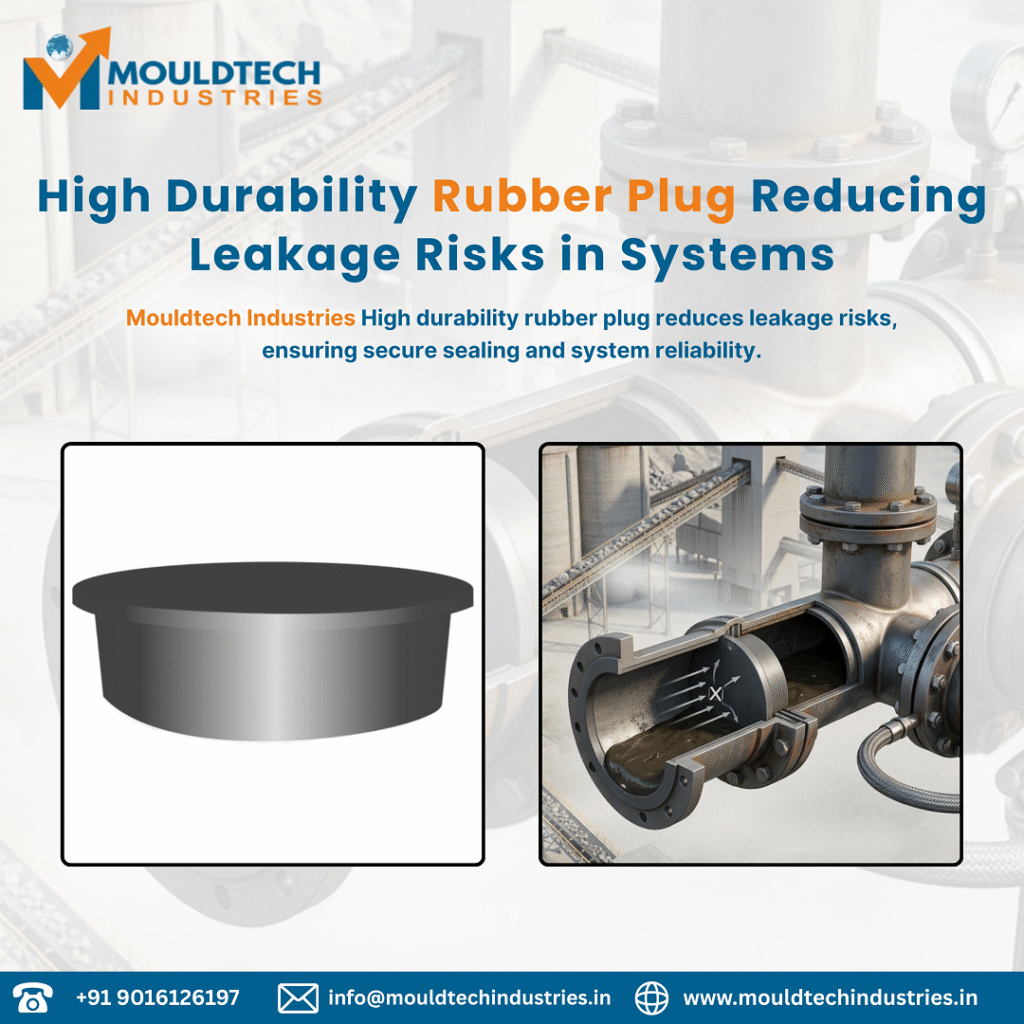
In the industrial context, a rubber plug is a precision-moulded elastomeric component. It seals, blanks off, or protects openings in equipment such as ball mill shells, pipe flanges, liner bolt holes, and machinery housings.
Unlike a generic hardware-store stopper, an industrial rubber plug meets specific dimensional tolerances. Manufacturers compound it for the target service environment and design it to seat securely under operational pressures and vibrations.
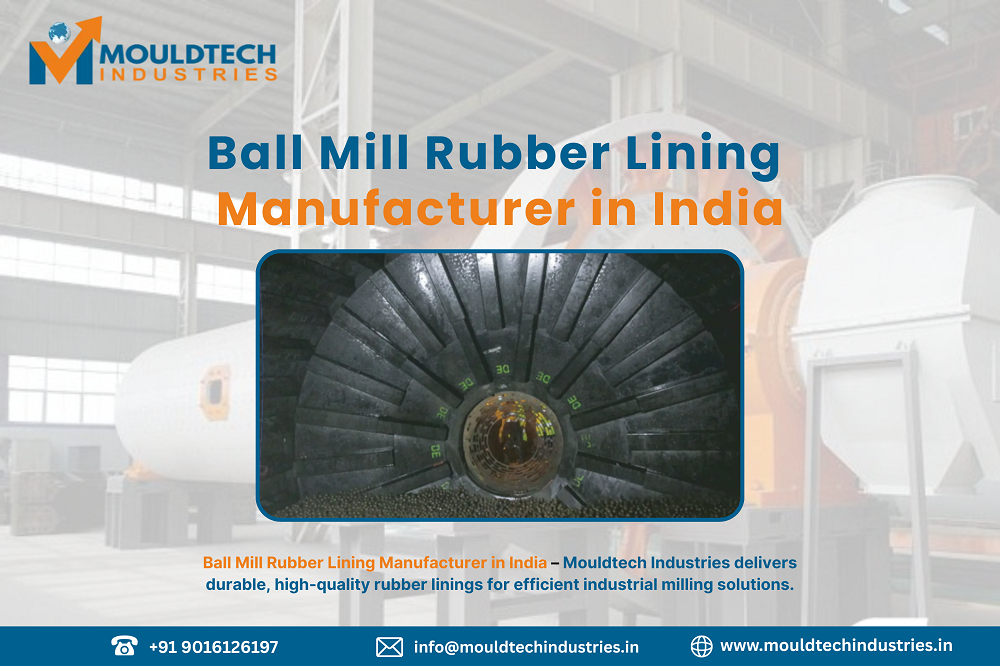
In ball mill applications, rubber plugs sit at liner bolt holes: the openings where liner fixing bolts pass through the shell. Once bolts are in place, the plugs protect bolt heads from grinding media impact and slurry ingress. This reduces corrosion and simplifies future liner changeouts.
Plants also use them in pipe blanking (temporary isolation during maintenance), equipment transport (protecting machined surfaces and ports), and occasionally as vibration-dampening inserts in structural assemblies.
Applications Across Industries
Mining is the most demanding application environment. Ball mills in copper, iron ore, gold, and zinc processing rely on rubber plugs at liner bolt positions. Plants in Rajasthan’s zinc belt (Zawar, Rampura Agucha), Odisha’s iron ore region, and Jharkhand’s coal preparation facilities use these plugs as part of their mill lining systems.
Cement Plants use rubber plugs in mill internals and pipe maintenance applications. Large plants across Madhya Pradesh, Gujarat, and Andhra Pradesh run continuous schedules. Component reliability is therefore critical.
Metal & Steel Plants operating rod mills, tumbling mills, and wet grinding circuits in Karnataka (Bellary-Hospet), West Bengal (Durgapur), and Odisha need plugs that resist both impact and chemical attack from process water.
Ceramic Manufacturers, especially in the Morbi cluster of Gujarat and Khurja in Uttar Pradesh, use ball mills for body and glaze grinding. Here, contamination prevention matters as much as wear performance. Plug materials must stay non-reactive with ceramic slurries.
Power Plants operating ash handling and coal grinding systems use rubber plugs for blanking and sealing during planned outages.
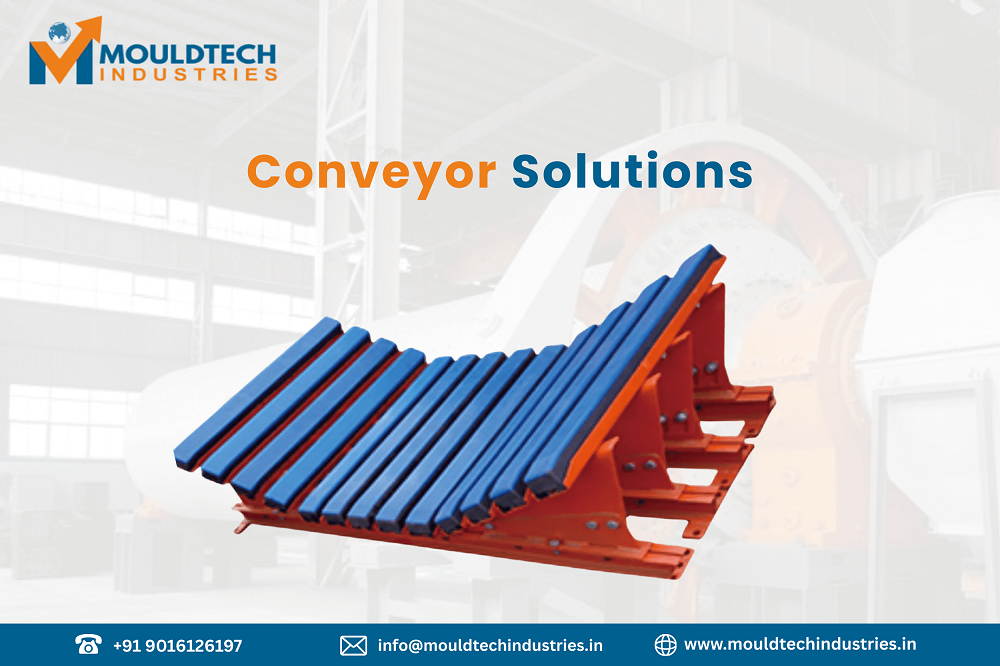
Bulk Material Handling operations use rubber plugs in conveyor system maintenance, equipment storage protection, and transfer chute blanking.
Material Science & Engineering Considerations
The performance of a rubber plug depends almost entirely on its compound formulation and vulcanisation quality: not just its shape.
Natural Rubber (NR) delivers excellent resilience and impact absorption. This makes it suitable for ball mill applications with high dynamic loading. Its weakness lies in highly oxidising or ozone-heavy environments.
Nitrile Rubber (NBR) suits environments with oil or hydrocarbon contamination: relevant in some mineral processing and metal working settings.
Neoprene (CR) balances weathering resistance, moderate chemical resistance, and mechanical strength. Plants often choose it for outdoor bulk handling and marine-adjacent applications.
EPDM performs well where steam, hot water, or alkali slurries are present: relevant in cement grinding at elevated process temperatures.
Hardness (Shore A) is a critical specification. A plug too soft deforms under mill operating pressures and loses its seat. Too hard, and it loses the sealing compliance needed to conform to machined surfaces. Most mill liner bolt plugs fall in the 50–70 Shore A range. Actual requirements depend on the application and mating surface condition.
Design & Customization Requirements
No two mill installations share identical dimensions. Liner bolt hole diameters, depths, shell curvature, and surface finish vary between equipment makes and models. Manufacturers must design a rubber plug to the actual equipment drawing: not adapt it from a close-but-not-quite standard size.
Key design parameters include:
- Outer diameter and taper profile: ensures correct seating without excessive force or gaps
- Flange or cap geometry: allows tool-assisted removal without damaging the plug or mill shell
- Material selection per process conditions: pH, temperature, slurry abrasivity, and media type all drive compound choice
- Batch compatibility: plants standardising across multiple mills need batch-to-batch dimensional consistency
Manufacturers with long-term industry exposure know that customisation is the norm here: not the exception. A manufacturer offering only off-the-shelf sizes cannot serve serious industrial clients well.
For deeper insights into SEO performance and keyword strategies, you can explore tools and resources available on Ahrefs.
Manufacturing Quality & Process Control
The quality of a rubber plug lives in the manufacturing process: not the finished appearance. Mould accuracy, compound mixing consistency, cure time and temperature precision, and dimensional inspection rigour all determine final performance.
Critical quality checkpoints include:
- Dimensional inspection against drawing tolerances
- Hardness testing per batch
- Visual inspection for voids, flash, or surface defects
- Compression set testing for plugs under sustained loading
Plants in ceramics and cement, where contamination is a real concern, may also require compound certification confirming the absence of specific elements.
Installation & Maintenance Considerations
Well-designed rubber plugs offer straightforward installation. In ball mill liner installations: already a labour-intensive, time-constrained activity: plugs that seat with hand pressure or light mallet taps save installation time. They also reduce damage risk during fitting.
Removal matters equally. Plugs with recessed extraction features or moulded grip geometry allow maintenance crews to pull them cleanly during liner changeouts. This avoids improvised methods that can damage the shell surface or leave plug fragments inside the mill.
Replacement intervals depend on service conditions. In abrasive slurry environments, inspect plugs at every major maintenance stop. In less aggressive applications: dry grinding, for instance: intervals can be considerably longer.
Safety & Operational Reliability
Plug failure in a ball mill is not merely an inconvenience. Slurry leakage through liner bolt holes reaches the mill trunnion area and accelerates corrosion of structural components. In extreme cases, sustained leakage compromises the structural integrity of the mill shell lining system. On mill access platforms, slurry creates slip hazards for maintenance workers.
Correct rubber plug specification and regular inspection belong in every responsible mill maintenance programme: not as an afterthought.
Cost Efficiency Over Equipment Life Cycle
The cost of a rubber plug is trivial compared to the cost of unplanned downtime in a grinding circuit. A single unscheduled mill stop for leaking bolt hole repair can cost multiples of what a full set of quality plugs costs across the entire liner campaign.
The economic argument is straightforward. Quality plugs deliver longer service life between replacements, lower risk of secondary damage (shell corrosion, bearing contamination), and faster, cleaner liner changeouts. Together, these drive down total maintenance cost per tonne of production.
To enhance your digital marketing and SEO strategies, explore expert insights and tools available on Neil Patel.
Export Readiness & Global Acceptance
Indian manufacturers supplying rubber mill components to export markets: Southeast Asia, Africa, the Middle East: face growing scrutiny. Buyers in established mining markets expect material test certificates, dimensional inspection reports, and clear compound specifications.
Manufacturers who treat documentation as an administrative burden will struggle to retain international clients. Those who embed it into their standard process meet export requirements naturally: without special effort.
Why Experienced Manufacturers Matter
In industrial rubber components, manufacturing experience translates directly to application understanding. An experienced manufacturer knows that a plug designed for a dry limestone grinding mill will not perform the same way in a wet copper ore circuit. They raise this with the client proactively. They maintain material records, know which compounds perform in which service environments, and advise on installation methods from field feedback.
No catalogue can replicate this depth of application knowledge. Read more on our Rubber Plug Manufacturer in Ahmedabad page to understand regional supply capabilities.
About Mouldtech Industries
Mouldtech Industries is an experienced industrial manufacturer based in India. They serve mining, cement, ceramic, metal processing, and bulk material handling sectors across the country: from Gujarat and Rajasthan to Odisha, Jharkhand, Maharashtra, Tamil Nadu, Karnataka, West Bengal, Andhra Pradesh, Telangana, Madhya Pradesh, and beyond.
Their product range includes ball mill rubber liners, ceramic wear protection solutions, rubber lining systems, conveyor solutions, and associated rubber mill products. All products carry application-specific engineering input and quality control processes suited to serious industrial procurement requirements.
For enquiries and technical support: 👉 Contact Mouldtech Industries
Conclusion
Rubber plugs occupy a small physical space in a ball mill: but they carry real operational significance. Specify them correctly, manufacture them to proper dimensional and material standards, and install them with attention to seating and retention. They then contribute meaningfully to mill reliability, maintenance efficiency, and equipment protection across the liner campaign life.
For plant engineers and procurement teams evaluating suppliers, the right question is not just “does this plug fit?” Ask instead: “Is this plug compounded for my service conditions? Is it dimensionally consistent across batches? Does the manufacturer understand how it will be used?”
If you source rubber plugs or any associated wear protection components, engage manufacturers who answer those questions with engineering specifics: not catalogue numbers. Get in touch with our team today.
Key Takeaways
- Rubber plugs in ball mills protect liner bolt holes from slurry ingress, impact damage, and corrosion
- Compound selection (Natural Rubber, NBR, EPDM, Neoprene) must match actual service conditions: pH, temperature, abrasivity
- Hardness specification (Shore A) drives seating performance and sealing reliability
- Custom dimensions are standard in serious industrial applications: off-the-shelf sizing rarely fits precisely
- Quality manufacturing demands process control at compounding, curing, and dimensional inspection stages
- Correct plug specification reduces downtime, speeds up liner changeouts, and lowers total maintenance cost
- Export-grade supply requires material traceability and dimensional documentation as standard
- Experienced manufacturers bring application knowledge that generic suppliers cannot replicate
Trending FAQs
Q1: How long do rubber plugs typically last in a ball mill application?
- Service life depends on slurry abrasivity, mill speed, and compound selection. In aggressive wet grinding circuits, teams inspect plugs at each scheduled liner maintenance stop: typically every 6–12 months. In less abrasive dry grinding applications, intervals run longer. No universal lifespan figure exists. Evaluate it per service condition.
Q2: Are rubber plugs suitable for all types of grinding mills?
- Rubber plugs work best in ball mills, rod mills, and SAG mills with bolt-fixed liner systems and accessible bolt holes. Suitability in any specific installation depends on bolt hole geometry, operating pressure conditions, and slurry chemistry. Always have the manufacturer review the equipment drawing before confirming plug design.
Q3: When should I choose rubber plugs over ceramic or metallic alternatives?
- Choose rubber plugs where impact absorption and sealing compliance are the primary needs: which covers most ball mill liner bolt applications. Ceramic solutions suit high-abrasion surface lining (chute lining, pipe lining) where hardness drives protection. Metallic plugs offer no impact absorption and corrode quickly in slurry environments.
Q4: Are custom-sized rubber plugs readily available from Indian manufacturers?
- Yes. Manufacturers with mould-making capabilities produce custom rubber plugs to client drawings within 2–4 weeks for initial samples: faster for repeat orders. Mouldtech Industries offers application-specific custom rubber plug solutions from their Vadodara facility, serving plants across India. Provide bolt hole dimensional drawings and service condition details when placing requests.
Q5: What information should I provide when sourcing rubber plugs for a ball mill?
- Share at minimum: liner bolt hole diameter and depth, mill shell material, operating conditions (wet/dry, slurry pH and temperature), grinding media type and size, and previous plug performance history. Specific application data helps the manufacturer recommend the right compound and geometry. Mouldtech Industries offers application-level technical consultation before order confirmation: contact their team directly for guidance.
#BallMillRubberLiner #RubberPlugs #CeramicWearProtection #RubberLining #MiningSolutions #BulkMaterialHandling #ConveyorSolutions #MouldtechIndustries #WearProtection #IndustrialManufacturing #MillMaintenance #MiningIndia #CementIndustry #CeramicIndustry #PlantEngineering