

Combo Liner Manufacturer, Supplier, And Exporter in India: Mouldtech Industries
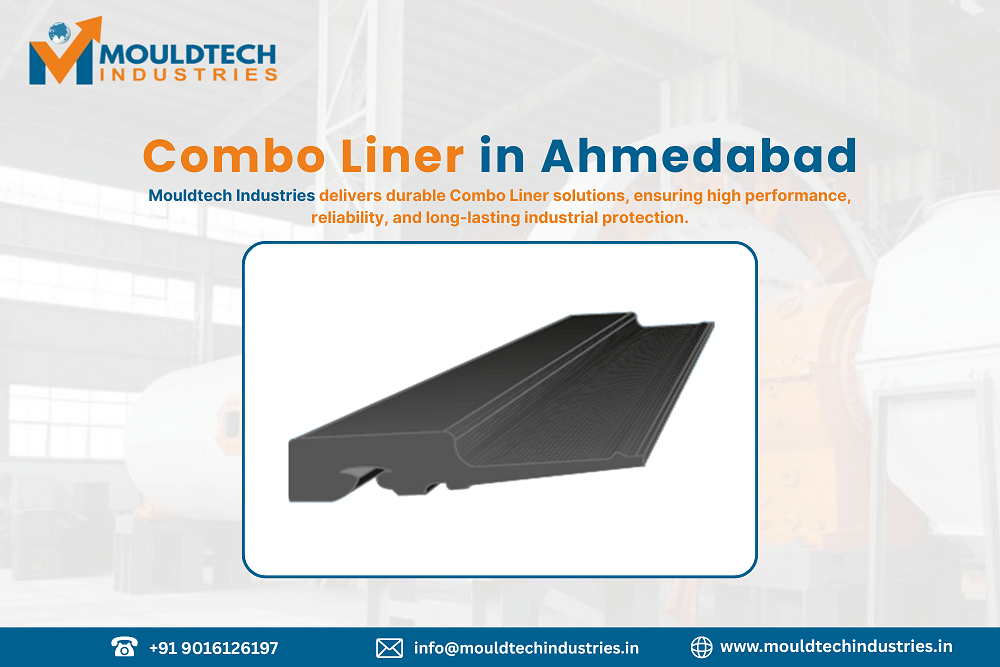
Mouldtech Industries is a Manufacturer of Combo liners in Ahmedabad.
Our Manufacturing Unit is in Vadodara, Gujarat, India.
Mouldtech Industries is a Manufacturer of Ball Mill Solutions, Ball Mill Rubber Lining, Wear Protection Line, Resistant Rubber Liner, Embedded Rubber Liners, Conveyors Solutions, Diamond Pulley Lagging, Belt Cleaners, Pulley Lagging, Ceramic Rubber Lagging Services, and Ceramic Rubber Lagging Sheet
Combo Liner: Shielding Against Wear in Tough Industrial Settings
Introduction
In sectors such as mining, metal refining, cement making, ceramics production, and bulk material movement, wear isn’t just a possibility—it’s a daily certainty. Falling materials, abrasive ores, corrosive liquids, and constant mechanical action gradually degrade equipment surfaces. In demanding industrial landscapes, this deterioration directly impacts operational reliability, worker well-being, and maintenance scheduling.
Seasoned plant operators frequently notice that unexpected shutdowns seldom stem from a single major failure. Instead, they often result from gradual liner deterioration, unnoticed thinning of protective sheeting, and postponed upkeep tasks. When liners fail sooner than expected, the outcomes are well known: more extended stoppages, hazardous repair work, and increased long-term costs.
Global industrial needs underscore this reality. As resource quality lessens and output volumes rise, machinery faces harsher operating conditions. Mining centres in places like India and areas rich in natural resources confront comparable reliability pressures. Ceramic production facilities in locations such as Morbi handle exceptionally abrasive raw components. Steel and cement works in established industrial zones like Jamshedpur, Durgapur, and Chittorgarh require steady equipment safeguarding to maintain output levels.
Given this operational context, the Combo Liner has emerged as a practical defence against wear, engineered for areas that experience both rubbing abrasion and direct blows. It blends elastic cushioning with hard ceramic wear surfaces, tackling genuine plant wear issues without exaggerated claims.
Industrial Demands Fueling the Combo Liner Adoption
A mix of physical and chemical stresses shapes the need for wear defence:
- Abrasion: Tiny mineral grains and tough fragments gradually scrape material away from chute walls, mill interiors, and transfer points.
- Impact Force: Heavy objects striking liners in crushers, storage containers, and ball mills create concentrated stress and fine cracks.
- Corrosion: Damp mixtures and process chemicals speed up material breakdown in mining and metal processing activities.
- Stoppages: Replacing liners commonly necessitates halting equipment, disrupting production timelines and subsequent processes.
- Upkeep Expense: Frequent liner replacements increase worker exposure and the quantity of spare parts needing storage.
In mining and metal processing operations, liners must withstand both sliding friction and direct impacts—cement facilities handling clinker encounter high-heat, abrasive zones. Systems moving ceramic raw materials see sharp, fine particles wearing down steel surfaces. Similar difficulties are reported in power stations handling coal residue and in material transfer hubs managing ores and aggregates through ports and inland transport networks.
These conditions are present throughout industrial zones in numerous states across India—including Odisha, Chhattisgarh, Jharkhand, Rajasthan, Maharashtra, Gujarat, Tamil Nadu, Andhra Pradesh, Telangana, Karnataka, Madhya Pradesh, and West Bengal—where extraction, cement, ceramics, steel, and material handling operations form the foundation of local economies.
Understanding the Combo Liner
A Combo Liner is a layered wear surface that merges two specially engineered materials into one lining arrangement:
- A resilient rubber base layer designed for cushioning blows and dampening vibrations.
- Tough ceramic pieces or inserts intended for resisting abrasive wear.
From a practical engineering viewpoint, this combination addresses two opposing needs. Ceramics excel at resisting sliding wear but are prone to fracturing under direct impact. Rubber, conversely, absorbs energy and adapts to structural shifts but wears down quickly under intense rubbing. The Combo Liner skillfully combines both characteristics in a deliberate design, enabling the ceramic elements to be buttressed by a flexible rubber matrix.
The outcome isn’t a liner that never fails, but rather a more predictable wear component for high-stress areas within mills, chutes, hoppers, and transfer points.
Applications Across Various Sectors
Mining
Combo Liners find use in ball mills, slurry transport chutes, and ore handling circuits where impact and abrasion occur simultaneously. They aid in stabilising wear rates in initial and secondary grinding stages.
Cement
In cement factories, these liners are fitted at material transfer points, pre-grinding machinery, and clinker-handling sections. These areas experience constant abrasive contact, along with occasional impacts from large chunks.
Metal & Steel
Steel facilities handling sinter, pellets, slag, and coke see intense wear in containment bins and conveyor pathways. Combo Liners help lengthen the time between liner exchanges in heavily worn locations.
Ceramic
The processing of raw ceramic materials involves abrasive fine particles that erode mild steel surfaces. Combo Liners are used in chutes and feeding mechanisms to preserve surface integrity and reduce dust generation from worn metal.
Power Plants
Coal and ash movement systems are subject to erosive wear. Composite liners are installed at bends and impact points within conveyance systems.
Bulk Material Handling
Ports, storage yards, and processing terminals that handle aggregates and minerals benefit from wear protection that maintains the intended flow profile and reduces spillage caused by liner wear.
Material Science & Engineering Factors
From a materials engineering perspective, the Combo Liner relies on complementary material traits:
- Rubber Qualities: Industrial-grade rubber compounds are developed for their flexibility, resistance to tearing, and controlled firmness. The intent is not just softness but reliable energy absorption without excessive stretching.
- Ceramic Toughness: Alumina-based ceramics provide excellent resistance to wear from fine scratches. Their hardness minimises material loss at sliding contacts.
- Wear Resistance Principles: Abrasive wear depends on particle toughness, the applied pressure, and the sliding speed. Ceramics reduce material loss; rubber reduces the stress transmitted.
- Impact Damping: The rubber underpinning spreads impact forces over a wider area, easing concentrated stress on the ceramic sections.
Manufacturers with extensive industry background recognise that balancing these characteristics is more crucial than maximising any single measurement.
Design & Tailoring Needs
Combo Liners are seldom standard, ready-made products in heavy industry. Design factors to consider include:
- Equipment Fit: The contours of chutes, the profiles of mill shells, and mounting interfaces differ across original equipment manufacturer specifications.
- Custom Sizing: The shape of the tiles and the thickness of the rubber are tailored to the impact force and the specific wear patterns observed.
- Task-Specific Layout: Areas of high impact necessitate deeper elastomeric layers, while zones with high abrasion prioritise broader ceramic coverage.
On-site inspections and wear mapping performed during scheduled maintenance stoppages frequently guide the final layout of the liners.
Manufacturing Quality & Process Oversight
Precise manufacturing is vital for wear liners, as minor dimensional variations can lead to fitting gaps and stress focal points. Process oversight typically involves:
- Managed rubber mixing and the heating/curing cycles.
- Accurate positioning and adhesion of the ceramic pieces.
- Review of each production batch for bond strength and exact dimensions.
- Tracking of material sources to ensure uniformity.
Consistency across batches minimises performance differences in linear sets installed in parallel machinery.
Fitting & Servicing Guidelines
From a maintenance scheduling viewpoint:
- Simpler Mounting: Modular liner panels lessen handling hazards and speed up work during shutdowns.
- Reduced Outage Time: A predictable, linear lifespan enables scheduled maintenance rather than reactive responses to failures.
- Service Intervals: Routine inspection timings synchronised with plant shutdown schedules help prevent liner breach and resulting damage to other equipment.
Maintenance crews appreciate liners that can be removed without harming underlying surfaces.
Safety & Operational Dependability
When liners fail, exposed sharp points and underlying metal increase the risk of injury during maintenance. Dependable wear shielding aids:
- Secure entry for inspection crews
- Diminished likelihood of liners separating during use
- Shielding for machinery casings and primary frameworks
In demanding industrial settings, liner dependability directly supports the site safety ethos.
Value for Money Across the Equipment Lifespan
Although liners are replaceable items, their performance influences total lifecycle expenditures:
- Extended periods between service interruptions
- Reduced the time personnel are exposed
- Safeguarding of valuable equipment surfaces
- Lesser probability of unexpected output loss
Good value stems from consistency in upkeep scheduling, not from any single liner lasting forever.
Preparedness for Shipping & Worldwide Approval
Buyers in the mining and cement sectors generally expect:
- Technical papers and schematics
- Uniformity in batch quality
- Recognition of worldwide material and safety norms
- Packing fitting for lengthy transport
Being ready for export signifies manufacturing rigour above mere promotional statements.
Why Producers with History Count
Manufacturers with extensive field experience understand failure modes that are not apparent in lab assessments. Engineering updates from real-world performance help fine-tune liner designs for particular ore types, force patterns, and maintenance routines. Reliable sourcing and technical assistance are as vital as the material makeup.
Concerning Mouldtech Industries
Mouldtech Industries is a seasoned maker of wear defence and lining setups serving all of India and global industrial users. With experience in mining, cement, ceramics, steel, and bulk conveyance across Indian industrial hubs and states, the firm emphasises tailored solutions over standard parts.
Further details accessible at 👉 https://www.mouldtechindustries.in/
Summary
The Combo Liner addresses real wear-and-tear challenges encountered in mining, cement, metal, ceramic, power, and bulk conveyance applications. Merging shock absorption with scrape resistance promotes machine reliability and predictable maintenance schedules. Its purpose is not to stop wear entirely, but to manage it in a controlled, safer, and markedly more stable operational manner.
For site engineers and maintenance teams, selecting the appropriate liner arrangement is part of embedding lasting reliability into daily tasks.
Main Points to Remember
- Composite linings manage both scraping and jarring in heavy-duty uses
- Predictable wear behaviour supports upkeep organisation
- Applicable across mining, cement, metal, ceramic, power, and bulk conveyance sectors
- Adds to equipment defence and worker well-being
- Relevant to industrial activities in India and worldwide arenas
Current Common Inquiries
Q1. What is the normal use duration for a Combo Liner?
Service span fluctuates based on ore toughness, impact energy, and running hours. In high-wear spots, linings are checked during scheduled stops and swapped based on measured wear rather than fixed timelines.
Q2. Are Combo Liners appropriate for both wet and dry uses?
Yes. They are utilised in slurry conditions in mining, as well as in dry material handling in cement and ceramics, provided the suitability of the material has been confirmed.
Q3. How frequently should Combo Liners be examined?
Check intervals usually align with site maintenance plans. Areas subject to high impact might need closer visual review.
Q4. How do rubber linings contrast with ceramic wear options?
Rubber linings cushion blows but degrade quickly from abrasion. Ceramic linings resist scraping but are fragile under impact. Combo Liners strike a balance between these traits for mixed-duty zones.
Q5. Are Combo Liners employed internationally?
Indeed. Industries worldwide use composite wear linings in mining, cement, and bulk-conveyance applications, where scraping and jarring occur simultaneously.
For expert wear protection solutions, contact Mouldtech Industries today. Explore our Combo Liner systems to enhance equipment reliability, reduce downtime, and optimise industrial operations across India.
#ComboLiner #BallMillRubberLiner #CeramicWearProtection #RubberLining #MiningSolutions #BulkMaterialHandling #ConveyorSolutions #MouldtechIndustries #WearProtection #IndustrialManufacturing