
Lifter Bar (Radical) Manufacturer, Supplier, And Exporter in India: Mouldtech Industries
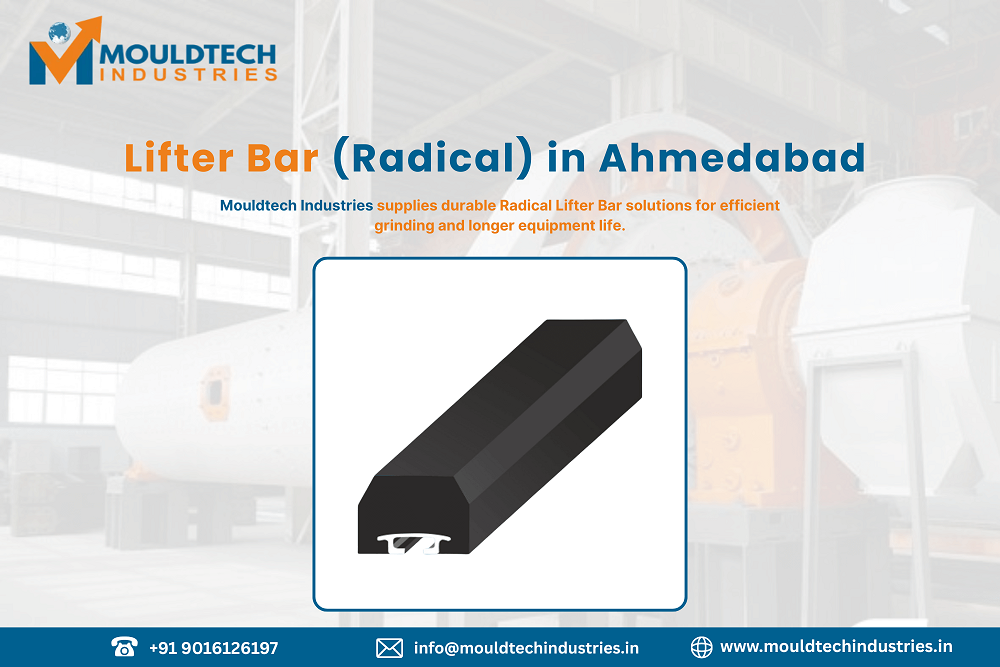
Mouldtech Industries is a Manufacturer of Lifter Bar (Radical) in Ahmedabad.
Our Manufacturing Unit is in Vadodara, Gujarat, India.
Mouldtech Industries is a Manufacturer of Ball Mill Solutions, Ball Mill Rubber Lining, Wear Protection Line, Resistant Rubber Liner, Embedded Rubber Liners, Conveyors Solutions, Diamond Pulley Lagging, Belt Cleaners, Pulley Lagging, Ceramic Rubber Lagging Services, and Ceramic Rubber Lagging Sheet.
Lifter Bar (Radical): Engineering Wear Protection for Reliable Ball Mill Performance in Heavy-Duty Industries
Introduction
Mining, metal processing, cement production, ceramics manufacturing, and bulk material handling operate in some of the most aggressive industrial environments. Equipment is exposed to continuous abrasion from ore, clinker, slag, and minerals; high-impact loading from grinding media; moisture and slurry-driven corrosion; and temperature fluctuations that accelerate material fatigue. In heavy-duty industrial environments, even well-designed machinery suffers from wear-related inefficiencies if protection systems are not engineered correctly.
Plant reliability today is not only about installing robust machines but about extending service life through engineered wear protection and predictable maintenance planning. Across global industrial markets, demand is increasing for wear solutions that reduce unplanned downtime, improve mill efficiency, and protect high-value equipment without introducing new safety or maintenance risks.
The Lifter Bar (Radical) is a critical component in ball mill lining systems that directly influences grinding efficiency, liner life, and operational stability. When designed and manufactured correctly, it contributes to controlled media lifting, reduced liner damage, and consistent throughput in demanding process conditions.
Industrial Challenges That Drive Demand for Lifter Bar (Radical)
In mining and metal processing operations, plant engineers face a combination of mechanical, material, and operational challenges that directly affect mill performance:
- Abrasion: Continuous sliding and rolling of ore and grinding media cause progressive wear on liners and lifter bars.
- Impact Loads: Lifter bars are repeatedly subjected to high-energy impacts as balls and rocks are lifted and dropped.
- Corrosion: Moisture, slurry chemistry, and process additives can degrade metallic components and reduce service life.
- Downtime: Unplanned liner replacements disrupt production schedules and increase operational risk.
- Maintenance Cost: Frequent liner changes increase labour exposure, crane time, and safety risks.
What Is a Lifter Bar (Radical)?
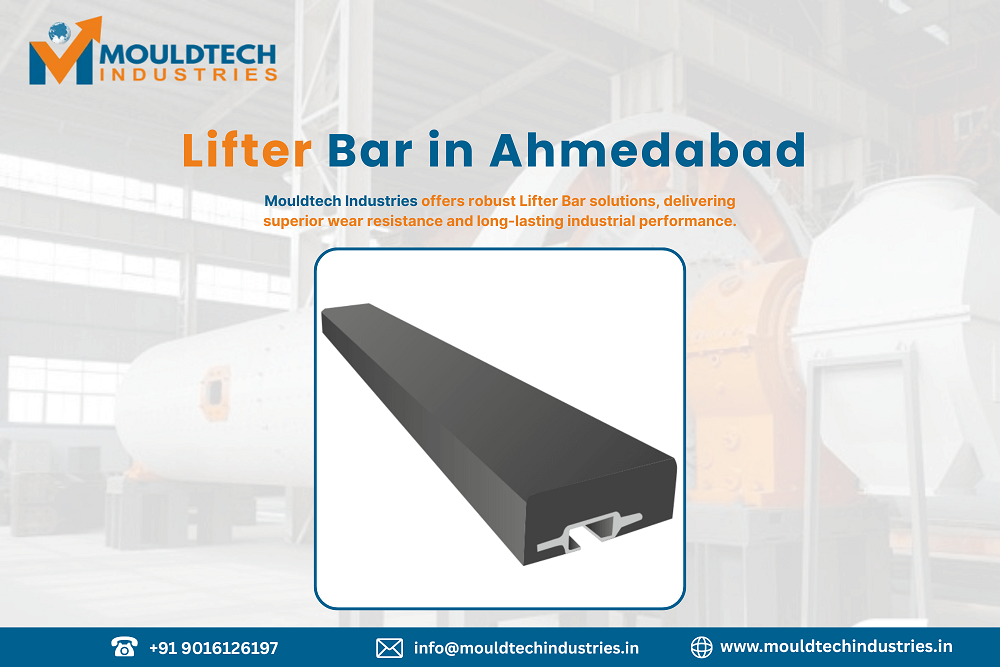
A Lifter Bar (Radical) is a wear-resistant profile fitted inside ball mills to lift grinding media and material to a defined trajectory before allowing it to cascade or cataract. It primarily controls the motion of the charge, efficiently transferring energy to the material being ground.
From an engineering standpoint, lifter bars:
- Influence grinding efficiency by defining the angle and height of media lift
- Protect the underlying shell liners from direct impact
- Contribute to uniform wear distribution across the lining system
- Support predictable liner replacement cycles.
There is no single “best” lifter profile for all applications. The performance of a lifter bar depends on ore characteristics, mill speed, liner configuration, and operating conditions. Manufacturers with long-term industry experience understand that lifter design must align with process requirements rather than rely on generic performance claims.
Applications Across Industries
- Mining: In ore grinding circuits, lifter bars shape the charge motion to balance impact and abrasion. This affects throughput, energy efficiency, and liner life in primary and secondary ball mills.
- Cement: Clinker grinding involves high hardness and variable feed size. Lifter bars help maintain consistent grinding action and protect shell liners from premature damage.
- Metal & Steel: Slag and sinter grinding in steel plants generates severe impact and abrasive conditions. Proper lifter geometry supports stable mill operation and predictable maintenance planning.
- Ceramic Manufacturing: Fine grinding of minerals and ceramic raw materials requires controlled media movement to avoid over-grinding and contamination. Lifter bars help maintain a consistent particle size distribution.
- Power Plants: Coal and mineral grinding mills rely on stable liner systems to ensure uninterrupted fuel preparation. Wear-resistant lifter bars contribute to operational continuity.
- Bulk Material Handling: In auxiliary grinding and material preparation systems, lifter bars reduce internal wear and improve process reliability in continuous operations.
Material Science & Engineering Considerations
Rubber and ceramic wear protection systems are selected based on wear mechanisms rather than marketing labels:
- Rubber Properties: Rubber liners and lifter bars offer elasticity, impact absorption, and noise reduction. They are suitable for applications with high impact loads and moderate abrasion. The resilience of rubber helps protect mill shells from shock loads.
- Ceramic Hardness: Ceramic wear tiles provide high hardness and abrasion resistance. They are often used in high-slurry or fine-particle abrasion zones where rubber alone may wear too quickly.
- Wear Resistance Principles: Abrasive wear depends on particle hardness, shape, and velocity. Impact wear depends on energy transfer and liner resilience. Engineers evaluate both mechanisms before selecting materials.
- Impact Absorption: Hybrid systems combining rubber backing with ceramic elements can balance impact absorption and abrasion resistance in specific zones of the mill.
In mining and metal processing operations, material selection is rarely uniform across the liner system. Engineers often perform zonal engineering to address varying wear profiles within the same mill.
Design & Customisation Requirements
Lifter Bar (Radical) design must account for:
- Equipment Compatibility: Matching lifter geometry to mill diameter, rotational speed, and liner layout
- Custom Sizing: Adapting profiles to suit specific mill designs and bolt patterns
- Application-Specific Design: Adjusting height and face angle based on ore characteristics and grinding objectives
Standardised components rarely deliver optimal results in high-wear zones. Custom-engineered lifter bars help maintain consistent grinding performance throughout the liner’s lifecycle.
Manufacturing Quality & Process Control
Precision manufacturing is essential for linear systems because minor dimensional deviations can alter charge motion and accelerate uneven wear. Process control typically involves:
- Controlled rubber compounding and curing
- Consistent ceramic bonding processes
- Dimensional inspections and hardness checks
- Batch traceability for quality consistency
Manufacturers with long-term industry exposure understand that repeatability is as essential as material quality, especially for plants that standardise maintenance cycles.
Installation & Maintenance Considerations
From a maintenance perspective, lifter bars should support:
- Ease of Installation: Proper bolt alignment and manageable component weight reduce installation time and manual handling risk
- Reduced Downtime: Predictable liner replacement intervals help align shutdown planning
- Maintenance Cycles: Consistent wear patterns allow condition-based maintenance rather than reactive shutdowns
Experienced maintenance teams value linear systems that are practical to handle and replace, as well as durable in service.
Safety & Operational Dependability
Personnel well-being is closely tied to the design of lining systems. Lifter bars that are properly engineered:
- Decrease the frequency of liner changes
- Minimise hands-on involvement during upkeep
- Lessen the chance of liners coming loose or failing early
Operational dependability increases when liner performance is consistent and doesn’t suddenly fail, which could put workers in emergency upkeep scenarios.
Value Over the Equipment’s Lifespan
Although lining systems are expendable items, their design affects long-term running costs. Advantages include:
- Longer stretches between planned stops
- Less collateral harm to mill shells
- More steady crushing output and throughput
Companies achieve cost-effectiveness by reducing unexpected downtime and optimizing maintenance schedules, rather than pursuing lower upfront material costs.
Preparedness for Export & Global Acknowledgement
Industrial purchasers in worldwide markets anticipate:
- Proof of material specifications
- Records of process tracking and quality checks
- Familiarity with international industry benchmarks
- A steady capacity to provide for long-term agreements
Export readiness involves more than just product quality; it also requires meticulous documentation and dependable processes.
The Value of Seasoned Manufacturers
Manufacturers with extensive experience in the sector grasp the real-world operation of demanding plants. Engineering skill, practical insights from on-site installations, and stable supply chains are vital to maintaining liner performance across multiple maintenance cycles. Authority in this field stems from reliable results under diverse industrial conditions, not isolated test outcomes.
About Mouldtech Industries
Mouldtech Industries is a well-established producer specialising in ball mill rubber linings, ceramic wear protection, rubber lining setups, rubber components for ball mills, and conveyor solutions, serving industrial customers throughout India and across the globe. The company partners with mining operations, cement facilities, metal producers, ceramics makers, and bulk material handlers to develop wear defence systems that match actual plant operating circumstances. Further details on their production capabilities and industrial offerings can be found at 👉 https://www.mouldtechindustries.in/
Summary
The Lifter Bar (Radical) serves a functional purpose in boosting crushing efficiency, extending liner life, and ensuring operational dependability in harsh industrial settings. Its effectiveness relies on appropriate material selection, engineering design, manufacturing uniformity, and integration with maintenance practices. When chosen with a clear understanding of process factors, it promotes safer work, predictable upkeep schedules, and stable plant output.
Plant engineers and project groups should concentrate on specifying solutions ideally suited to the task that reflect operational realities, rather than accepting broad claims about wear protection.
Main Takeaways
- Designed lifter bars aid in controlled grinding and reduce liner deterioration.
- Selecting the right materials balances resistance to wear with impact buffering.
- Tailored design enhances suitability for specific mill environments.
- Predictable wear patterns facilitate better maintenance scheduling.
- Dependable wear defence contributes to enhanced long-term plant efficiency.
Current Frequently Asked Questions
1. What is the typical lifespan of a Lifter Bar (Radical)?
Service duration varies based on ore toughness, mill rotation speed, and running hours. In challenging industrial settings, wear rates are more determined by process conditions than by the material alone.
2. Is the Lifter Bar (Radical) appropriate for all ball mill variations?
It needs to be engineered specifically for the mill’s dimensions and operating conditions. Adjustments are often necessary for peak efficiency.
3. How often should lifter bars be checked or swapped out?
Inspection periods usually correspond with planned maintenance shutdowns. Replacement depends on observed wear and performance drop-off, not on a fixed timetable.
4. How do rubber and ceramic solutions for wear differ in effectiveness?
Rubber excels at absorbing shocks and reducing noise, while ceramic offers superior abrasion resistance. Many facilities use zonal combinations based on the type of wear occurring.
5. Are such lifter mechanisms used in mining operations worldwide?
Yes. Similar lifter concepts are employed in mineral processing and mining facilities in numerous regions where dependable grinding is crucial.
For inquiries about Lifter Bar (Radical) and industrial wear solutions, contact Mouldtech Industries. Visit our website or reach out to our experts for technical guidance today.
#BallMillRubberLiner #CeramicWearProtection #RubberLining #MiningSolutions #BulkMaterialHandling #ConveyorSolutions #MouldtechIndustries #WearProtection #IndustrialManufacturing