

Discharge Cone Manufacturer, Supplier, And Exporter in India: Mouldtech Industries
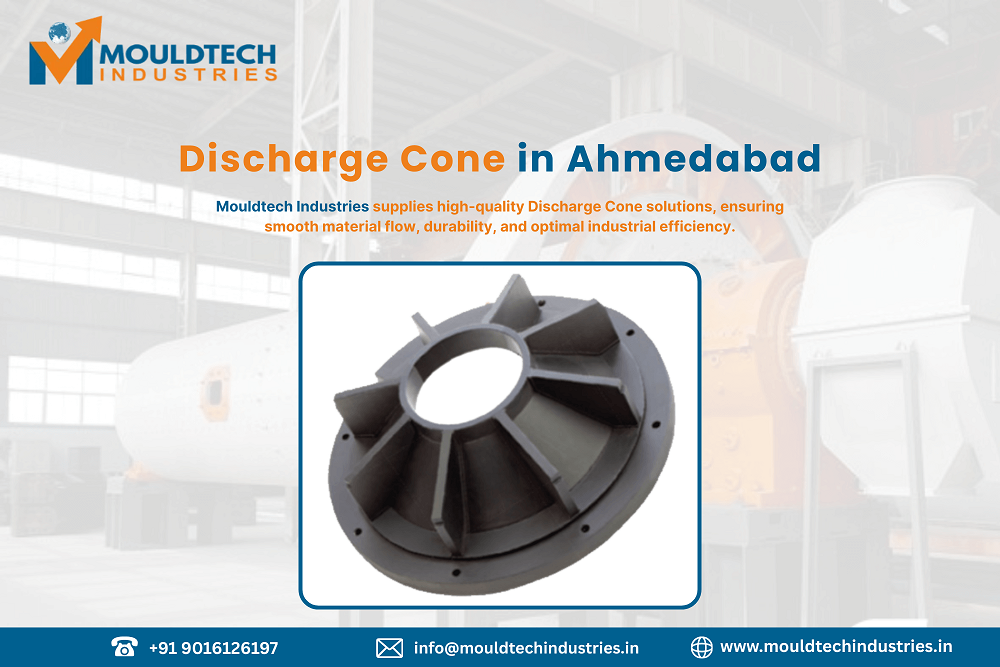
Mouldtech Industries is a Manufacturer of Discharge cones in Ahmedabad.
Our Manufacturing Unit is in Vadodara, Gujarat, India.
Mouldtech Industries is a Manufacturer of Ball Mill Solutions, Ball Mill Rubber Lining, Wear Protection Line, Resistant Rubber Liner, Embedded Rubber Liners, Conveyors Solutions, Diamond Pulley Lagging, Belt Cleaners, Pulley Lagging, Ceramic Rubber Lagging Services, and Ceramic Rubber Lagging Sheet
Discharge Cone: A Vital Component for Wear Defence in Rigorous Industry Settings
Introduction
In demanding industrial settings, machinery endures constant rubbing, recurring heavy blows, corrosive substances, and lengthy operational periods. Mining operations manage sharp rock fragments and oversized material—cement facilities process hot clinker under vast temperature swings. Metal and steel works confront scale, slag, and significant mechanical pressure, while ceramic producers handle intensely abrasive feedstocks. Across these sectors, equipment dependability directly impacts plant uptime, operational safety, and cost management.
Unexpected stoppages stemming from wear-related failures remain a persistent headache for plant professionals and maintenance teams. As worldwide output increases and permitted turnaround times shrink, industries are increasingly turning to specialized wear mitigation solutions rather than simply reacting to failures.
The Discharge Cone holds a key position in this scenario. Situated at the material outlet of devices like tumbling mills, it sustains focused abrasive action and impact. Its functioning directly influences material outflow, liner lifespan, and the reliability of subsequent machinery.
Industry Pressures Driving Need for Discharge Cone Solutions
In mineral extraction and metal processing, the discharge zone of a mill faces the most demanding service conditions. Experienced plant engineers often note that failures here seldom result solely from design flaws, but rather from protracted exposure to:
- Intense wear from coarse and sharp particles
- Shock loads from descending charge and grinding media
- Chemical attack due to moisture, slurry makeup, and process aids
- Frequent halts during the process of changing liners
- Increasing upkeep expenditures are tied to early failure
Comparable circumstances exist in cement production, raw material preparation for ceramics, power generation, handling coal or fly ash, and bulk conveyance networks. Across global industrial landscapes—from coal fields in India to international cement hubs—the exit area is a high-risk zone that demands engineered defence over conventional metal parts.
Defining the Discharge Cone
A Discharge Cone is a purposefully engineered wear protection element fitted at the exit of tumbling mills or similar grinding apparatus. Its primary purpose is to direct material flow while safeguarding the underlying shell structure from rubbing, striking forces, and surface erosion.
Unlike plain steel cones, rubber-lined or composite discharge cones are designed to absorb impact energy, reduce noise, and minimize metal-on-metal contact. The primary goal isn’t boosting output, but ensuring steady material transit while prolonging component service duration under taxing operational settings.
Diverse Field Implementations
Mining Sector
In resource extraction, discharge cones manage abrasive ore paste and the exit of grinding media. Effective wear defence lessens shell degradation and stabilizes mill performance over extended running cycles.
Cement Production
Grinding clinker and additives in cement manufacturing causes severe abrasion. Discharge cones help maintain a uniform exit profile and reduce wear along liner edges.
Metal & Steel Plants
In metal refining and slag pulverizing tasks, discharge cones experience high impact forces and fine metallic particles. Rubber or ceramic-infused designs help manage impact stress and decrease the need for frequent servicing.
Ceramic Fabrication
Feedstocks such as feldspar and quartz used in ceramics are highly abrasive. Discharge cones shield adjacent hoppers and prevent contamination from dislodged metal wear debris.
Power Generation
Systems handling coal and ash benefit from regulated discharge and reduced erosion in pulverizing and size reduction equipment.
Bulk Material Conveyance
In transfer arrangements, discharge cones guarantee smooth passage while defending critical transition points from erosion and impact damage.
Material Science & Design Principles
Firms with deep industry background recognize that discharge cone efficacy hinges significantly upon material selection and engineering design.
- Rubber traits, such as flexibility, tear resistance, and elasticity, enable efficient shock attenuation.
- Ceramic wear units, when incorporated, supply high surface hardness for abrasion resistance.
- Principles of wear mitigation concentrate on minimizing surface breakdown and inhibiting crack formation.
- Impact cushioning reduces stress transmission to the mill shell, preserving structural soundness.
These concepts are tailored according to operating demands rather than general assumptions, ensuring suitability for specific plant environments.
Specific Engineering & Customization Needs
Discharge cones are not one-size-fits-all parts. Effective design factors in:
- Suitability with the current mill dimensions
- Tailored sizing based on the shape of the discharge opening
- Application-specific covering depth and contour
- Integration compatibility with existing rubber liner systems
Custom adaptation ensures that wear defence aligns with actual operational conditions rather than forcing standard parts into inappropriate settings.
Manufacturing Quality & Process Oversight
Precise fabrication is vital to the reliability of discharge cones. Controlled forming, precise dimensional compliance, and uniform material composition yield predictable results.
Quality scrutiny usually encompasses:
- Inspection of incoming materials
- Verification of measurements
- Testing of bonding strength
- Tracking consistency across production batches
Such methodical execution is vital for industrial purchasers seeking dependable performance across several installations.
Setup & Servicing Aspects
From a service perspective, discharge cones must allow for:
- Simple fitting during scheduled outages
- Reduced weight for easier handling compared to steel counterparts
- Predictable wear patterns that facilitate inspection
Simplicity of placement directly contributes to reduced idle time and safer maintenance protocols.
Safety & Operational Dependability
Safeguarding personnel is paramount in industrial settings. Rubber-lined outlet cones help reduce noise, protect against sharp edges, and mitigate the risk of sudden part failure.
Consistent performance from wear-defence elements boosts operational dependability, leading to fewer emergency call-outs and fostering greater overall plant steadiness.
Value Over Equipment Lifetime
Cost-effectiveness is attained via:
- Prolonged service intervals
- Fewer unexpected stoppages
- Optimized upkeep scheduling
- Safeguarding valuable equipment structures
Seasoned operators assess outlet cones based on their entire service history, prioritizing long-term performance over initial purchase price.
Preparedness for Global Markets & International Acceptance
Industrial purchasers worldwide anticipate:
- Adherence to worldwide quality benchmarks
- Thorough documentation and traceability
- Uniform production methods
Components suited for export demonstrate a producer’s grasp of international industrial needs beyond local specifications.
The Importance of Veteran Producers
Outlet cones function in sensitive areas where failure can trigger widespread issues. Engineering proficiency, deep application understanding, and dependable supply chains are vital.
Manufacturers with hands-on field experience formulate products based on actual operational hurdles, not just theoretical models.
About Mouldtech Industries
Mouldtech Industries is an established manufacturer of wear defence systems, catering to the India and international industrial sectors. The firm supports activities across all Indian states and union territories, including Maharashtra, Gujarat, Rajasthan, Odisha, Chhattisgarh, Jharkhand, Karnataka, Tamil Nadu, Andhra Pradesh, Telangana, Madhya Pradesh, Uttar Pradesh, West Bengal, Punjab, Haryana, Himachal Pradesh, Uttarakhand, Bihar, Assam, Meghalaya, Manipur, Tripura, Nagaland, Mizoram, Arunachal Pradesh, Sikkim, Kerala, Goa, Delhi, and all major industrial hubs involved in mining, cement, metal, ceramic, and bulk movement industries.
Focusing on tailored engineering solutions rather than standard items, the company supports plant engineers, OEMs, EPC contractors, and maintenance teams with dependable manufacturing techniques and application expertise. 👉 https://www.mouldtechindustries.in/
Summary
The Outlet Cone is a crucial element in grinding and material conveyance systems, directly influencing durability, safety, and operational consistency. When established and built with engineering rigour, it contributes to steady plant output and managed maintenance schedules.
For industrial activities seeking sustained dependability rather than quick fixes, appropriately engineered outlet cone solutions are a key element of a wear defence strategy.
Primary Conclusions
- Outlet cones shield areas subject to high wear during discharge
- Specially designed materials enhance resistance to impact and abrasion
- Applicable across mining, cement, metal, ceramic, and energy sectors
- Facilitates safer servicing and reduced periods of inactivity
- A wear protection item accepted in worldwide markets
Frequently Asked Questions (Current Trends)
1. What is the expected operational period for an outlet cone?
Service duration depends on the material used, working conditions, and maintenance routines. Solutions designed effectively last considerably longer than standard steel parts.
2. In which areas are outlet cones typically found?
Mainly within ball mills, grinding apparatus, and material exit points at mining, cement, metal, and ceramic facilities.
3. How frequently should outlet cones be checked?
Regular inspections during planned shutdowns are advised to monitor wear.
4. Rubber versus ceramic outlet cones – which offers advantages?
Rubber excels at absorbing impacts, whereas ceramic provides superior resistance to rubbing wear. The choice depends on the intensity of the specific job.
5. Are outlet cones utilized internationally?
Yes, they are widely used across the global mining and processing sectors.
Contact Mouldtech Industries for reliable Discharge Cone solutions engineered for demanding industrial environments. Our team supports design, supply, and long-term plant reliability.
#DischargeCone #BallMillRubberProducts #RubberLiningSystems #CeramicWearProtection #WearProtectionSolutions #MiningEquipment #CementPlantSolutions #SteelPlantEquipment #BulkMaterialHandling #IndustrialWearParts #MillLinerSolutions