
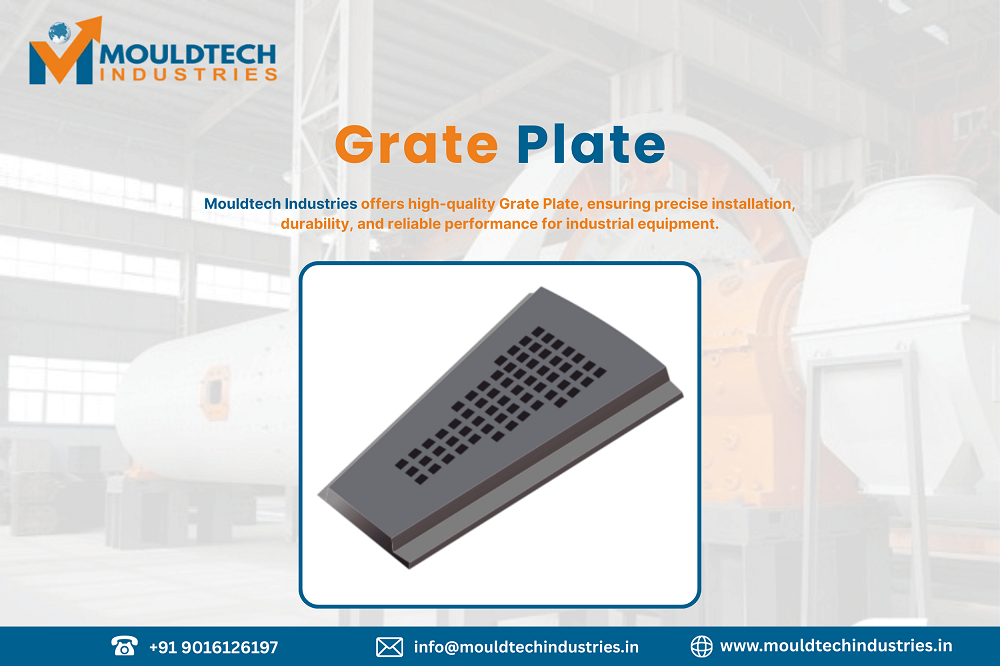
Grate Plate Manufacturer in India: Mouldtech Industries
Mouldtech Industries is a Manufacturer, Supplier and Exporter of Grate Plate.
Our Manufacturing Unit is in Vadodara, Gujarat, India.
Mouldtech Industries is a Manufacturer of Ball Mill Solutions, Ball Mill Rubber Lining, Wear Protection Line, Resistant Rubber Liner, Embedded Rubber Liners, Conveyors Solutions, Impact Bed Assembly and Impact Pads, Belt Cleaners, Pulley Lagging, Ceramic Rubber Lagging Services and Ceramic Rubber Lagging Sheet.
Grate Plate: A Critical Wear Solution for Heavy-Duty Industrial Operations
Introduction
Mining, metal processing, cement manufacturing, ceramic production, and bulk material handling operate under some of the harshest mechanical conditions in industry. Equipment is continuously exposed to abrasive ores, sharp aggregates, clinker, slag, coal, and ceramic raw materials. Impact loads from falling material, corrosion from moisture and chemicals, and high operating temperatures accelerate wear on critical components.
In heavy-duty industrial environments, wear is not just a maintenance issue—it directly affects production stability, worker safety, and operating cost. Unplanned shutdowns caused by worn parts often disrupt entire process chains, from crushing and grinding to conveying and storage.
Globally, industrial production is increasing due to infrastructure growth, urbanization, and energy demand. This rise puts additional pressure on equipment reliability. As a result, wear protection systems are no longer optional—they are an essential part of plant design.
Industrial Challenges That Drive Demand for Grate Plate
- Abrasion: Materials like iron ore, bauxite, limestone, clinker, coal, and ceramic minerals contain hard particles that grind against metal surfaces. Over time, this leads to material loss, shape deformation, and reduced functional efficiency.
- Impact Loads: In crushers, mills, and chutes, large lumps fall at high speed: repeated impact damages conventional steel parts, causing cracking, bending, and premature failure.
- Corrosion: Moisture, chemicals, and process water accelerate corrosion, especially in mining slurry circuits, coal handling, and cement plants.
- Downtime: Every worn-out component means a stoppage. In continuous-process industries, even a few hours of downtime can cause large production losses.
- Maintenance Cost: Frequent part replacement increases labour, spare inventory, and maintenance planning complexity.
These challenges are seen in industrial regions worldwide—whether in mining belts of Australia, Africa, and South America, cement clusters in Asia, or metal processing hubs in Europe. Indian industries face the same conditions across mining belts, industrial corridors, and power generation zones.
What Is a Great Plate?
A Grate Plate is a wear-resistant structural component used in grinding mills, discharge systems, and heavy material flow zones. Its main function is to:
- Control the flow of processed material
- Allow undersized material to pass through
- Retain grinding media inside mills
- Protect structural parts from direct wear
Unlike simple plates, a Grate Plate is engineered with specific slot sizes, thickness, and material composition depending on the application. It is commonly manufactured using:
- Rubber
- Rubber-metal composites
- Ceramic-lined rubber
- High-wear polymers or hybrid systems
The design balances wear resistance, impact absorption, and controlled material flow.
Applications Across Industries
- Mining: In mining and metal processing operations, Grate Plates are widely used in ball mills, SAG mills, and discharge systems. They handle abrasive ores like iron, copper, gold, and bauxite while controlling grinding efficiency.
- Cement: Cement plants use Grate Plates in raw mills, cement mills, and clinker handling zones where material is both abrasive and hot.
- Metal & Steel: Steel plants use them in slag grinding, sinter processing, and auxiliary grinding systems where impact and abrasion are severe.
- Ceramic: Ceramic manufacturers use wear systems in raw material grinding, slip preparation, and mineral processing lines.
- Power Plants: Coal handling, ash handling, and limestone milling systems rely on wear-resistant grates to avoid shutdowns.
- Bulk Material Handling: Ports, stockyards, and conveyor systems use similar wear components in transfer points and feeders.
Material Science & Engineering Considerations
Wear protection is not about hardness alone. Engineers evaluate several material properties:
Rubber Properties
Rubber offers:
- High impact absorption
- Noise reduction
- Resistance to corrosion
- Flexibility under load
However, rubber alone may not handle extreme abrasion.
Ceramic Hardness
Ceramic tiles provide:
- Very high hardness
- Excellent abrasion resistance
- Long life in sliding wear zones
But ceramics are brittle under heavy impact.
Wear Resistance Principles
Experienced plant engineers often observe that the best wear systems combine:
- Impact absorption from rubber
- Abrasion resistance from ceramics
- Structural support from metal backings
This hybrid approach is commonly used in modern Grate Plate designs.
Design & Customization Requirements
Every mill and material system is different. Grate Plates must be designed based on:
- Mill diameter and speed
- Material type and size
- Impact energy
- Flow rate
- Slot configuration needs
Custom sizing ensures:
- Proper fit
- Balanced load distribution
- Efficient material discharge
Manufacturers with long-term industry exposure understand that standard designs rarely fit all operating conditions.
Manufacturing Quality & Process Control
Precision manufacturing is critical because:
- Slot geometry affects grinding efficiency
- Thickness affects service life
Poor bonding between rubber and ceramic leads to early failure
Process control includes:
- Raw material testing
- Controlled vulcanization for rubber
- Accurate ceramic placement
- Dimensional inspection
- Batch traceability
Consistent quality ensures predictable plant performance.
Installation & Maintenance Considerations
Good Grate Plate design allows:
- Easy lifting and handling
- Simple bolt alignment
- Faster replacement
Reduced downtime during maintenance is often more valuable than marginal increases in wear life.
Maintenance planning includes:
- Regular inspection cycles
- Monitoring wear pattern
- Replacing before failure
Safety & Operational Reliability
Worn or broken grates can cause:
- Sudden material release
- Equipment vibration
- Structural damage
- Worker injury risk
Reliable wear systems improve:
- Equipment stability
- Predictable operation
- Safer maintenance activities
Cost Efficiency Over Equipment Life Cycle
Cost efficiency is measured over the full life cycle, not by initial purchase.
Long-term benefits include:
- Fewer shutdowns
- Lower spare consumption
- Reduced emergency repairs
- Better energy efficiency
This leads to steady production and controlled operating budgets.
Export Readiness & Global Acceptance
Industrial buyers expect:
- Consistent quality
- Engineering documentation
- Material certificates
- Dimensional accuracy
- Packing suitable for long-distance shipping
Export-oriented manufacturers must understand global standards and buyer expectations in the mining, cement, and heavy engineering sectors.
Why Experienced Manufacturers Matter
Manufacturers with long-term industry exposure understand:
- How wear behaves in real plants
- How to design for actual operating conditions
- How to ensure repeat quality
- How to support after-sales requirements
Engineering experience reduces trial-and-error at the customer’s site.
About Mouldtech Industries
Mouldtech Industries is an industrial manufacturer specializing in wear protection and material handling solutions, including:
- Ball Mill Rubber Liners
- Ceramic Wear Protection Systems
- Rubber Lining Systems
- Ball Mill Rubber Products
- Conveyor Solutions
- Grate Plate systems
Serving Pan India and export markets, the company supplies industries across mining belts, cement clusters, metal processing hubs, ceramic zones, and power plants.
Mouldtech Industries supports industrial operations across all Indian states and union territories, including:
Andhra Pradesh, Arunachal Pradesh, Assam, Bihar, Chhattisgarh, Goa, Gujarat, Haryana, Himachal Pradesh, Jharkhand, Karnataka, Kerala, Madhya Pradesh, Maharashtra, Manipur, Meghalaya, Mizoram, Nagaland, Odisha, Punjab, Rajasthan, Sikkim, Tamil Nadu, Telangana, Tripura, Uttar Pradesh, Uttarakhand, West Bengal, and union territories such as Delhi, Chandigarh, Puducherry, Jammu & Kashmir, Ladakh, Dadra & Nagar Haveli and Daman & Diu, Andaman & Nicobar Islands, and Lakshadweep.
Major industrial cities served include Ahmedabad, Surat, Vadodara, Mumbai, Pune, Nagpur, Raipur, Durg, Rourkela, Bhubaneswar, Angul, Jamshedpur, Bokaro, Dhanbad, Ranchi, Kolkata, Durgapur, Asansol, Chennai, Coimbatore, Salem, Erode, Bengaluru, Ballari, Hospet, Hyderabad, Warangal, Visakhapatnam, Vijayawada, Kakinada, Nellore, Tirupati, Jaipur, Kota, Bhilwara, Jodhpur, Udaipur, Alwar, Gurugram, Faridabad, Panipat, Sonipat, Hisar, Ludhiana, Mandi Gobindgarh, Patiala, Bhopal, Indore, Ujjain, Katni, Satna, Jabalpur, Singrauli, Varanasi, Kanpur, Lucknow, Aligarh, Agra, Noida, Greater Noida, Ghaziabad, Meerut, Moradabad, Bareilly, and many other industrial locations.
More information is available at https://www.mouldtechindustries.in/
Conclusion
Grate Plate systems play a critical role in controlling material flow, protecting equipment, and improving grinding and handling efficiency. In mining, cement, metal, ceramic, and bulk material handling industries, their performance directly affects uptime, safety, and operating stability.
When designed with proper material science, engineered geometry, and quality manufacturing, Grate Plates contribute to long-term plant reliability.
For industrial operators, choosing experienced manufacturers and technically sound designs is not a purchasing decision—it is an operational strategy.
Key Takeaways
- Grate Plates manage material flow and protect critical equipment
- Proper wear protection reduces downtime and maintenance costs
- Hybrid rubber-ceramic designs balance impact and abrasion
- Custom engineering improves plant compatibility
- Long-term reliability matters more than short-term cost
- Industrial experience ensures consistent performance
Trending FAQs
1. What is the typical lifespan of a Grate Plate?
Lifespan depends on material type, impact load, and operating hours. In heavy-duty environments, it is monitored through wear inspections rather than fixed time limits.
2. Where are Grate Plates mainly used?
They are used in ball mills, discharge systems, crushers, feeders, and heavy material flow zones across mining, cement, metal, ceramic, and power industries.
3. How often should Grate Plates be inspected?
Inspection frequency depends on operating severity. High-abrasion zones may need monthly checks, while moderate zones follow quarterly schedules.
4. Rubber vs ceramic wear solutions – which is better?
Rubber absorbs impact and resists corrosion, while ceramic resists abrasion. Many modern systems combine both for balanced performance.
5. Are Grate Plates used globally?
Yes. They are standard components in mining, cement, and bulk handling plants across Asia, Africa, Australia, Europe, and the Americas.
6. What should be considered during installation?
Proper alignment, bolt torque, safe lifting methods, and correct slot orientation are essential for performance and safety.
Connect with our engineers to design the right Grate Plate for your plant, reduce wear, improve material flow, and ensure reliable, long-term performance in heavy-duty industrial operations.