
Ball Mill Lining Manufacturer in India: Mouldtech Industries
Mouldtech Industries is a Manufacturer, Supplier, and Exporter of Ball Mill Lining.
Our Manufacturing Unit is in Vadodara, Gujarat, India.
Mouldtech Industries is a Manufacturer of Ball Mill Solutions, Ball Mill Rubber Lining, Wear Protection Line, Resistant Rubber Liner, Embedded Rubber Liners, Conveyors Solutions, Impact Bed Assembly and Impact Pads, Belt Cleaners, Pulley Lagging, Ceramic Rubber Lagging Services, and Ceramic Rubber Lagging Sheet.
Ball Mill Lining: A Guide to Industrial Wear Defense
Overview
In the mining, metal refining, cement production, ceramics, and bulk material management sectors, equipment is subjected to constant mechanical strain. Abrasive raw materials, heavy impact forces, moisture, chemicals, and high temperatures all hasten the deterioration of vital machinery. In rigorous industrial settings, even a minor breakdown in a rotating apparatus can result in unexpected stoppages, safety hazards, and substantial output reductions.
Consequently, facility dependability has become a primary concern for operations and maintenance teams globally. Current global industrial needs indicate a distinct shift towards engineered wear protection systems that prolong equipment lifespan, reduce maintenance frequency, and enhance operational predictability.
Within this context, the Ball Mill Lining serves a vital function. Whether used in mining, cement, or metal processing, these linings safeguard the mill casing, optimize grinding efficiency, and directly affect output and power consumption. Their performance has a quantifiable effect on facility accessibility and lasting operational expenditures.
Industrial Difficulties Fueling Lining Demand
Ball mills function under some of the most severe conditions encountered in industrial processing. Several hurdles consistently drive the need for dependable lining systems:
- Abrasion: Constant contact with complex ores, clinker, or ceramic media causes progressive material loss. Abrasive wear is often irregular, making lining blueprint and material choice crucial.
- Impact Loads: Grinding media and incoming Material generate repeated shock forces. Linings must absorb jolts without fracturing or deforming unduly.
- Corrosion: In wet grinding, chemical interactions and moisture accelerate corrosion, particularly in metal components.
- Outage Time: Liner substitution necessitates mill idleness. In mining and metal processing operations, even brief closures can disrupt subsequent procedures.
- Maintenance Expenditure: Frequent liner swaps raise labor hours, crane utilization, and safety exposure for upkeep crews.
These issues are prevalent across worldwide industrial landscapes, from iron ore pits in Odisha to cement works in Gujarat and ceramic hubs in Morbi. Reliable ball mill linings are therefore essential for steady facility performance.
What Constitutes a Ball Mill Lining?
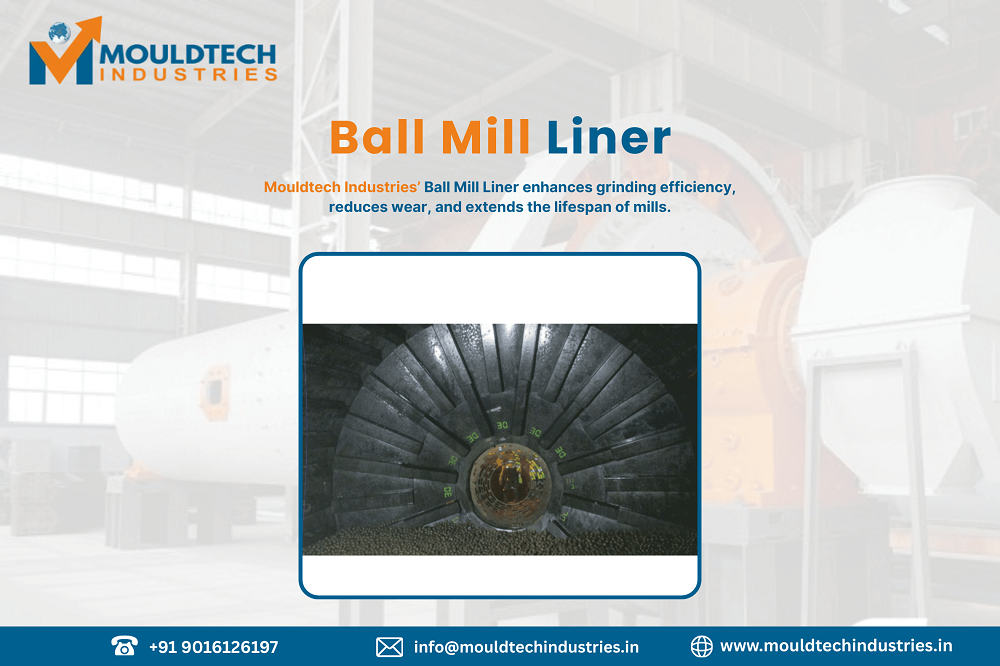
A ball mill lining is a protective layer fitted inside the rotating shell of a ball mill. Its primary purpose is to shield the mill body from direct impact and scraping caused by grinding media and processed substance.
Beyond mere protection, linings influence the grinding action itself. Their contour affects media movement, material transit, and energy transmission. Skillfully designed linings promote effective grinding while minimizing needless wear on both the mill shell and the grinding media.
Ball mill linings are typically constructed from rubber, composite rubber-metal blends, or ceramic wear defense elements, depending on the task’s demands.
Usage Across Sectors
Ball mill linings find application across a broad spectrum of industrial areas:
- Mining: For pulverizing ores such as iron, copper, gold, and bauxite. Linings must withstand high abrasion and impact while supporting extended operational life.
- Cement Plants: Employed in raw mills and finish mills where consistent grinding and contamination management are paramount.
- Metal & Steel: Used in mineral concentration and slag grinding processes where wear rates can be unpredictable.
- Ceramic Production: In ball mills processing feldspar, quartz, and ceramic powders, linings help maintain product cleanliness while controlling abrasion.
- Power Plants: Utilized in coal and limestone grinding systems, supporting energy creation.
- Bulk Material Handling: Supporting apparatus where regulated material flow and diminished wear are necessary for lasting dependability.
Material Science & Engineering Aspects
Material selection is fundamental to lining performance. Seasoned facility engineers often note that an inappropriate material choice leads to premature failure, regardless of lining thickness.
- Rubber Characteristics: Rubber linings provide flexibility, shock absorption, and noise dampening. Their ability to recover energy from repeated impacts lessens stress on the mill shell.
- Ceramic Hardness: Ceramic wear defense features offer superior resistance to scraping. Their firmness makes them suitable for high-wear zones, especially for fine-grinding tasks.
- Wear Resistance Concepts: Abrasive friction relies on particle hardness, dimension, and speed. Linings must balance firmness with resilience to prevent brittle breakdown.
Producers with extensive industry insight understand that lining performance is dictated not by a single attribute but by the interplay of several material qualities.
Blueprint & Customization Needs
No two ball mills operate under identical circumstances. Effective lining systems must account for:
- Apparatus Suitability: Mill diameter, length, rotation rate, and lifter configuration.
- Bespoke Sizing: Precise dimensional control ensures appropriate seating, load spread, and ease of fitting.
- Application-Specific Blueprint: Feed particle size, grinding media type, and process variables affect lining profile and depth.
Tailored lining blueprints help predict wear patterns and streamline maintenance scheduling.
Production Excellence & Process Governance
Precise manufacturing is vital for consistent lining service. Industrial purchasers anticipate:
- Regulated Material Blending: Guaranteeing uniform mechanical traits across production lots.
- Dimensional Exactitude: Close limits for dependable fitting and load dispersion.
- Performance Verification: Visual checks, firmness measurement, and record traceability.
- Lot Uniformity: Replicable results across multiple lining sets.
These checks directly influence the longevity of the lining and the facility’s dependability.
Fitting & Upkeep Matters
Expertly designed linings simplify mounting and lessen upkeep exertion:
- Mounting Simplicity: Segmented blueprints reduce handling complications and installation duration.
- Reduced Stoppage: Quicker liner exchanges boost mill availability.
- Upkeep Intervals: Foreseeable wear permits scheduled breaks instead of urgent fixes.
Clear fitting guidelines and correct tension management are essential for secure operation.
Safety & Functional Dependability
Worker security is a primary concern during liner handling and assembly. Appropriate lining blueprints decrease manual handling hazards and limit exposure within confined mill areas.
Operationally, linings protect the mill shell from structural harm, bolstering long-term facility reliability and mitigating the chance of severe failure.
Economic Prudence Over Equipment Life Cycle
Although linings are expendable parts, their effect on lifetime cost is considerable:
- Long-Haul Economy: Extended lining life reduces replacement frequency.
- Decreased Stoppages: Enhanced operational time supports steady production schedules.
- Maintenance Streamlining: Predictable wear trends simplify inventory and workforce planning.
Cost effectiveness is achieved through trustworthiness and consistency, not quick-fix compromises.
Export Readiness & Worldwide Acceptance
International industrial purchasers expect manufacturers to demonstrate:
- Data & Standard Awareness: Clear technical specifications and quality documentation.
- Packaging & Distribution Preparedness: Secure transit for heavy industrial modules.
- Conformity Focus: Grasp of international industrial benchmarks.
Liner solutions prepared for shipment reflect manufacturing maturity and systematic rigor.
Why Manufacturer Experience is Key
Ball mill linings perform where material science meets mechanical design. Producers with hands-on industry experience understand real operational constraints, beyond theoretical effectiveness.
Dependable sourcing, technical assistance, and design consistency are vital for enduring collaborations.
About Mouldtech Industries
Mouldtech Industries is an experienced industrial producer specializing in ball mill rubber linings, ceramic wear defense options, rubber lining assemblies, ball mill rubber goods, and conveyance systems. Serving industrial clientele across India in states and cities including Odisha, Jharkhand, Chhattisgarh, Gujarat, Maharashtra, Rajasthan, Tamil Nadu, Karnataka, Andhra Pradesh, Telangana, West Bengal, Madhya Pradesh, Uttar Pradesh, Bihar, Punjab, Haryana, Himachal Pradesh, Uttarakhand, Delhi NCR, Assam, Meghalaya, and other industrial territories, the firm supports the mining, cement, metal, ceramic, and bulk Material handling sectors.
With an emphasis on engineering accuracy and manufacturing uniformity, Mouldtech Industries also meets worldwide industrial needs with export-ready solutions. Further details are accessible at https://www.mouldtechindustries.in/.
Summary
Ball mill linings are crucial for the safe and productive functioning of the grinding apparatus. Their function goes beyond just resisting wear to influencing process stability, maintenance preparation, and overall facility efficiency.
For sectors operating under taxing conditions, selecting the appropriate lining solution.
Trending FAQs
1. What is the typical lifespan of a ball mill liner?
Lifespan depends on material type, operating conditions, and maintenance practices. Industrial applications vary widely.
2. Are ball mill liners suitable for wet and dry grinding?
Yes, liners are designed for both environments with material selection adjusted accordingly.
3. How often should liners be inspected?
Regular inspections during planned shutdowns help track wear and prevent unexpected failures.
Reach out to Mouldtech Industries to explore technically sound wear protection solutions designed for demanding industrial operations and long-term equipment reliability.
#BallMillRubberLiner #CeramicWearProtection #RubberLining #MiningSolutions #BulkMaterialHandling #ConveyorSolutions #MouldtechIndustries #WearProtection #IndustrialManufacturing