
Discharge Cone Manufacturer, Supplier, And Exporter in India: Mouldtech Industries
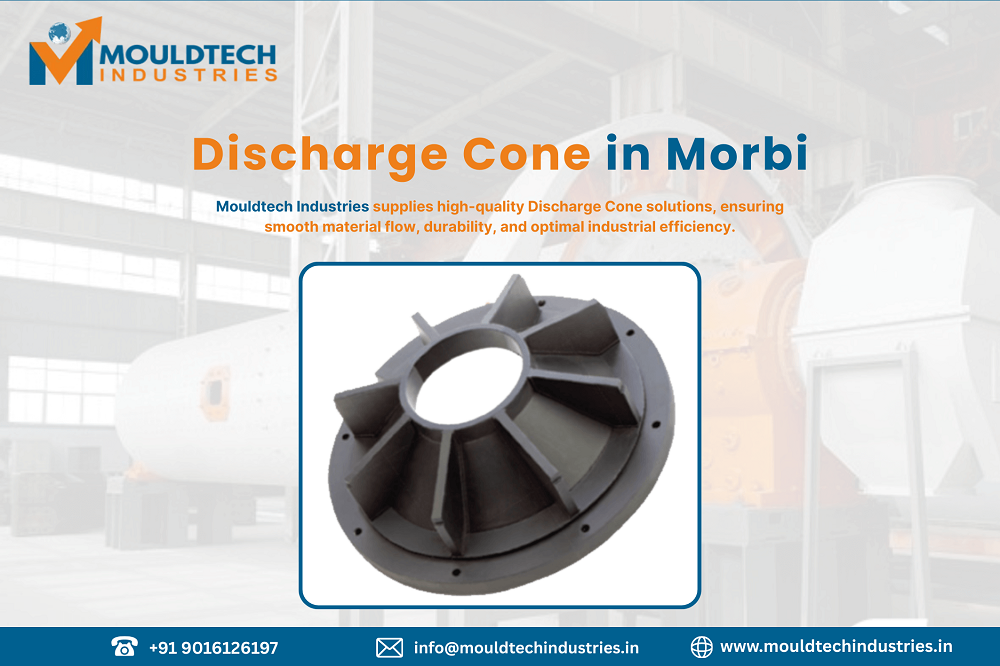
Mouldtech Industries is a Manufacturer of Discharge Cone in Morbi.
Our Manufacturing Unit is in Vadodara, Gujarat, India.
Mouldtech Industries is a Manufacturer of Bridge Rubber Pad, Ball Mill Rubber Lining, Bridge Rubber Pad, Resistant Rubber Liner, Embedded Rubber Liners, Conveyors Solutions, Ceramic Lagging Sheet, Belt Cleaners, Bridge Rubber Pad, Ceramic Rubber Lagging Services, and Ceramic Rubber Lagging Sheet.
Discharge Cone: A Key Component for Shielding Against Wear in Demanding Industrial Settings
Introduction
In heavy-duty industrial settings, keeping equipment running reliably is essential, not optional. Sectors like mining, cement production, metal fabrication, ceramics, and bulk material handling endure continuous mechanical strain, abrasive material movement, impact forces, and challenging operational environments. Any breakdown in material exit areas directly impacts a facility’s output, safety, and expenses.
As the worldwide need for minerals, cement, metals, and specialized ceramics grows, plants are pushed to operate for longer periods with minimal interruptions. This places greater strain on wear parts that are often secondary in initial equipment design but play a crucial role in maintaining continuous operation.
One such part is the Discharge Cone—a vital element for wear protection fitted at material exit points on mills, hoppers, and material transfer systems. While sometimes overlooked, a well-conceived discharge cone significantly affects how efficiently material flows, how long it lasts before wearing out, and how well downstream equipment is protected.
This piece explores the industrial significance of discharge cones, the issues they tackle, and how expertly designed wear solutions aid in dependable plant functioning.
Industrial Problems Driving the Need for Discharge Cones
Throughout various industries, material discharge zones face exceptionally severe operating circumstances. Seasoned plant supervisors frequently observe that problems in these spots result in recurring outages and unpredictable servicing schedules.
Primary issues encompass:
- Wear from Friction: In mining and metal processing, discharge areas handle ground ore, clinker, slag, or raw minerals. Constant sliding and rolling of abrasive substances cause rapid surface deterioration if not suitably safeguarded.
- Impact Forces: Material flow isn’t always smooth. Sudden surges, overly large chunks, or foreign objects generate high impact pressures, particularly in ball mills and material transition points.
- Deterioration from Moisture: The presence of dampness, chemicals, slurry conditions, and process water accelerates corrosion, especially when metal liners lack protective shielding.
- Unscheduled Stoppages: Failures linked to wear at discharge locations often necessitate a complete halt to the equipment, disrupting production plans and staffing logistics.
- Rising Service Expenses: Frequent replacement of liners, necessary welding repairs, and emergency call-outs inflate total lifecycle costs and safety hazards.
These problems are widespread across mining centers, cement facilities, steel complexes, ceramic production zones, and bulk storage terminals across all of India—from Rajasthan and Odisha to Maharashtra, Tamil Nadu, Gujarat, Karnataka, West Bengal, Andhra Pradesh, Telangana, Chhattisgarh, Jharkhand, Madhya Pradesh, and beyond.
Defining the Discharge Cone
A Discharge Cone is a specifically engineered component for wear defense installed at the exit or discharge end of industrial machinery such as ball mills, crushers, hoppers, and material transfer setups.
Its main purposes include:
- Ensuring smooth material channeling during the exit process
- Shielding the fixed structure of the equipment against rubbing and impact
- Sustaining a stable discharge opening profile over extended periods of use
Unlike standard steel parts, discharge cones are typically constructed from wear-resistant rubber, rubber backed with ceramic, or composite lining structures, depending on the severity of the task.
The design emphasizes managed material movement more than just resisting wear, ensuring that subsequent processes remain stable and predictable.
Usage Across Different Sectors
Discharge cones find use wherever material exits under intense wear conditions.
- Mining Sector: In facilities grinding ore and processing minerals, discharge cones shield ball mill exits from severe friction and impact caused by ground ore and grinding media.
- Cement Plants: Clinker discharge locations endure constant abrasion and heat. Discharge cones help keep discharge flow consistent and lessen downtime due to wear.
- Metal & Steel Works: In handling slag, sinter operations, and raw material preparation, discharge cones protect machinery from high-density material streams and impact loads.
- Ceramic Manufacturing: Raw materials used in ceramics are extremely abrasive. Correctly designed discharge cones prevent excessive wear on liners and contamination.
- Power Stations: Systems handling coal and discharging ash depend on durable components to maintain an uninterrupted fuel feed and waste removal.
- Bulk Material Handling Systems: Conveyors, chutes, and transfer stations benefit from discharge cones that reduce material agitation and structural deterioration.
Material Science & Engineering Considerations
The selection of material is vital for how well a discharge cone performs.
- Rubber Characteristics: Industrial-grade rubber offers superb impact dampening, noise reduction, and resistance to sliding abrasion. Its pliability lets it temporarily yield under stress and return to form without breaking.
- Ceramic Toughness: Ceramic tiles deliver excellent defense against fine abrasive wear. When embedded in a rubber base, they merge hardness with the capacity to absorb shocks.
- Wear Resistance Logic: Deterioration occurs due to a mix of rubbing, impact, and the material’s own hardness. Engineers balance toughness and flexibility to prevent brittle failure.
- Shock Absorption: Systems combining rubber backing with ceramics disperse impact energy, safeguarding both the lining and the main piece of equipment.
Manufacturers with extensive field experience know that prioritizing hardness too much, without considering impact, often leads to early part failure.
Design & Customization Needs
No two material exit points are identical. Proper discharge cone design necessitates:
- Alignment with the current equipment’s physical layout
- Tailored dimensions to match the exit diameter and flow characteristics
- Optimal thickness determined by how severe the wear is expected to be
- Material choice suited to the specific process environment
A design specific to the application guarantees even distribution of wear and prevents failure in narrow spots.
Production Quality & Process Oversight
Precise manufacturing directly influences the lifespan of the liner.
Key production factors include:
- Careful formulation of the rubber mixture
- Exact positioning of ceramic pieces
- Consistent processes for bonding materials
- Accurate measurement of final dimensions
Consistency across production batches and the ability to track materials ensure reliable field performance, particularly in large-scale industrial operations.
Fitting & Servicing Guidelines
Even well-designed discharge cones are built for:
- Straightforward mounting procedures
- Secure fastening mechanisms
- Fewer problems with component alignment
Correct installation cuts down on initial setup delays, while predictable wear patterns allow maintenance teams to schedule replacement intervals effectively.
Safety & Operational Dependability
Shielding against wear is also a matter of safety.
A degraded discharge cone can result in:
- Sudden failure of the lining material
- Spillage of process material
- Damage to machinery
- Increased risk for personnel performing maintenance
Dependable wear components contribute to safer work environments and stable plant operation.
Value Over the Equipment’s Operational Lifespan
Although discharge cones are parts that will eventually be consumed, their real worth is demonstrated by their long-term service.
Advantages include:
- Fewer necessary interruptions to production
- Reduced need for maintenance staff hours
- Safeguarding of more costly, core machinery
Long-term operational consistency provides greater benefit than the upfront expense of replacement.
Export Readiness & Worldwide Acceptance
Industrial purchasers nowadays commonly anticipate:
- Uniform product caliber
- Lucid technical papers
- Awareness of worldwide operational settings
Manufacturers prepared for export harmonize their offerings with worldwide industrial benchmarks spanning mining, cement, and bulk material movement sectors.
The Significance of Seasoned Producers
While discharge cones might seem straightforward, flawed design or material choices can lead to recurring breakdowns.
Seasoned manufacturers offer:
- In-depth application insight
- Expertise in material science
- Production methods driven by process
- Assured continuity of supply
This depth of experience results in fewer unexpected issues on site.
Introducing Mouldtech Industries
Mouldtech Industries stands as a seasoned Indian fabricator specializing in ball mill rubber linings, ceramic defense systems against wear, rubber coating setups, rubber goods for ball mills, and conveying solutions. Catering to industries throughout India and specific international industrial arenas, the firm concentrates on expertly designed wear defense solutions crafted for practical operating environments.
Further details can be found at https://www.mouldtechindustries.in/
Summary
The Discharge Cone performs a vital function in safeguarding machinery, standardizing material movement, and boosting facility dependability within the mining, cement, metal, ceramic, and bulk material handling sectors.
When correctly conceived, built, and fitted, it substantially aids operational effectiveness, safety, and lasting expense management—thus becoming a fundamental element in contemporary industrial sites.
For technical staff and facility supervisors, choosing the correct discharge cone concerns dependability more than mere replacement.
Core Lessons
- Discharge cones safeguard areas subject to intense wear at the discharge point
- Appropriate material choice extends service life
- Intelligent design minimizes stoppages
- Suitable across numerous demanding sectors
- Bolsters enduring operational consistency
Trending FAQs
Q1. What is the typical lifespan of a discharge cone?
Lifespan depends on material flow, abrasion severity, and operating conditions. Properly engineered cones offer predictable service cycles.
Q2. Are discharge cones suitable for high-impact applications?
Yes, rubber and ceramic-rubber composite designs are commonly used for impact-prone environments.
Q3. How often do discharge cones require maintenance?
Maintenance frequency depends on wear rate but is generally aligned with scheduled shutdowns.
Q4. Rubber vs ceramic wear solutions—what’s the difference?
Rubber handles impact well, while ceramic offers superior abrasion resistance. Composite systems combine both benefits.
Q5. Are discharge cones used globally?
Yes, they are standard components in mining, cement, and bulk handling plants worldwide.
Contact Mouldtech Industries today for expert guidance and solutions on Discharge Cone installation, maintenance, and customization. Ensure reliable operations across your industrial plant.
#BallMillRubberLiner #CeramicWearProtection #RubberLining #MiningSolutions #BulkMaterialHandling #ConveyorSolutions #MouldtechIndustries #WearProtection #IndustrialManufacturing