
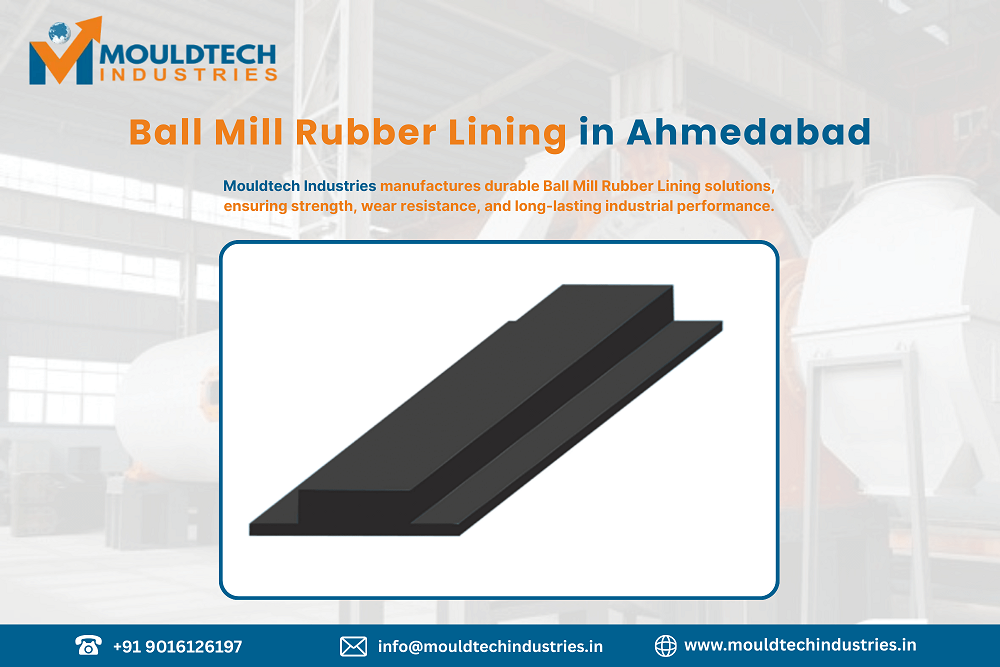
Ball Mill Rubber Lining Manufacturer, Supplier, And Exporter in India: Mouldtech Industries
Mouldtech Industries is a Manufacturer of Ball Mill Rubber Lining in Ahmedabad.
Our Manufacturing Unit is in Vadodara, Gujarat, India.
Mouldtech Industries is a Manufacturer of Ball Mill Solutions, Ball Mill Rubber Lining, Wear Protection Line, Resistant Rubber Liner, Embedded Rubber Liners, Conveyors Solutions, Diamond Pulley Lagging, Belt Cleaners, Pulley Lagging, Ceramic Rubber Lagging Services, and Ceramic Rubber Lagging Sheet
Ball Mill Rubber Lining: Shielding Against Wear in Tough Industrial Settings
Introduction
In harsh industrial settings, equipment faces multiple challenges simultaneously. Mining deals with constant ore erosion. Cement producers contend with the impact of hard clinker. Ceramic factories process sharp, brittle feedstocks. Bulk transport lines endure repeated mechanical stress, often with limited scheduled stops. Across these sectors, unexpected stoppages, rapid material loss, and safety concerns are common operational headaches.
As global demand for resources, building materials, and energy continues to rise, production facilities are under pressure to run longer, harder, and more efficiently. This places greater strain on vital machinery, such as grinding mills, conveyors, chutes, and transfer points. Wear management is now fundamental to maintaining operational uptime and controlling long-term expenses.
Ball Mill Rubber Lining has become an essential industrial solution for tackling these issues. When properly engineered and fitted, it plays a key role in safeguarding machinery, stabilizing output, and enhancing future maintenance across the mining, cement, metal, ceramic, and bulk-handling sectors.
Industrial Issues Driving the Need for Ball Mill Rubber Lining
Seasoned plant supervisors know wear-related failures seldom happen overnight. They develop slowly under demanding operating conditions characterized by:
- Abrasion: Continuous rubbing between grinding media, feed material, and the mill’s interior causes surface erosion. In mining and metal refining, abrasive ores accelerate liner wear.
- Impact Loads: Heavy grinding components and incoming material create repeated shock forces. Metal liners can transmit these shocks directly into the shell, increasing structural stress.
- Corrosion: Dampness, chemical exposure, and slurry environments promote rust, particularly in wet grinding processes.
- Downtime and Maintenance Strain: Frequent liner swaps result in more extended closures, increased safety hazards for workers, and lost production.
- Increasing Repair Costs: Reactive maintenance approaches drive up the use of spare parts and labour needs over time.
These issues are widespread. Similar operational demands exist in mining centers, ceramic production areas, and metal refining hubs globally, including major manufacturing regions in India.
Defining Ball Mill Rubber Lining
Ball Mill Rubber Lining describes customized rubber-based protection systems installed inside grinding mills to protect the mill shell from deterioration, impact, and corrosion.
Unlike metal liners, rubber ones rely on flexible energy absorption rather than stiffness. The rubber flexes under impact, spreads out the energy, and then springs back. This basic mechanical response lessens stress transfer to the mill structure.
Rubber liners are typically built in manageable sections, enabling spot replacement based on wear patterns instead of total system overhauls.
This is not a universal product. Its effectiveness hinges significantly on the rubber blend, the liner’s shape, operational settings, and the quality of its application.
Sector-Specific Uses
Mining Sector
In mining operations, ball mills process abrasive ores heavily. Rubber liners help cut down shell wear, manage noise, and absorb impact energy, especially in later-stage grinding circuits.
Cement Facilities
Cement mills run constantly with minimal allowance for stoppages. Rubber liner systems help handle impact from grinding parts and clinker, supporting more predictable maintenance scheduling.
Metal & Steel Plants
In metal processing sites, wear defence solutions are needed not only for grinding but also for moving and transferring materials. Rubber linings complement ceramic protection in areas with severe abrasion.
Ceramic Production
Ceramic factories handle exceptionally hard feedstocks. Rubber lining is often paired with ceramic wear tiles in spots where erosion is a bigger concern than direct impact.
Power Plants
Coal-handling and ash-processing systems benefit from rubber lining solutions that reduce erosion and vibration-related damage.
Bulk Conveyance
Conveyors, chutes, bins, and transfer points use rubber lining systems to regulate material flow and minimize shutdowns caused by wear.
Material Science & Design Factors
Producers with deep industry knowledge recognize that material choice dictates performance.
Rubber Characteristics
Industrial rubber mixes are engineered for:
- Flexibility and bounce-back
- Resistance to tearing
- Resistance to wear
- Chemical stability
Finding the right balance between firmness and pliability is vital. Rubber that is too hard may resist surface wear but sacrifice impact dampening.
Ceramic Hardness
Ceramic wear tiles offer superior hardness and abrasion defense. When backed by rubber, they merge rigidity with energy cushioning.
Wear Resistance Principles
Wear is affected by particle size, speed, impact angle, and material toughness—a successful lining design accounts for all these elements, not just the material’s strength.
Engineering & Customization Requirements
Ball mill rubber lining solutions must be custom-made for the equipment—not forced to fit afterward.
Key design considerations include:
- Mill size (diameter and length)
- Rotation speed
- Size of grinding media
- Feed material nature
- Lifter bar design
Exact sizing guarantees correct placement, load sharing, and more straightforward fitting. Poorly designed liners can create stagnant spots, uneven material removal, and operational inefficiencies.
Manufacturing Excellence & Process Oversight
Precise fabrication directly influences liner longevity and function.
Crucial production controls involve:
- Consistent rubber compound blending
- Accurate moulding and curing times
- Exact dimensional compliance
- Tracking by production lot
Quality checks usually involve testing hardness, conducting visual inspections, and verifying dimensions to ensure consistency across all manufactured units.
Fitting & Upkeep Notes
Ease of installation impacts both safety and production time.
Thoughtfully engineered rubber lining systems:
- They are lighter than metal equivalents
- Permit replacement of single parts
- Reduce handling hazards during servicing
Maintenance timelines become more predictable, enabling scheduled downtime rather than urgent repairs.
Safety & Operational Dependability
Worker well-being is closely linked to linear performance.
Rubber coverings contribute to:
- Diminished noise levels
- Reduced transmission of vibrations
- More secure handling during setup
Operational dependability is enhanced when machinery runs within its intended stress tolerances, safeguarding both staff and assets.
Value Over the Equipment’s Lifespan
Cost-effectiveness is achieved not through cheaper initial material outlays, but via lifecycle enhancement.
Ball Mill Rubber Lining facilitates:
- Lengthened liner service intervals
- Fewer shell repair necessities
- Streamlined maintenance planning
Over time, this leads to quantifiable reductions in unexpected stoppages and maintenance-related losses.
Export Readiness & Worldwide Acceptance
International industrial purchasers expect more than just product shipment.
Manufacturers prepared for export showcase:
- Clear documentation practices
- Uniform quality benchmarks
- Adherence to packaging and transport regulations
Ball mill rubber lining systems that meet global industrial standards are gaining traction across the worldwide mining, cement, and bulk material handling sectors.
The Importance of Experienced Producers
Engineering expertise cannot be replicated by standard manufacturing.
Producers with extensive industry involvement grasp:
- Actual plant operating environments
- Failure patterns observed across many years
- Design needs to be specific to the application
Dependable supply, specialized support, and consistent quality are results of experience, not just marketing efforts.
Regarding Mouldtech Industries
Mouldtech Industries is a seasoned manufacturer specializing in Ball Mill Rubber Liners, Ceramic Wear Protection Systems, Rubber Lining Assemblies, Ball Mill Rubber Components, and Conveyor Services.
Serving Pan India industrial sectors across key mining territories, ceramic zones, metal processing hubs, cement manufacturing areas, and bulk material transport routes, the firm assists plant engineers, maintenance crews, equipment manufacturers, project contractors, and advisory consultants with tailored wear protection solutions for specific applications.
Further details are accessible at 👉 https://www.mouldtechindustries.in/
Summary
Ball Mill Rubber Lining serves a vital function in safeguarding grinding machinery, stabilizing processes, and boosting long-term plant productivity. When correctly engineered, it promotes safer maintenance routines, more predictable wear progression, and optimized equipment lifespan.
For industries subjected to constant mechanical stress, deliberate wear protection design is not optional—it is fundamental to operational trustworthiness.
Essential Points
- Effective wear defence enhances equipment reliability.
- Rubber coverings manage impact, erosion, and chemical attack
- Suitable for mining, cement, metal, ceramic, and bulk handling sectors
- Promotes safer servicing and well-timed outages
- A globally recognized solution when expertly designed
Current Frequently Asked Questions
1. What is generally the service duration for Ball Mill Rubber Lining?
Its service life is contingent on operational demands, the material’s abrasiveness, and the mill’s structure. Linings designed appropriately generally endure through several pre-planned maintenance periods.
2. Is Ball Mill Rubber Lining appropriate for all types of milling operations?
Rubber coverings are excellent for numerous uses but require assessment against heat, impact severity, and chemical exposure.
3. How frequently should rubber linings be checked?
Regular examinations during scheduled downtimes help monitor wear trends and organize replacements effectively.
4. Comparing rubber versus ceramic wear solutions—what are the differences?
Rubber excels at absorbing impact, whereas ceramics offer superior abrasion resistance. Many setups integrate both materials.
5. Are these solutions utilized internationally?
Yes. Rubber and ceramic wear protection packages are widely used across the global mining, cement, and bulk-handling industries.
Contact Mouldtech Industries for Ball Mill Rubber Lining solutions. Our team supports plant engineers with reliable wear protection, application guidance, and industrial supply across India.
#BallMillRubberLining #BallMillRubberLiner #RubberLining #CeramicWearProtection #BallMillRubberProducts #IndustrialWearProtection #MiningWearSolutions #CementMillLiner #BulkMaterialHandling #MouldtechIndustries