

Impact Bar Manufacturer, Supplier, And Exporter in India: Mouldtech Industries
Mouldtech Industries is a Manufacturer of Impact Bar in Morbi.
Our Manufacturing Unit is in Vadodara, Gujarat, India.
Mouldtech Industries is a Manufacturer of Bridge Rubber Pad, Ball Mill Rubber Lining, Bridge Rubber Pad, Resistant Rubber Liner, Embedded Rubber Liners, Conveyors Solutions, Ceramic Lagging Sheet, Belt Cleaners, Bridge Rubber Pad, Ceramic Rubber Lagging Services, and Ceramic Rubber Lagging Sheet.
Impact Bars: A Vital Wear Defense for Modern Bulk Material Conveying
Introduction
Industries like mining, metal refinement, cement production, ceramics, and general bulk material handling face extremely demanding operational settings. The constant movement of material, heavy impacts, and handling of abrasive substances such as ores, clinker, coal, limestone, and ceramic inputs place immense strain on machinery, particularly where materials transfer between conveyors.
In these severe industrial settings, unprotected impact points are a frequent cause of conveyor belt harm, material escape, excessive shaking, and unexpected stoppages. These problems directly hurt facility uptime, repair expenses, and personnel safety.
Across the globe, there’s a trend towards longer equipment lifespans, less downtime, and more predictable upkeep scheduling. Wear protection is increasingly viewed not just as a recurring cost, but as a crucial element of facility engineering planning.
In this context, Impact Bars have emerged as a necessary component for safeguarding conveyor belts and support frameworks at loading and transfer locations, especially in high-capacity setups.
Industrial Hurdles Driving the Need for Impact Bars
Several consistent issues across mining, cement, steel, ceramics, and bulk material transport facilities fuel the demand for sturdy impact mitigation systems:
- Surface Wear and Material Fall: Heavy, jagged, and irregularly shaped loads dropping from a height inflict significant surface damage on belts and supporting structures. Experienced facility supervisors often note that most premature belt failures originate at transfer points.
- Intense Impact Forces: Large lump sizes and significant drop distances generate focused impact energy that standard idlers or rollers cannot effectively manage.
- Degrading and Dusty Conditions: Moisture, chemical exposure, fine particles, and temperature fluctuations speed up the deterioration of metal parts.
- Downtime and Maintenance Stress: Unexpected belt replacements and necessary framework repairs lead to lost production time, particularly in continuous processing plants.
- Ascending Maintenance Expenditures: Frequent fixes, the need to stock spare parts, and labor requirements substantially inflate operating costs.
These difficulties are regularly observed in mining and metal processing operations—from iron ore lines in regions like Odisha and Chhattisgarh to coal facilities in Jharkhand and power stations throughout India.
What Constitutes an Impact Bar?
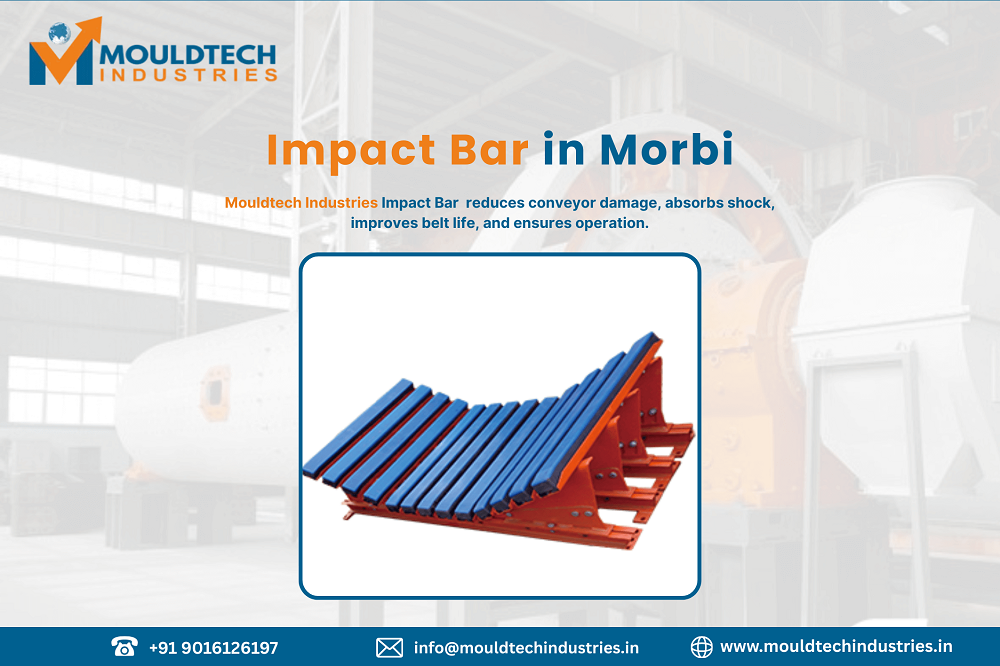
An Impact Bar is a sectional support unit fitted at material loading and transfer points along a conveyor. It serves in place of traditional impact rollers and is engineered to absorb kinetic energy while maintaining continuous support for the belt.
A typical impact bar assembly includes:
- A durable top surface (frequently UHMWPE or a polymer enhanced with ceramics) for smooth belt interaction.
- An internal rubber layer designed to cushion and disperse impact shocks.
- A robust metal base for secure attachment to impact beds or support racks.
The objective is straightforward yet vital: to shield the conveyor belt, lessen shock loads, and stabilize material flow without introducing undue friction or strain on the belt itself.
Use Cases Across Sectors
Impact bars find application wherever bulk materials are moved, dropped, or loaded onto conveyors.
- Mining Sector: Deployed in systems handling iron ore, coal, bauxite, limestone, and minerals to protect belts below crushers and at transfer chutes.
- Cement Facilities: Installed on clinker conveyors, limestone feeding areas, and raw mill input belts to cut down on belt damage and system vibration.
- Metal & Steel Mills: Utilized in sinter plants, coke handling lines, slag conveyors, and raw material storage areas where heavy impacts are unavoidable.
- Ceramic Production: In ceramic manufacturing centers across Gujarat, Rajasthan, and Morbi, impact bars guard conveyors moving feldspar, quartz, clay, and other rough feedstock.
- Power Generation Plants: Coal handling lines in thermal power stations depend on impact bars to manage heavy and uneven coal loading.
Bulk Handling & Port Operations: Used in fertilizer plants, ports, and EPC-managed material handling projects throughout India—spanning states like Maharashtra, Gujarat, Tamil Nadu, Karnataka, Telangana, and Andhra Pradesh, and industrial centers such as Pune, Ahmedabad, Surat, Chennai, Coimbatore, Hyderabad, Vizag, Raipur, Rourkela, Jamshedpur, Durgapur, and Bokaro.
Material Science and Design Principles
The efficacy of an impact bar is heavily reliant on the selection of materials and the engineering of its structure.
- Rubber Characteristics
- The rubber stratum needs a balance between:
- High elasticity for effective shock absorption.
- Appropriate firmness to prevent lasting deformation.
- Durability against repeated stress cycles.
Manufacturers with extensive time in the field recognize that the specific rubber mix dictates energy dispersal capability and component lifespan.
- Wear Surface Engineering
- The outer layer in contact with the belt must provide:
- Low surface drag to preserve belt covering integrity.
- High resistance to abrasive wear.
- Shape stability when under load.
In zones subject to extreme impact, surfaces incorporating ceramics or specialized engineering polymers are sometimes favored for extended service life.
Impact Dissipation Mechanics: Effective impact bars spread the applied force over a broader surface, mitigating the peak stress exerted on the belt and underlying framework.
Design Specifications and Custom Adaptation
No two conveyor installations are identical. Impact bars must be tailored to the unique operational parameters of each facility.
Key design elements to consider include:
- Belt dimension and velocity
- The height of material drop and the size of the largest lumps
- Levels of moisture, temperature, and airborne dust
- Compatibility with existing impact beds or support mounting points
Bespoke sizing, the spacing of support slots, and specific attaching methods are frequently necessary to guarantee correct load distribution and straightforward replacement during scheduled maintenance.
Manufacturing Excellence and Process Controls
Predictable performance stems from rigorous manufacturing standards.
Manufacturers focused on quality emphasize:
- Controlled processes for mixing and curing the rubber compounds
- Precise machining of the metal support base
- Dimensional verification for batch uniformity
- Strong adhesion between the rubber, the wear layer, and the steel structure
Adherence to process control ensures that every impact bar functions reliably under equivalent running conditions.
Setup and Servicing
From a servicing viewpoint, impact bars are favored due to their simplicity.
Key benefits include:
- Easy assembly and unit exchange
- Fewer issues with belt alignment
- Minimal need for fine-tuning post-installation
With proper fitting, maintenance intervals are lengthened, and routine checks become more predictable, thereby reducing the incidence of emergency downtime.
Safety and Operational Consistency
Impact bars play a direct role in enhancing site safety.
By stabilizing belts and minimizing dropped material, they help to:
- Reduce hazards related to workplace cleanliness
- Protect personnel from sudden belt failure events
- Lower vibration and noise output at material transfer zones
Protecting the equipment inherently leads to smoother, more dependable operations.
Value Proposition Across the Equipment Lifespan
Although impact bars represent a small portion of a conveyor setup, their effect over the entire service life is considerable.
Long-term advantages include:
- Extended operational life for the main conveyor belt
- Reduced damage to structural elements
- Lower consumption of replacement parts
- Fewer unexpected outages
For operational management, this translates into improved overall equipment effectiveness (OEE) without adding complexity to the system design.
Export Readiness & Worldwide Acceptance
International industrial purchasers anticipate:
- Uniform quality
- Technical specifications
- Verifiable sourcing
- Awareness of worldwide operational settings
Impact bars sent to foreign destinations need to conform to global standards for material handling and bundling, particularly for overseas mining and cement ventures.
The Value of Seasoned Producers
Impact bars might seem straightforward, yet their effectiveness hinges on technical insight.
Producers with extensive background provide:
- Design expertise tailored to the specific application
- Insight into how materials behave
- Dependable manufacturing scheduling
- Ongoing technical assistance
In crucial industrial settings, the dependability of the supplier is just as vital as the standard of the product.
Introducing Mouldtech Industries
Mouldtech Industries is a seasoned producer of industrial wear defense and material movement systems, serving customers throughout India and select international industrial sectors.
Possessing proficiency in:
- Rubber linings for ball mills
- Solutions for ceramic wear resistance
- Rubber cladding setups
- Rubber goods for ball mills
- Elements for conveyors and bulk material conveyance
the firm assists the mining, cement, metal, ceramic, and energy sectors with custom-engineered remedies driven by application needs.
Summary
Impact bars are vital in shielding conveyor setups from harm due to heavy blows and rubbing. In challenging industrial settings, they assist in stabilizing processes, extending machinery lifespan, and encouraging safer workspaces.
When designed and implemented accurately, impact bars feed directly into sustained facility output rather than temporary upkeep adjustments.
For facility technical staff and operational groups, choosing the correct design and manufacturing collaborator continues to be essential for steady service.
Main Points to Remember
- Impact bars shield conveyor belts in areas subject to strong impact
- They boost dependable operation and workplace security
- Suitable for the mining, cement, metal, ceramic, and power sectors
- Correct material science guarantees enduring functionality
- Universally recognized in current bulk material transport setups
Trending FAQs
Q1. What is the typical lifespan of an impact bar?
Lifespan depends on material handled, drop height, and operating conditions. In controlled environments, impact bars often outlast conventional impact idlers.
Q2. Are impact bars suitable for all conveyor systems?
They are best suited for loading and transfer zones. System compatibility should be evaluated during design.
Q3. How often do impact bars require maintenance?
Routine visual inspections are usually sufficient. Replacement is typically required only after wear layer degradation.
Q4. Rubber vs ceramic wear solutions—what’s the difference?
Rubber absorbs impact energy, while ceramic provides high abrasion resistance. Some designs combine both for balanced performance.
Q5. Are impact bars used globally?
Yes. They are standard in mining, cement, and bulk handling projects worldwide.
Contact Mouldtech Industries today to discuss Impact Bar solutions engineered for heavy-duty conveyor systems, ensuring reliable wear protection, reduced downtime, and long-term operational efficiency.
#ImpactBar #ConveyorImpactBar #ConveyorSolutions #BulkMaterialHandling #WearProtection #MiningConveyors #CementPlantEquipment #SteelPlantConveyors #PowerPlantHandling #RubberProducts #IndustrialConveyors #MaterialHandlingSolutions #HeavyDutyConveyors #MouldtechIndustries