
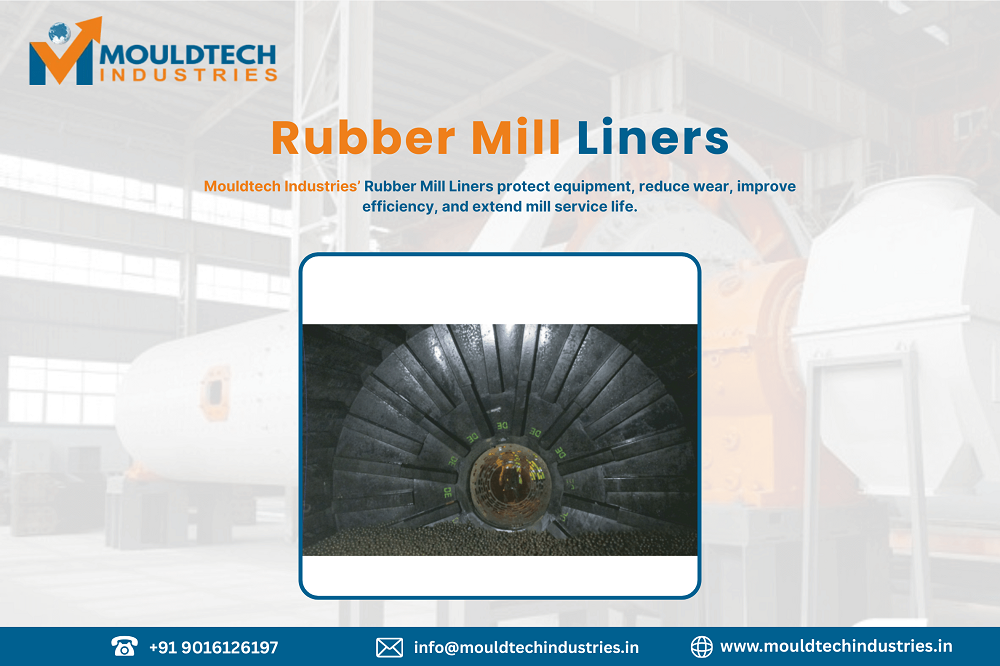
Rubber Mill Liners Manufacturer in India: Mouldtech Industries
Mouldtech Industries is a Manufacturer, Supplier, and Exporter of Rubber Mill Liners.
Our Manufacturing Unit is in Vadodara, Gujarat, India.
Mouldtech Industries is a Manufacturer of Ball Mill Solutions, Ball Mill Rubber Lining, Wear Protection Line, Resistant Rubber Liner, Embedded Rubber Liners, Conveyors Solutions, Impact Bed Assembly and Impact Pads, Belt Cleaners, Pulley Lagging, Ceramic Rubber Lagging Services, and Ceramic Rubber Lagging Sheet.
Rubber Mill Liners: Designing Wear Defense for Dependable Industrial Functioning
Introduction
Industries such as mining, metal fabrication, cement production, ceramics, and bulk material logistics operate amidst some of the most severe mechanical settings in current manufacturing. Constant rubbing, recurring shock loads, dampness, chemical exposure, and high operating temperatures impose constant strain on machinery. For facility designers and upkeep crews, managing wear isn’t solely about prolonging component lifespan—it’s about guaranteeing operational continuity, personnel well-being, and consistent output schedules.
In rigorous industrial settings, machinery dependability directly impacts operating costs, compliance with safety regulations, and overall facility output. As worldwide demand for minerals, cement, steel, and processed goods continues to rise, these sectors face pressure to improve efficiency while keeping maintenance costs in check.
Rubber Mill Liners have surfaced as a crucial industrial remedy in this context. They serve a primary function in shielding mills, chutes, hoppers, and material-conveyance gear from excessive deterioration, while also assisting with noise dampening, shock absorption, and safer maintenance procedures. Their adoption stems not from passing trends, but from genuine operational necessities observed throughout industrial sites in India and major global mining centers.
Industrial Hurdles Driving the Need for Rubber Mill Liners
Industrial facilities across India—from resource extraction zones in Odisha and Chhattisgarh to cement hubs in Rajasthan, Gujarat, and Andhra Pradesh—face similar challenges of material degradation.
- Abrasion: The nonstop movement of ores, clinker, coal, and aggregates causes material erosion on metal surfaces. Over time, unaddressed scraping diminishes equipment thickness and jeopardizes structural soundness.
- Impact Forces: Within grinding mills and transfer junctures, descending material creates repeated impact stresses. Metal linings frequently transmit these jolts straight to the shell, escalating fatigue stress.
- Corrosion: Moisture, slurry conditions, and contact with chemicals speed up degradation, especially in resource extraction and mineral processing activities.
- Outages: Recurrent liner substitution leads to both scheduled and unscheduled halts. Seasoned facility engineers often note that the cost of downtime far surpasses the expense of replacing parts.
- Upkeep Expenditures: Manpower, lifting apparatus, safety oversight, and lost production hours collectively swell maintenance spending.
These difficulties are not exclusive to India. Comparable operational scenarios are present in mining locales throughout Australia, Africa, South America, and Asia, where defending equipment from wear is a fundamental operational concern.
What Constitutes a Rubber Mill Liner?
A Rubber Mill Liner is a protective covering system installed inside mills, chutes, hoppers, and material transport machinery, designed to buffer impacts, reduce friction, and safeguard structural elements.
Unlike stiff metal coverings, rubber liners are crafted to blend flexibility with wear resistance. This characteristic enables them to flex under impact, diffusing energy instead of transmitting it directly to the equipment housing. In specific uses, rubber liners are also paired with ceramic wear inserts to achieve a balance between resilience and surface hardness.
Rubber mill liners are not a one-size-fits-all solution for every wear problem. Their efficacy hinges on operational circumstances, material properties, and equipment configuration—making a technical evaluation vital before selection.
Uses Across Various Sectors
- Mining Sector: In extraction activities, rubber mill linings are widely used in ball mills, SAG mills, slurry conveyance systems, and feed chutes. They assist in managing the force from large rock fragments while mitigating sound and vibration.
- Cement Manufacturing: Cement grinding units, raw material chutes, and clinker transport systems benefit from rubber cladding due to its resistance to erosion and its ability to reduce stoppages caused by liner failure.
- Metal & Steel Production: Steel mills use rubber linings in sinter plants, ore-handling systems, and ash-disposal areas where both rubbing and striking forces are present.
- Ceramic Production: Raw materials for ceramics are highly abrasive. Rubber- and ceramic-lined arrangements protect processing gear while maintaining uniform material flow.
- Power Generation Plants: Coal-handling facilities and ash slurry pipelines employ rubber lining systems to combat erosive wear and damp-related deterioration.
- Bulk Material Conveyance: Transfer spots on conveyors, hoppers, and storage bins across ports, depots, and processing sites rely on rubber linings to lessen wear and prevent spillage.
Material Science & Engineering Aspects
The performance of rubber lining is grounded in material science fundamentals rather than promotional statements.
Rubber Characteristics
Industrial-grade rubber mixtures are formulated to deliver:
- Managed flexibility
- High resistance to tearing
- Wear-defying qualities
- Stability across environmental factors
The rubber’s stiffness is selected based on impact severity and the dimensions of the transported material.
- Ceramic Rigidity: When ceramic wear components are incorporated, they offer superior resistance to surface wear. Ceramics effectively handle sliding friction but necessitate a rubber base to manage sudden impacts.
- Wear Resistance Concepts: Wear results from contact pressure, sliding speed, material strength, and impact energy. Rubber absorbs energy, while ceramics resist surface loss, making hybrid systems effective in demanding zones.
- Impact Dampening: Rubber’s ability to absorb shock reduces stress on equipment housings, fasteners, and supporting structures.
This equilibrium explains why rubber and ceramic solutions are engineered together rather than used interchangeably.
Design & Customization Needs
No two facilities operate under precisely the same conditions. Producers with extensive industry tenure recognize that practical wear defense demands tailored solutions.
Key design considerations encompass:
- Equipment shape and shell density
- Material dimensions and flow dynamics
- Operational pace and loading
- Fitting constraints
Bespoke dimensions ensure correct placement, load dispersal, and liner anchoring. Application-specific design also influences lining thickness, supporting structures, and attachment methods.
Production Quality & Process Oversight
Precise manufacturing is non-negotiable for dependable rubber mill liners.
Manufacturers focused on quality employees:
- Regulated compound blending
- Accurate shaping and vulcanization schedules
- Measurement verification
- Uniformity checks across batches
Every liner must meet mechanical and dimensional specifications to guarantee consistent performance. Variable vulcanization or compound discrepancies can cause early failure—something astute purchasing managers actively avoid.
Fitting & Servicing Considerations
The simplicity of attachment directly influences facility downtime.
Rubber linings are typically lighter than steel counterparts, reducing:
- Handling hazards
- Time spent on installation
- Need for heavy lifting gear
Service intervals are often stretched due to less shell damage and controlled wear patterns. Appropriate inspection routines enable liners to be replaced during planned downtimes rather than emergency stops.
Safety & Functional Dependability
Worker safety is a significant factor in selecting linings.
Rubber linings contribute to:
- Lower noise metrics
- Reduced risk of liner fracture
- Safer handling during upkeep tasks
By protecting equipment from excessive deterioration, linings also improve operational reliability and reduce secondary failures in interconnected machinery.
Value Over Total Equipment Lifespan
Economic value is assessed across the entire machinery lifespan—not at the initial purchase.
Rubber mill liners help to:
- Cut down on unscheduled stoppages
- Safeguard costly assets
- Optimize maintenance timings
While the price of individual liners differs, the long-term operational savings often validate their selection in high-wear areas.
Export Readiness & Worldwide Acknowledgment
Global industrial purchasers anticipate:
- Uniform quality standards
- Detailed technical reports
- Guidance on application use
- Reliable supply timelines
Manufacturers prepared for export adhere to international benchmarks, material tracking, and packaging norms. These expectations apply equally to mining endeavors in Africa, cement works in the Middle East, and metal processors in Southeast Asia.
Why In-Depth Manufacturer Experience Matters
Wear defense is not a standard off-the-shelf item. It necessitates:
- Expertise in application
- Engineering backing
- Manufacturing rigor
- Sustained dependability
Manufacturers with real facility experience grasp failure mechanisms, fitting complications, and operational limits—knowledge that directly impacts liner effectiveness.
Regarding Mouldtech Industries
Mouldtech Industries is a seasoned industrial producer specializing in rubber mill linings, ceramic wear protection solutions, rubber cladding systems, ball mill rubber components, and conveyor solutions. Serving a wide array of Indian industries—including major operational zones in Maharashtra, Gujarat, Odisha, Chhattisgarh, Rajasthan, Tamil Nadu, Karnataka, Andhra Pradesh, Telangana, West Bengal, and beyond—the company supports the mining, cement, metal, ceramic, and bulk-material-handling sectors.
With a grasp of both domestic and international industrial demands, Mouldtech Industries delivers engineered wear solutions tailored to actual operational settings. Further insights are available at https://www.mouldtechindustries.in/.
Summary
Rubber mill liners serve a crucial function in safeguarding machinery, enhancing safety, and sustaining consistent plant operations. Their merit lies not in assertions, but in demonstrated performance across demanding industrial settings.
When properly conceived, manufactured, and fitted, rubber linings help achieve greater equipment reliability and more predictable maintenance scheduling—essential considerations for modern industrial facilities.
For engineers and purchasing groups, making an informed lining selection remains a practical engineering determination rather than a marketing choice.
Key Insights
- Mill liners made of rubber offer defense against wear, shock, and rust for machinery
- They boost dependable operation and personnel security
- Appropriate for sectors like mining, concrete production, metallurgy, ceramics, and mass conveyance
- Effectiveness hinges on the chosen substance and a design tailored to the specific use
- Recognized worldwide in rigorous industrial settings
Trending FAQs
Q1. What is the typical lifespan of rubber mill liners?
Lifespan depends on operating conditions, material characteristics, and maintenance practices rather than fixed timelines.
Q2. Are rubber liners suitable for high-impact applications?
Yes, when correctly engineered. Rubber’s elasticity helps absorb impact loads effectively.
Q3. How often do rubber mill liners require maintenance?
Inspection intervals are usually aligned with planned shutdowns, reducing emergency maintenance.
Q4. Rubber vs ceramic wear solutions—how do they differ?
Rubber absorbs impact, while ceramics resist abrasion. Hybrid systems often combine both advantages.
Q5. Are rubber mill liners used globally?
Yes, they are widely used in mining, cement, and bulk handling industries worldwide.
Reach out to Mouldtech Industries for technical inquiries, product specifications, or customized wear protection solutions. Our team of experienced engineers works closely with plant engineers, maintenance professionals, and project teams to understand operating conditions and recommend solutions aligned with your plant requirements.
#BallMillRubberLiner #CeramicWearProtection #RubberLining #MiningSolutions #BulkMaterialHandling #ConveyorSolutions #MouldtechIndustries #WearProtection #IndustrialManufacturing