
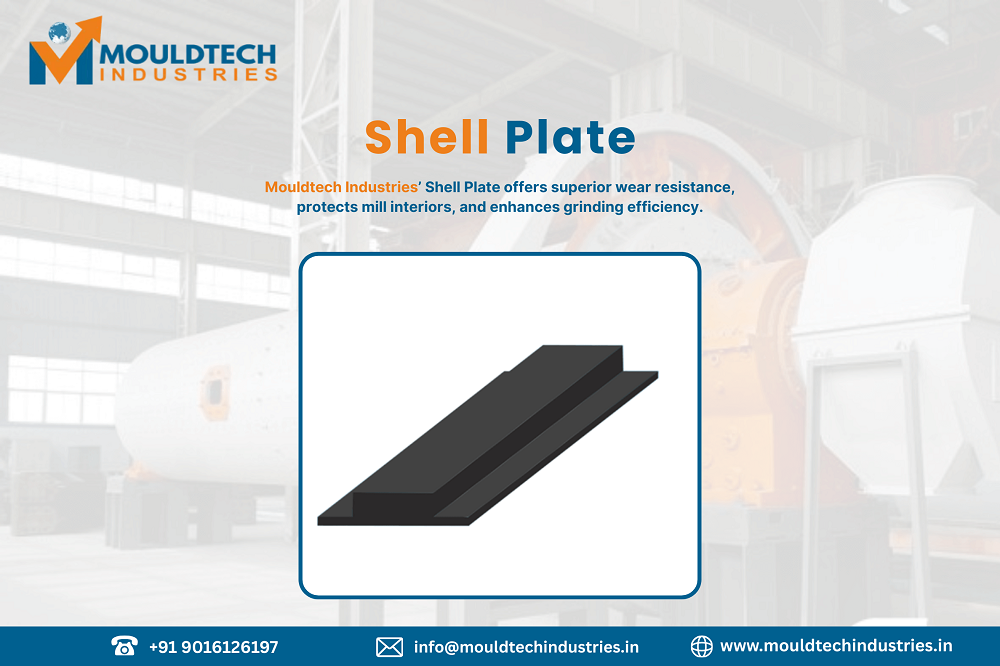
Shell Plate Manufacturer in India: Mouldtech Industries
Mouldtech Industries is a Manufacturer, Supplier, and Exporter of Shell plates.
Our Manufacturing Unit is in Vadodara, Gujarat, India.
Mouldtech Industries is a Manufacturer of Ball Mill Solutions, Ball Mill Rubber Lining, Wear Protection Line, Resistant Rubber Liner, Embedded Rubber Liners, Conveyors Solutions, Impact Bed Assembly and Impact Pads, Belt Cleaners, Pulley Lagging, Ceramic Rubber Lagging Services, and Ceramic Rubber Lagging Sheet.
Shell Plate: A Vital Component for Protecting Heavy-Duty Industrial Machinery
Introduction
Across sectors such as mining, metal processing, cement production, ceramics production, and bulk material transport, equipment degradation due to wear remains a significant operational hurdle. Continuous abrasion from ores, clinker, aggregates, coal, and unprocessed ceramic materials leads to early equipment breakdowns, unexpected halts, and rising repair costs. In demanding industrial settings, even minor wear issues can result in substantial output dips.
Industries worldwide are increasingly prioritizing longer machinery lifespans, more predictable service schedules, and safer facility operations. Tighter project deadlines, rising energy expenses, and greater demands for dependable performance are fueling this shift. Wear defense is no longer an optional addition—it’s now integral to facility design and upkeep planning.
In this context, Shell Plate systems perform a crucial function. Widely used in SAG and ball mills, material transfer gear, and vulnerable zones, Shell Plates provide controlled protection against rubbing, shock loads, and chemical attack while ensuring consistent, extended machinery operation.
Industrial Hurdles Driving Shell Plate Demand
In mining and metal refinement operations, machinery endures persistent mechanical strain. Shell Plates are specifically engineered to tackle these real-world difficulties:
- Abrasion: Fine and coarse particles scrape against machinery surfaces during grinding and conveyance.
- Impact Loads: Large incoming material sizes and dropping material generate recurring shock stress.
- Corrosion: Moisture, process chemicals, and water accelerate surface deterioration.
- Outages: Unforeseen liner or shell failures stop production and affect subsequent operations.
- Repair Expenses: Frequent component swaps increase labor, stockholding, and shutdown expenditures.
Seasoned facility engineers frequently note that exposed or poorly designed shell surfaces are among the first to fail in aggressive operating areas. This holds not just in Indian mining regions but also in global industrial centers like iron ore complexes, cement hubs, ceramic processing zones, and major ports.
What Exactly is a Shell Plate?
A Shell Plate is a protective element fitted along the inner or outer casing surfaces of industrial apparatus such as ball mills, blenders, chutes, and conveying mechanisms. Its primary purpose is to absorb wear, impact, and mechanical pressure before the underlying equipment structure is compromised.
Shell Plate might be fabricated from specialized rubber mixes, ceramic-embedded assemblies, or combined wear-defense configurations, depending on the specific need. Instead of merely serving as a disposable outer layer, a Shell Plate functions as part of the equipment’s structured strategy for managing wear.
Unlike generic linings, Shell Plates are tailored to the machinery’s shape, material flow, and operating forces.
Use Cases Across Different Sectors
- Mining Sector: Shell plates are extensively used in ball mills, slurry-handling setups, and transfer chutes where ore grinding and impact are continuous.
- Cement Plants: In cement grinding units and clinker-handling sections, Shell Plates help manage high-temperature abrasion and reduce the frequency of liner changes.
- Metal & Steel Plants: Steelworks depend on Shell Plate as a raw material for preparation, sinter plants, and slag-handling systems to withstand severe abrasive conditions.
- Ceramic Manufacturing: Raw ceramic inputs are highly erosive. Shell Plate safeguards blenders, mills, and feeders from rapid surface thinning.
- Power Plants: Coal-handling setups, pulverizers, and ash-processing units benefit from Shell Plates that resist rubbing and impact.
- Bulk Material Transport: Conveyors, transfer points, storage bins, and loading areas use Shell Plate to enhance system reliability and reduce service intervention.
Material Science & Engineering Factors
Producers with extensive industry background recognize that Shell Plate effectiveness heavily relies on materials science.
- Rubber Characteristics: Engineered rubber compounds offer flexibility, shock absorption, and sound dampening.
- Ceramic Durability: Ceramic inserts provide exceptional resistance to surface wear under sliding friction.
- Wear Resistance Principles: Selecting the correct material strikes a balance between hardness and elasticity to avoid shattering.
- Impact Buffering: Rubber-backed or hybrid systems cushion shock loads, protecting both ceramic pieces and the equipment casings.
The objective isn’t merely maximum hardness, but controlled wear behavior that matches the process environment.
Design & Customization Demands
Shell plates are not universal parts. Effective designs account for:
- Equipment Suitability: Proper fit with mill diameter, casing contour, and attachment mechanisms.
- Bespoke Sizing: Thickness, segment length, and profile adjusted for high-wear zones.
- Application-Specific Layout: Feed size, rotation speed, moisture presence, and impact energy.
An adequately designed Shell Plate integrates smoothly with existing machinery without demanding structural alteration.
Manufacturing Quality & Process Oversight
Precise fabrication is crucial for Shell Plate dependability. Quality-focused producers adhere to regulated procedures that involve:
- Accurate molding and dimension management
- Uniform material mixture
- Testing checks per production lot
- Confirmation of adhesion strength (for composite assemblies)
Consistency across batches guarantees predictable wear performance in large installations over extended operational periods.
Installation & Servicing Notes
From a maintenance viewpoint, the Shell Plate should facilitate:
- Simple Fitment: Modular designs shorten installation duration.
- Minimized Downtime: Quicker liner swaps equate to shorter interruptions.
- Planned Service Intervals: Consistent wear patterns allow scheduled maintenance rather than emergency repairs.
Facility maintenance crews prefer solutions that reduce manual handling hazards and streamline inspection protocols.
Safety & Operational Dependability
Workforce safety and facility reliability are closely linked. Shell Plate aided by:
- Reducing sudden casing failures
- Limiting direct worker exposure during frequent servicing
- Safeguarding essential equipment structures
In rugged industrial settings, dependable wear defense directly aids safer operations and steady output.
Economic Value Over Equipment Lifespan
Shell Plates are assessed based on the entire equipment lifecycle, not just the initial expense:
- Prolonged service intervals
- Fewer required shutdowns
- Decreased fundamental structure repairs
- Optimized maintenance scheduling
Collectively, these elements enhance overall economic efficiency without sacrificing operational capability.
Export Readiness & International Acceptance
Industrial purchasers in worldwide markets anticipate:
- Uniform production standards
- Thorough technical documentation
- Engineering support specific to the application
- Recognition of international quality benchmarks
Shell Plate intended for export projects must comply with these prerequisites for acceptance across different industrial jurisdictions.
Why Seasoned Manufacturers Are Important
Shell Plate effectiveness relies as much on engineering insight as on the raw materials. Experienced manufacturers provide:
- Grounded knowledge of facility conditions
- Validated design methodologies
- Dependable supply capacity
- Long-term application expertise
This accumulated experience minimizes on-site trial-and-error.
About Mouldtech Industries
Mouldtech Industries is an established industrial fabricator specializing in rubber linings for ball mills, ceramic wear defense systems, rubber coating setups, rubber mill components, and conveyor solutions. Serving all of India, the company supports industrial activities across numerous states and major industrial hubs, including Ahmedabad, Mumbai, Chennai, Hyderabad, Kolkata, and many others.
With a strong emphasis on engineering-led solutions, Mouldtech Industries backs both domestic and international industrial sectors. https://www.mouldtechindustries.in/
Conclusion
Shell plates are a foundational part of contemporary industrial defense strategies against wear. By managing abrasion, impact, and corrosion at vital junctures, they help extend machinery life, stabilize operations, and foster safer facility environments. When correctly designed and built, Shell Plates become a lasting asset rather than a recurring servicing hurdle.
For facility engineers, purchasing departments, and project advisors, choosing the right Shell Plate solution is a significant step toward reliable, long-lasting industrial output.
Key Takeaways
- Shell Plate guards machinery against friction and impact
- Boost operational consistency in demanding settings
- Suitable for mining, cement, metal, ceramic, and bulk transport sectors
- Support extended machinery function over time
- Widely embraced throughout global industrial marketplaces
Trending FAQs
1. What is the typical lifespan of a shell plate?
Lifespan depends on material selection, application severity, and maintenance practices, but properly engineered shell plates offer predictable service intervals.
2. Are shell plates suitable for high-impact applications?
Yes, when designed with appropriate rubber or composite structures to absorb impact energy.
3. How often do shell plates require maintenance?
Maintenance frequency is usually aligned with planned shutdowns, reducing unplanned intervention.
4. How do rubber and ceramic shell plates differ?
Rubber focuses on impact absorption, while ceramic offers higher abrasion resistance. Hybrid systems combine both.
5. Are shell plates used globally?
Yes, shell plates are standard components in the mining, cement, and material-handling industries worldwide.
6. Do shell plates require special installation tools?
Most systems are designed for standard plant installation practices with minimal special tooling.
For inquiries about Shell Plate solutions or other wear protection systems, contact Mouldtech Industries. Our experts provide guidance, technical support, and custom solutions for industrial operations across India.
#BallMillRubberLiner #CeramicWearProtection #RubberLining #MiningSolutions #BulkMaterialHandling #ConveyorSolutions #MouldtechIndustries #WearProtection #IndustrialManufacturing