
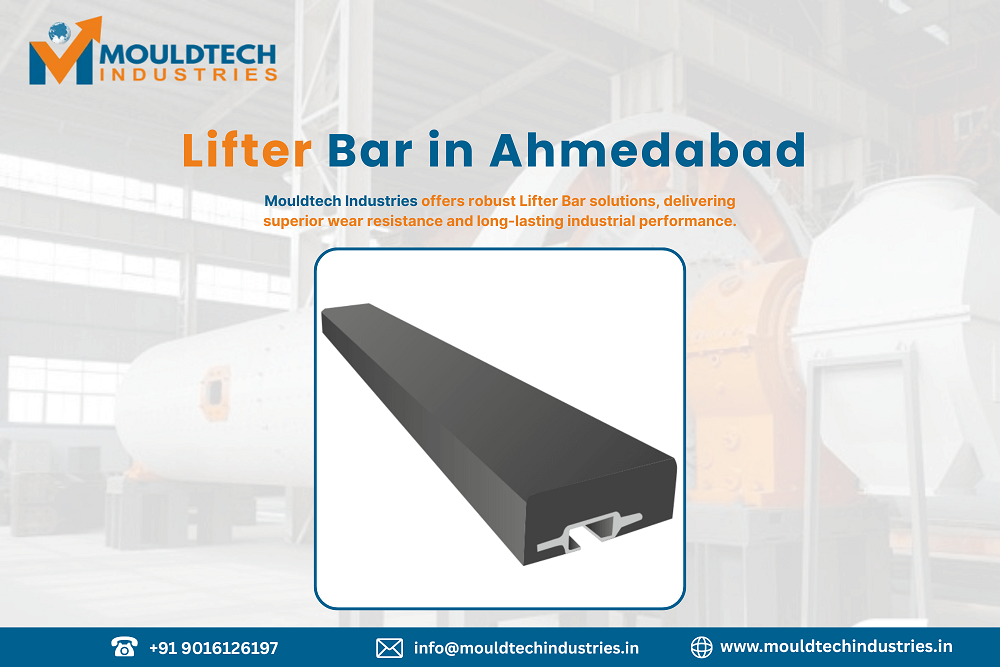
Lifter Bar Manufacturer, Supplier, And Exporter in India: Mouldtech Industries
Mouldtech Industries is a Manufacturer of Lifter Bar in Ahmedabad.
Our Manufacturing Unit is in Vadodara, Gujarat, India.
Mouldtech Industries is a Manufacturer of Ball Mill Solutions, Ball Mill Rubber Lining, Wear Protection Line, Resistant Rubber Liner, Embedded Rubber Liners, Conveyors Solutions, Diamond Pulley Lagging, Belt Cleaners, Pulley Lagging, Ceramic Rubber Lagging Services, and Ceramic Rubber Lagging Sheet.
Lifter Bars in Heavy-Duty Processing: Engineering for Wear Control, Uptime, and Plant Reliability
Introduction
Operations such as mining, metal refining, ceramic production, cement production, and handling bulk materials are subject to some of the industry’s toughest mechanical stresses. Machinery faces constant scraping from hard particles, sudden heavy loads from large incoming material sizes, moisture and process chemicals that hasten deterioration, and intense work schedules, leaving minimal room for unexpected stops. In these severe industrial settings, these elements directly cause component failures, unscheduled halts, and rising maintenance costs.
Global industrial demand is showing steady growth in mineral processing, cement, and ceramics, driven by infrastructure development and urbanisation in areas with active mining centres and ceramic production. As output goals climb, the margin for equipment malfunction shrinks. Wear, defence, and equipment dependability are now key production hazards, not just maintenance concerns.
In grinding and material-conveyance setups, the lifter bar plays an essential role. Mounted inside mills like ball mills, lifter bars elevate and cascade the grinding elements and ore, directly affecting milling effectiveness, component lifespan, and energy usage. A poorly designed or made lifter bar hastens shell wear, increases power consumption, and can jeopardise mill uptime. A well-conceived lifter bar supports steady material flow while safeguarding structural parts.
This discussion explores lifter bars from a plant engineering perspective—the issues that prompt their need, their mechanism, their uses, and what is important regarding their design, materials, production quality, fit, safety, and overall service life.
Industrial Issues Driving Lifter Bar Needs
Lifter bars sit at the crossover between process output and wear defence. Several industrial challenges highlight why their design and material selection are significant:
- Abrasion: Hard ores, clinker, and ceramic feedstocks continuously wear down liner surfaces. Over time, this alters the lifter shape, lessening its lifting ability and milling efficiency.
- Impact Loads: Large incoming pieces and heavy ball charges inflict repeated sudden force. Lifter bars must absorb this energy without cracking or separating.
- Corrosion: Dampness, slurry chemistry, and temperature fluctuations encourage the deterioration of metal parts and the breakdown of polymers.
- Outages: Replacing liners requires stopping the mill. For mining and metal operations, even brief interruptions can affect subsequent processes.
- Upkeep Expense: Frequent liner replacements increase worker exposure and the need for spare parts.
These circumstances are ordinary worldwide. Similar difficulties are observed in mining areas such as Australia, Chile, and South Africa, as well as in industrial zones in India and China. Regardless of location, lifter bars are expected to function reliably under abrasive, high-impact service.
Defining the Lifter Bar
A lifter bar is an exchangeable component attached to the inner wall of grinding mills, such as ball mills. Its purpose is to raise the grinding media and input material to a specific height before allowing them to fall back into the charge in a controlled manner. This managed movement boosts milling efficiency and minimises direct wear on the shell.
From an engineering perspective, lifter bars are structural longevity components. They:
- Direct the path of the material charge
- Shield the mill shell and lining plates
- Impact power draw and grinding dynamics
- Determine the wear pattern within the mill
They are not standalone performance “enhancers”; their value is in their predictable behaviour under load and consistent wear performance throughout their service interval.
Uses Across Different Sectors
Lifter bars and corresponding rubber liner systems are employed in several heavy industries:
- Mining: Initial and secondary grinding of ores in ball mills and SAG mills.
- Cement: Processing of raw meal and clinker, where abrasive minerals and high output accelerate deterioration.
- Metal & Steel: Grinding slag and minerals for sinter feed preparation.
- Ceramic: Milling hard raw materials like feldspar and quartz for tile and sanitaryware manufacturing.
- Power Plants: Coal milling and ash handling systems where impact and erosion occur together.
- Bulk Material Handling: Liners in conveyor chutes where similar wear principles apply.
Seasoned plant engineers often note that lifter bar shaping directly influences mill throughput stability. Alterations in lift height or face angle can modify milling effectiveness and how wear is spread across the liner.
Material Science & Engineering Considerations
Selecting the right material for lifter bars involves balancing wear resistance, impact cushioning, and chemical stability:
- Rubber Characteristics: Natural and synthetic rubbers offer flexibility and shock absorption. Rubber lifter bars lessen noise and absorb sudden loads, reducing strain on the mill shell. Their rate of wear is usually predictable, simplifying maintenance planning.
- Ceramic Hardness: Alumina and comparable ceramics offer superior abrasion resistance. Ceramic pieces integrated into rubber are used in high-wear areas to lengthen service life when handling fine, abrasive slurries.
- Wear Resistance Fundamentals: Resistance to scraping depends on hardness and internal structure, while resistance to impact depends on toughness and energy uptake. Hybrid solutions merge both aspects.
- Impact Dampening: Rubber backing layers absorb energy before it reaches the mill shell, limiting fatigue damage.
Viewed from an engineering standpoint, no single material is optimal for every task. The choice depends on ore hardness, incoming particle size, mill speed, slurry chemistry, and maintenance approach.
Design & Customisation Needs
Lifter bars must be engineered to suit the specific parameters of the mill:
- Equipment Compatibility: Bolt patterns, liner connections, and shell curvature differ between mill models and sizes.
- Tailored Sizing: Lifter height and face angle are chosen based on the desired material trajectory and media size.
- Specific Application Design: Grinding coarse ore requires a different lifter geometry than that used in fine regrinding circuits.
Manufacturers with extensive industry background recognise that standard profiles seldom fit all operational scenarios. Customisation serves to maintain a predictable grinding action throughout the component’s life, rather than solely for aesthetic reasons.
Manufacturing Quality & Process Control
Consistent operational results rely on rigorous manufacturing standards:
- Accurate Production: Dimensional tolerances affect component fit and alignment. Loose tolerances lead to localised pressure points and premature failure.
- Quality Assurance: Consistency of the rubber compound, the bond integrity of any ceramics, and the accuracy of bolt holes require inspection at the batch level.
- Uniformity Between Batches: Differences in rubber firmness or ceramic placement cause inconsistent wear, complicating maintenance scheduling.
In practice, strict process control during manufacture generally results in fewer operational surprises.
Installation & Upkeep Details
How the components are fitted and maintained has as much bearing on real-world results as the material selection:
- Ease of Fitting: Lighter rubber lifter bars lower manual handling risk and the time required for installation compared to metal alternatives.
- Reduced Stoppages: Modular lining systems permit phased replacement, shortening the duration of necessary shutdowns.
- Maintenance Intervals: Predictable wear patterns enable maintenance based on condition rather than reactive maintenance.
Field crews prefer liner systems that can be installed with standard equipment and that meet precise tightness specifications.
Safety & Operational Dependability
Safety is closely linked to the design of components subject to wear:
- Personnel wellbeing: Lighter liner weight and better grip handles reduce the risk of strain injuries during maintenance.
- Asset preservation: Suitable lifter engineering prevents the shell from being exposed, reducing the risk of structural damage.
- Facility dependability: Consistent wear patterns decrease the risk of abrupt liner failures that could harm internal mill parts.
Operational dependability is achieved through a combination of excellent design, uniform production, and committed upkeep methods.
Cost Effectiveness Across the Equipment Lifespan
Efficiency over the equipment’s life centres on the overall cost of possession rather than the initial purchase price of components:
- Long-term savings: Extended replacement intervals mean fewer stoppages and fewer liner changes.
- Fewer interruptions: Scheduled maintenance periods are easier to manage when wear rates are predictable.
- Upkeep streamlining: Steady liner performance helps plan for spare parts and staffing needs.
From an operational viewpoint, avoiding unexpected downtime often delivers greater value than slight variations in liner operational duration.
Preparedness for Export & Worldwide Acceptance
Industrial purchasers in international venues anticipate:
- Need for documentation & adherence to norms: Material testing confirmations, dimension drawings, and quality paperwork consistent with worldwide purchasing standards.
- Needs of global buyers: The ability to trace materials, established packing norms, and clear setup guidelines.
- Export readiness: Uniform packaging and logistics arrangements to safeguard against damage during transit.
Suppliers serving mining operations in Peru or cement factories in Vietnam encounter comparable expectations concerning quality and paperwork.
The Value of Seasoned Manufacturers
Wear parts are not mere bulk items in demanding industrial setups. Engineering acumen is crucial because:
- Engineering insight: Selecting the right material and shape necessitates an understanding of mill movement dynamics.
- Sector familiarity: Field observations across several operational cycles drive design enhancements.
- Dependable sourcing: Predictable delivery times and batch quality support maintenance scheduling.
Manufacturers with extensive industry background recognise that plant environments evolve, often requiring minor tuning of liner designs rather than complete overhauls.
Regarding Mouldtech Industries
Mouldtech Industries is a seasoned industrial producer specialising in wear safety solutions, including ball mill rubber linings, ceramic wear protection systems, rubber lining assemblies, ball mill rubber goods, and conveyor systems. The firm furnishes engineered wear elements for the mining, cement, metal, ceramic, and bulk material handling sectors throughout Pan India—supporting industrial hubs in states like Odisha, Jharkhand, Rajasthan, Gujarat, Maharashtra, Tamil Nadu, Andhra Pradesh, Telangana, Karnataka, Chhattisgarh, West Bengal, and beyond—while also assisting international industrial arenas.
More particulars on their engineering capabilities and product range can be found at https://www.mouldtechindustries.in/.
Summary
Lifter bars are minor components with a significant impact on grinding effectiveness, liner longevity, and mill reliability. In severe industrial settings, their performance relies on suitable material choice, sound engineering layout, consistent production quality, and practical setup and servicing methods. For plant personnel, the objective is not abstract performance gains but rather dependable operation, regulated wear, and safer service intervals. A structured approach to selecting and overseeing lifter bars helps maintain steady output and long-term asset condition.
Main Points to Remember
- Lifter bars safeguard mill shells whilst shaping the grinding action
- Wear safeguards improve operational dependability and upkeep planning
- Rubber and ceramic materials suit different wear and impact conditions
- Design tailored to the specific application is more significant than standard shapes
- Uniform production quality is the foundation for sustained performance
Current Frequently Asked Questions
1) What is the usual service duration for a lifter bar?
Service duration shifts based on ore hardness, mill rotation speed, and the material load size. In highly abrasive circuits, operational circumstances drive wear more than the material itself.
2) Are lifter bars appropriate for both wet and dry grinding processes?
Indeed. The selected material and adhesion methods must account for slurry makeup and moisture exposure during wet grinding.
3) How frequently ought lifter bars to be examined?
Regular assessments during planned downtimes help monitor wear patterns and prevent shell exposure.
4) When should rubber linings be paired with ceramic wear solutions?
Hybrid designs are helpful in areas with intense abrasion where fine particles cause rapid deterioration, while the rubber structure absorbs impacts.
5) Are lifter bars utilised across the globe with comparable setups?
The core design tenets remain consistent internationally, yet the shape and materials are modified to suit local ore and process requirements.
For inquiries about Lifter Bar solutions, contact Mouldtech Industries. Our team provides expert guidance on wear protection and industrial applications.
#LifterBar #BallMillRubberLiner #CeramicWearProtection #RubberLining #MiningSolutions #BulkMaterialHandling #ConveyorSolutions #MouldtechIndustries #WearProtection #IndustrialManufacturing