

Grate Plate Manufacturer, Supplier, And Exporter in India: Mouldtech Industries
Mouldtech Industries is a Manufacturer of Grate plates in Ahmedabad.
Our Manufacturing Unit is in Vadodara, Gujarat, India.
Mouldtech Industries is a Manufacturer of Ball Mill Solutions, Ball Mill Rubber Lining, Wear Protection Line, Resistant Rubber Liner, Embedded Rubber Liners, Conveyors Solutions, Diamond Pulley Lagging, Belt Cleaners, Pulley Lagging, Ceramic Rubber Lagging Services, and Ceramic Rubber Lagging Sheet
Grate Plates: Key Wear Defense in demanding Industrial Settings
Introduction
In demanding industrial settings, equipment dependability isn’t optional—it’s mandatory. Mining facilities constantly process abrasive ores. Cement factories manage scorching clinker under forceful impacts. Metal and steel operations contend with sharp debris, surface scale, and cyclical loading. Ceramic makers work with exceptionally tough and erosive raw inputs, while systems moving bulk materials run ceaselessly with narrow maintenance windows.
Across these sectors, wear-related failures persist as a major operational hurdle. Unexpected stops, regular liner swaps, and safety concerns directly hit production volumes, upkeep budgets, and worker productivity. As the worldwide need for minerals, cement, metal, and ceramics grows, facilities are pressured to boost operational time without sacrificing safety or escalating lifetime expenditure.
Against this backdrop, the Great Plate holds a vital yet often overlooked function. Positioned in grinding mills and material transport lines, grate plates directly influence how material flows, how wear distributes, and the equipment’s overall performance. When expertly conceived and produced, they contribute substantially to process stability and foreseeable upkeep schedules.
Operational Hurdles Driving Great Plate Need
Industrial sites throughout India and major worldwide mining areas encounter comparable wear-related challenges:
- Abrasion: Constant contact with tough minerals, clinker, residue, and ceramic dust leads to slow but severe surface wear.
- Impact Forces: Large incoming material sizes and falling masses generate recurring impact stresses on linings and grates.
- Corrosion: Damp surroundings, handling slurries, and chemical contact speed up material breakdown.
- Outages: Even brief interruptions disrupt subsequent processes, particularly in integrated plants.
- Upkeep Expense: Frequent liner exchanges increase labour needs, crane utilization, and safety risks.
In mining and metal refining, seasoned plant engineers frequently observe that poor grate layout results in uneven wear, material buildup, and less effective grinding. These issues are universal across mining zones in Odisha, Jharkhand, Rajasthan, Chhattisgarh, Karnataka, Maharashtra, Tamil Nadu, Andhra Pradesh, Telangana, Gujarat, and major industrial hubs across India.
Defining the Grate Plate
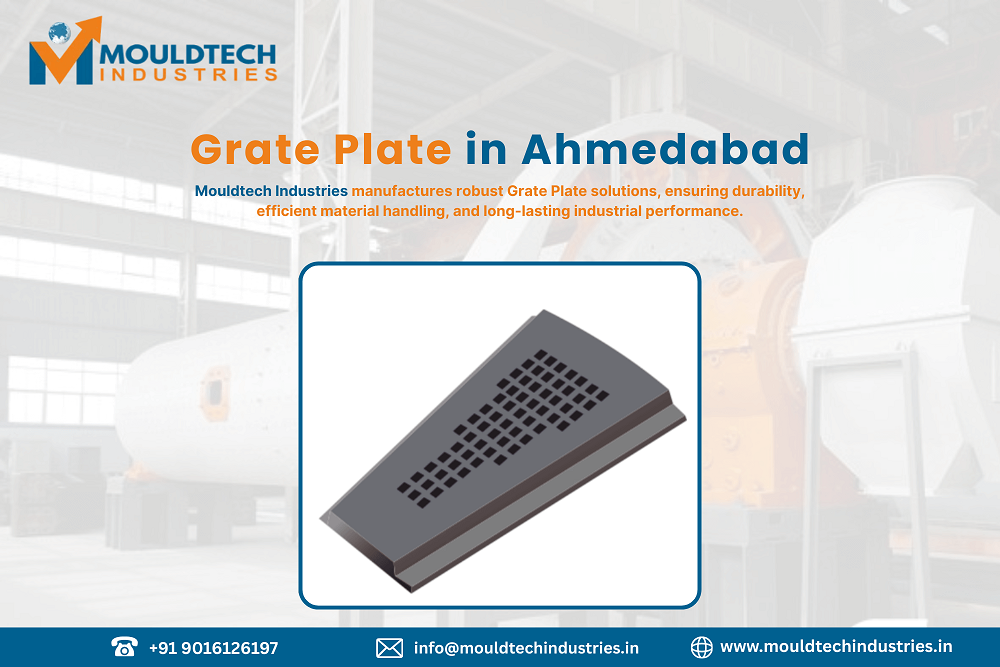
A Grate Plate is a hard-wearing part set at the exit of ball mills and comparable grinding machinery. Its main purpose is to manage the passage of ground material out of the mill while keeping grinding media contained within.
From an engineering viewpoint, a grate plate must strike a balance between three crucial demands:
- Regulated Material Exit: Ensuring steady output without blocking or holding back too much material.
- Wear Endurance: Resisting relentless rubbing and blows.
- Structural Soundness: Maintaining its form and slot pattern throughout its service duration.
Unlike standard liners, grate plates directly impact mill function. Their design affects grinding effectiveness, power usage, and stability of downstream material handling.
Sector-Specific Deployments
Grate plates find use across numerous heavy industries, each presenting unique operating environments:
Mining
In ore grinding trains, grate plates control slurry movement while resisting wear from hard rock and minerals. Dependable grate activity supports steady mill running and predictable maintenance planning.
Cement Plants
Cement mills function amid high heat and abrasive clinker flow. Great plates must handle temperature swings while assuring consistent discharge.
Metal & Steel Plants
Grinding slag, scale, and metallic waste subjects grate plates to jagged, uneven particles and heavy impact loading.
Ceramic Production
Raw materials for ceramics, like quartz and feldspar, are exceptionally hard. Grate plates must keep slot openings accurate to prevent material bridging and process inefficiency.
Power Generation
Coal and ash handling setups rely on durable parts to manage fine yet abrasive substances under nonstop operation.
Bulk Material Transport
At transfer points and processing gear, grate plates aid in flow regulation and equipment safeguarding.
Material Science & Design Elements
Producers with extensive sector background recognize that material choice dictates performance more than any surface finish.
- Rubber Characteristics: Rubber provides flexibility, impact absorption, and sound dampening. Its resilience helps absorb impact energy, protecting both the grate and the surrounding gear.
- Ceramic Hardness: Ceramic sections offer superb rubbing resistance, especially in high-wear zones involving sliding contact.
- Wear Resistance Principles: Resistance to rubbing relies on hardness, while resistance to impact depends on elasticity. Composite designs frequently merge both qualities.
- Impact Damping: Grate plates backed by or made of rubber lessen stress transfer to the mill shell, extending structural life.
Design choices are based on ore type, feed size, mill velocity, and discharge specifications—not on generalized assumptions.
Design & Tailoring Needs
No two plants run under identical conditions. Successful grate plate engineering necessitates:
- Equipment Synchronization: Matching mill dimensions, bolt arrangements, and exit mechanisms.
- Custom Dimensions: Slot width, proportion of open area, and thickness adjusted to process necessities.
- Application-Specific Layout: Accounting for slurry density, particle size spread, and output objectives.
Off-the-shelf layouts might trim initial procurement time, but tailored solutions boost long-term operational steadiness.
Manufacturing Excellence & Process Control
Precise manufacturing is vital for uniform grate performance. Key elements include:
- Regulated mixing of rubber compounds
- Accurate placement and adhesion of ceramics
- Uniform measurements across production lots
- Checks at every manufacturing stage
Consistency from batch to batch ensures predictable wear patterns, simplifying upkeep schedules and spare parts inventory oversight.
Setup & Service Procedures
From a plant upkeep viewpoint, grate plates should allow for:
- Simple Mounting: A correct fit speeds up setup and avoids alignment problems.
- Quicker Turnarounds: Faster liner exchanges minimize lost production.
- Foreseeable Service Intervals: Uniform wear permits scheduled maintenance rather than emergency fixes.
Service teams generally favour designs that lessen manual handling and improve safety during liner replacement.
Safety and Dependable Operation
Equipment upkeep is directly tied to safety. Superiorly designed grate segments:
- Prevent unforeseen breakdowns
- Minimize material spillage and obstructions
- Reduce the necessity for hands-on adjustments during running cycles
Consistent machine performance boosts overall facility dependability and operator assurance.
Value Across the Equipment Lifespan
Instead of concentrating solely on the initial purchase price, facility planners assess:
- Uniformity of service duration
- Frequency of necessary stoppages
- Labour is needed for upkeep tasks
- Influence on subsequent apparatus
Throughout the entire equipment service period, expertly crafted grate sections deliver notable operational cost reductions without sacrificing safety or output rates.
Suitability for International Shipment and Market Acceptance
Industrial purchasers in worldwide venues anticipate:
- Comprehensive technical paperwork
- Verification of material origins
- Adherence to quality benchmarks
- Uniform production standards
Components ready for international dispatch demonstrate a producer’s understanding of global industry standards.
The Importance of Seasoned Producers
Significant structures function where materials science, mechanical engineering, and on-site processes converge. Specialized engineering knowledge, practical field experience, and dependable production methods are vital for delivering components that withstand genuine industrial strain.
Introducing Mouldtech Industries
Mouldtech Industries is a long-established fabricator specializing in rubber linings for ball mills, ceramic safeguards against wear, rubber covering systems, rubber-manufactured items for ball mills, and conveyor systems. Serving industrial customers across India and internationally, the firm emphasizes engineering-led production supported by real-world insight from facility floors.
Discover more here 👉 https://www.mouldtechindustries.in/
Summary
Grate segments fulfill a core function in controlling erosion, material throughput, and equipment dependability in rigorous industrial settings. When tailored with specific application understanding, they facilitate steady processes, safer maintenance protocols, and enduring operational efficiency. In sectors where lost production is costly and safety is essential, properly designed grate structures remain a key contributor to facility performance.
Main Conclusions
- Grate elements significantly affect mill efficiency and how wear occurs
- The right material selection balances resistance to scraping and the ability to absorb shock
- Customized designs outperform standard parts under actual plant conditions
- Foreseeable maintenance boosts both safety and operational time
- Top-tier manufacturing supports global operational benchmarks
Current Frequently Asked Questions
1. What is the expected service life for a grate plate?
Its duration of use is determined by the substance being processed, the mill’s operating conditions, and maintenance routines—most facilities schedule replacements based on wear measurements.
2. Are grate plates appropriate for every grinding task?
They are mainly employed when precise material outflow and media retention are necessary. Their appropriateness hinges on the specific process layout.
3. How frequently should grate plates be checked?
Standard checks are usually synchronized with mill outage schedules or condition monitoring triggers.
4. Rubber versus ceramic wear defences—how do engineers make the call?
Rubber excels at absorbing impact, while ceramic offers superior protection against abrasive wear. Hybrid configurations are standard in many uses.
5. Are grate plates utilized everywhere in mining and cement production sites?
Indeed. Grate sections are standard fittings within grinding circuits globally across industrial sectors.
For reliable Grate Plate solutions designed for demanding industrial applications, contact Mouldtech Industries to discuss engineering support, customization needs, and dependable manufacturing expertise.
#GratePlate #BallMillRubberProducts #WearProtectionSolutions #RubberLiningSystems #CeramicWearProtection #MiningEquipment #CementPlantSolutions #BulkMaterialHandling #IndustrialManufacturing #MouldtechIndustries