
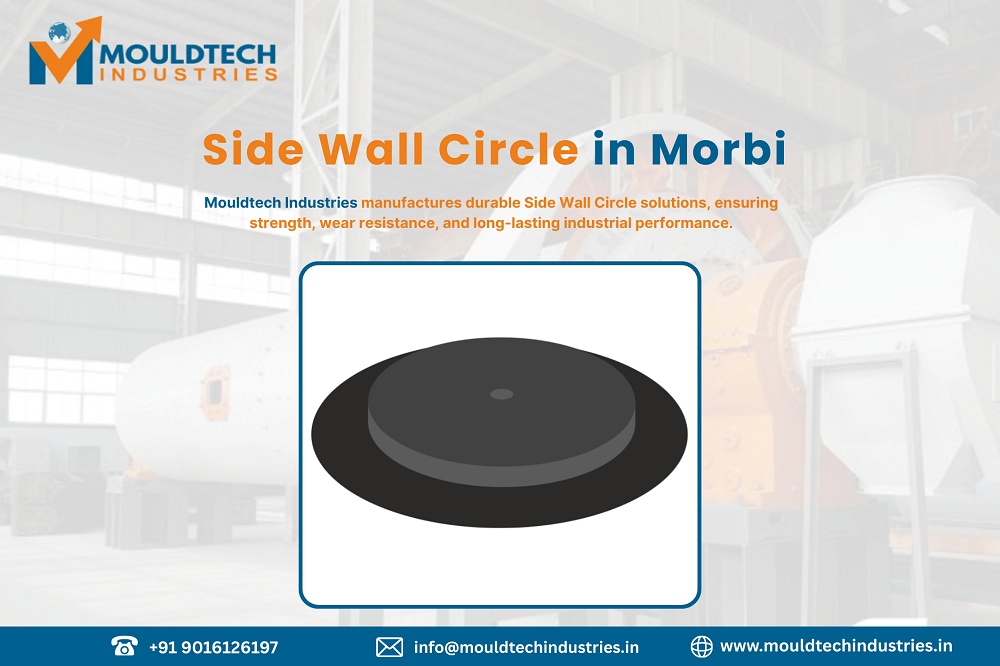
Side Wall Circle Manufacturer, Supplier, And Exporter in India: Mouldtech Industries
Mouldtech Industries is a Manufacturer of Side Wall circles in Morbi.
Our Manufacturing Unit is in Vadodara, Gujarat, India.
Mouldtech Industries is a Manufacturer of Bridge Rubber Pad, Ball Mill Rubber Lining, Bridge Rubber Pad, Resistant Rubber Liner, Embedded Rubber Liners, Conveyors Solutions, Ceramic Lagging Sheet, Belt Cleaners, Bridge Rubber Pad, Ceramic Rubber Lagging Services, and Ceramic Rubber Lagging Sheet.
Side Wall Circle: Key Defense Against Wear in Tough Industrial Work
Introduction
Industries such as mining, metal refining, cement production, ceramics, and bulk handling face some of the most demanding equipment conditions. Constant movement of materials, complex ores, heavy impacts, wetness, chemical exposure, and long running times heavily tax equipment surfaces. Over time, unchecked wear leads to frequent malfunctions, unsafe conditions, rising maintenance costs, and unexpected stops.
In heavy-duty work settings, stopping wear isn’t a mere add-on—it’s essential for dependable equipment and efficient plant function. As global output increases and plants aim for higher output with smaller maintenance crews, the need for robust, site-specific protection parts is growing across mining areas, cement hubs, steel mills, and ceramic production zones worldwide.
In this light, Sidewall Circle parts hold a vital yet often overlooked function. Used in high-wear zones of turning machinery, material transfer points, and internal casings, Sidewall Circles help shield structural surfaces from rubbing, impact, and material turbulence, extending machine life and stabilizing processes.
Producers like Mouldtech Industries, with deep experience in industrial wear issues, recognize how these parts directly affect operational time, safety, and the overall cost of ownership.
Tough Conditions Driving Need for Side Wall Circles
Across worldwide industrial activities, several regular difficulties fuel the demand for innovative wear solutions like Sidewall Circles:
- Friction: In mining and metal processing, constant contact with tough minerals, crushed rock, slag, and ceramic feedstocks causes gradual surface thinning. Sidewalls of grinders, chutes, and conveyors are particularly at risk.
- Impact Force: Heavy materials dropping onto equipment surfaces create strong, localized impact energy. This eventually leads to cracks, shaping, or liner breakdown if the impact energy isn’t managed well.
- Rust and Chemical Attack: Wetness, slurry conditions, acidic substances, and chemical additives accelerate the corrosion of unprotected metal surfaces.
- Downtime and Upkeep Pressure: Unscheduled stops caused by liner failure or structural damage disrupt production schedules and strain resource teams.
- Increasing Upkeep Expenditures: Frequent repairs, part replacements, and emergency halts significantly increase operating costs throughout the machine’s lifespan.
Seasoned plant operators often see sidewall protection fail before core equipment components—making focused solutions like Sidewall Circles crucial.
Defining the Side Wall Circle
A Side wall Circle is a precisely designed part meant to shield the inner sidewalls of industrial machinery from rubbing, physical blows, and damage from material flow. Depending on the job, it might be made from:
- Tough wear-resistant rubber
- Rubber mixed with embedded ceramics
- Engineered ceramic plates backed by support layers
Unlike standard liners, Sidewall Circles target specific wear spots where material speed, impact angle, and load concentration are highest. Their curved or sectioned shape allows pressure to spread evenly and offers consistent protection along curved or rotating equipment surfaces.
Crucially, Sidewall Circles aren’t universal fixes. Their effectiveness hinges on material choice, thickness, firmness, attachment method, and compatibility with the surrounding hardware.
Uses Across Sector Types
- Mining Sector: Utilized in grinders, slurry containment units, chutes, and transfer areas to guard sidewalls against abrasive rock and impact from grinding components.
- Cement Plants: Mounted in feed grinders, fuel mills, aggregate handling systems, and separators where constant rubbing and dust buildup occur.
- Metal & Steel Mills: Applied in pelletizing lines, slag handling, and conveyor crossover points.
- Ceramic Making: Protects machinery handling silica, feldspar, alumina, and other highly abrasive ceramic inputs.
- Power Generation: Used in coal handling lines, ash pipes, and discharge areas subject to erosive flow.
- Bulk Material Moving: Common in conveyors, storage bins, hoppers, and feeders, where material patterns cause uneven wear on walls.
Throughout India—covering industrial belts in regions like Maharashtra, Gujarat, Rajasthan, Odisha, Jharkhand, Chhattisgarh, West Bengal, Tamil Nadu, Andhra Pradesh, Telangana, Karnataka, Madhya Pradesh, Uttar Pradesh, Punjab, Haryana, Himachal Pradesh, Kerala, and major industrial centers such as Ahmedabad, Surat, Vadodara, Mumbai, Pune, Nagpur, Chennai, Coimbatore, Salem, Hyderabad, Visakhapatnam, Bengaluru, Bellary, Raipur, Bhilai, Durgapur, Rourkela, Jamshedpur, Bokaro, Ranchi, Angul, Talcher, Jaipur, Udaipur, Kota, Morbi, Wankaner, Thangadh, and others—Sidewall Circles are widely employed where material wear is a persistent operational obstacle.
Material Science & Engineering Factors
The capability of a Sidewall Circle relies heavily on material expertise:
- Rubber Traits: Top-grade wear rubber offers superb resistance to rubbing and shock absorption. Choosing the right mix balances toughness, flexibility, and tear resistance.
- Ceramic Firmness: Ceramic elements provide extreme defense against sliding friction. When backed with rubber, they offer both wearproofing and impact damping.
- Wear Prevention Principles: Wear happens via slicing, gouging, stress fatigue, and corrosion. Good Sidewall Circle designs tackle these processes by managing how the material touches the surface and the surface hardness.
- Impact Dissipation: Rubber layers cushion impact energy, protecting both the ceramic pieces and the underlying structure.
Producers with long industry tenure know that material performance must perfectly match working conditions—not just be picked from a catalog.
Design & Customization Needs
Successful Sidewall Circles require engineering tailored to the specific job:
- Compatibility with the existing shape of the machinery
- Custom diameters, thicknesses, and segment arrangements
- Consideration of how the liner is fixed and access for repairs
- Adjustment for material pathways and rotational speeds
Tailoring ensures even wear and prevents early failure caused by poor fit or pressure points.
Production Quality & Process Oversight
Precise manufacturing directly affects real-world performance:
- Controlled rubber mixing and heating processes
- Accurate positioning and securing of ceramic pieces
- Uniform dimensions across all manufactured batches
- Strict checks for bonding strength and material soundness
Disciplined processes ensure predictable performance under continuous industrial loads.
Fitting & Servicing Points
Well-conceived Sidewall Circles simplify setup and cut down on downtime:
- Modular sections permit step-by-step replacement
- Secure fastening methods enhance safety during fitting
- A longer time between servicing reduces the need for shutdowns
Experienced upkeep crews value solutions that fit smoothly into scheduled downtime.
Safety & Operational Dependability
Reliable wear defense boosts overall plant safety:
- Lowered the risk of the liner coming loose
- Protection for vital structure components against failure
- Safer conditions during checks and maintenance
Stable equipment directly supports continuous production.
Value Over the Machine’s Working Life
Instead of focusing on the initial price, industrial buyers look at:
- Fewer unexpected service interruptions
- Less frequent need to swap out liners
- Better use of maintenance personnel time
Over the long run, engineered Sidewall Circles lead to noticeable reductions in running costs.
Export Readiness & Worldwide Acceptance
Industrial purchasers globally anticipate:
- Uniform documentation of quality
- Familiarity with global operational benchmarks
- Demonstrated effectiveness in strict settings
Manufacturers prepared for export create goods keeping these needs central.
The Value of Seasoned Manufacturers
Side Wall Circles endure intense forces. Sound engineering insight, material proficiency, and direct field feedback are vital. Manufacturers with significant experience offer:
- Design competence shaped by specific uses
- A dependable capacity for provision
- Ongoing product enhancement drawn from actual plant metrics
Introducing Mouldtech Industries
Mouldtech Industries is a seasoned Indian producer specializing in Ball Mill Rubber Liners, Ceramic Wear Protection Systems, Rubber Lining Methods, Ball Mill Rubber Goods, and Conveyor Systems. Serving industrial sectors throughout India and a global clientele, the firm emphasizes applied engineering, consistent production quality, and solutions tailored to specific applications.
Further details can be seen at https://www.mouldtechindustries.in/
Summary
Side Wall Circles are a vital element in controlling abrasion, boosting reliability, and ensuring consistent performance across rigorous industrial sectors. When correctly designed and implemented, they safeguard machinery, foster safer workplaces, and aid sustained operational effectiveness.
For facilities aiming for trustworthy wear defense, the right choice and backing from experienced production partners create a tangible positive impact.
Main Points Remembered
- Side Wall Circles safeguard areas of equipment subject to heavy wear
- Enhance operational consistency in severe settings
- Applicable across mining, cement, metallurgy, ceramics, and energy sectors
- Sustain long-term equipment function
- Conform to international industrial standard expectations
Trending FAQs
1. What is the typical lifespan of a Side Wall Circle?
Lifespan depends on material type, operating conditions, and maintenance practices.
2. Are Side Wall Circles suitable for high-impact applications?
Yes, when engineered with appropriate rubber and ceramic combinations.
3. How often do Side Wall Circles require maintenance?
Inspection intervals usually align with planned shutdown cycles.
4. Rubber vs ceramic wear solutions—how do they differ?
Rubber absorbs impact; ceramics resist abrasion. Hybrid designs combine both benefits.
5. Are Side Wall Circles used globally?
Yes, across the mining, cement, metal, and bulk-handling industries worldwide.
6. Is installation complex?
Properly designed systems allow safe, efficient installation with standard tools.
Contact Mouldtech Industries for reliable Side Wall Circle solutions engineered for mining, cement, metal, and bulk-material-handling operations across India and global markets.
#SideWallCircle #BallMillRubberProducts #RubberLiningSystems #CeramicWearTiles #CeramicProtectionSystems #BallMillLiners #WearResistantRubber #IndustrialWearSolutions #ConveyorWearParts #BulkMaterialHandlingEquipment