
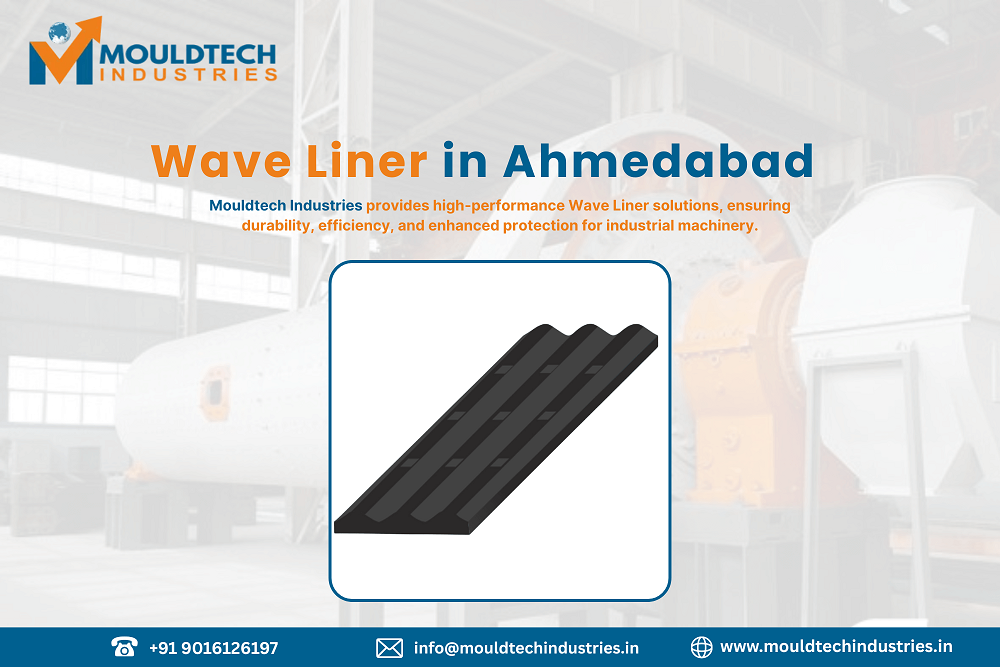
Wave Liner Manufacturer, Supplier, And Exporter in India: Mouldtech Industries
Mouldtech Industries is a Manufacturer of Wave Liner in Ahmedabad.
Our Manufacturing Unit is in Vadodara, Gujarat, India.
Mouldtech Industries is a Manufacturer of Ball Mill Solutions, Ball Mill Rubber Lining, Wear Protection Line, Resistant Rubber Liner, Embedded Rubber Liners, Conveyors Solutions, Diamond Pulley Lagging, Belt Cleaners, Pulley Lagging, Ceramic Rubber Lagging Services, and Ceramic Rubber Lagging Sheet
Wave Liner: Shielding Against Wear in Rugged Industrial Settings
Introduction
In mining, metal refining, ceramics, cement production, and bulk material transport facilities, the lifespan of exposed surfaces is crucial for equipment uptime. Chutes, mills, hoppers, conveyors, and transition points are constantly exposed to abrasive grit, forceful material drops, moisture, chemical exposure, and temperature shifts. In demanding industrial environments, even minor failures in wear protection can lead to unexpected shutdowns, safety hazards, and rising repair costs.
Seasoned plant engineers often note that wear-related interruptions seldom stem from one major breakdown. Instead, they accumulate via linear thinning, bolt stress, material accumulation, corrosion at seams, and repeated local impacts. As production ramps up across global mining centres, cement hubs, metal processing areas, and ceramic manufacturing sites, the need for reliable wear duration and simpler upkeep scheduling has increased.
Wave Liner, a rubber-based lining profile frequently employed in ball mills and handling gear, addresses these site-specific issues. Its shape and material properties are engineered to withstand abrasion and impact while maintaining steady equipment performance over extended operating periods.
Industrial Demands Driving Wave Liner Use
Wear resistance isn’t a universal need; it’s shaped by the specific operational stresses found across sectors:
- Abrasion: Fine ores, clinker, silica, and powdered ceramics act like grinding agents on liner surfaces. Over time, even tough steels lose material, exposing the main structure.
- Impact Forces: In mining and metal refining jobs, heavy chunks strike liners at transfer spots and mill entrances, causing localised fractures and loose fastenings.
- Corrosion: Dampness, slurry chemical makeup, and added agents accelerate corrosion beneath liners, particularly where metal touches metal.
- Outages: Set maintenance slots are getting tighter. Lining systems that need complicated handling or frequent swaps interrupt output.
- Repair Expense: Numerous liner changes increase labour hours, crane utilisation, and spare parts inventory, all of which impact the operational budget.
These difficulties are common across heavy industry zones—mining areas in regions like Odisha, Jharkhand, Chhattisgarh, and Rajasthan; cement clusters in Andhra Pradesh, Telangana, Tamil Nadu, and Madhya Pradesh; steel mills in Maharashtra, West Bengal, and Karnataka; ceramic production sites in Gujarat; and bulk handling facilities near ports in states such as Gujarat, Tamil Nadu, and Kerala. Similar conditions prevail in worldwide industrial settings where abrasive minerals and high-volume handling systems dominate.
What Sets Wave Liner?
Wave Liner is a moulded rubber profile primarily used in ball mills and rotational gears, and is also adapted for wear surfaces in slides and transfer zones. The “wave” contour provides a curved surface rather than a flat, linear face.
From a design viewpoint, the wave shape serves two functional goals:
- Energy Spreading: The geometry alters how grinding media and material contact the liner, diffusing impact energy over a wider area.
- Material Flow Regulation: In milling tasks, the liner profile influences how the charge lifts, thereby impacting crushing effectiveness and liner wear.
The rubber blend is chosen for pliability and resistance to wear rather than extreme rigidity. This lets the liner absorb impact energy, lessen noise and shaking, and safeguard the underlying mill shell or chute framework. In select high-wear areas, Wave Liners are combined with ceramic wear components to boost abrasion defence without sacrificing impact cushioning.
Sectoral Uses
Wave Liners and related rubber-ceramic lining setups are used where dependable wear performance and ease of upkeep are vital:
- Mining: Ball mills, slurry chutes, trommels, and feed bins handling iron ore, coal, bauxite, and limestone.
- Cement: Raw mill linings, clinker transport slides, and transition spots are subjected to high abrasion and temperature swings.
- Metal & Steel: Sinter plant transfer chutes, slag handling gear, and ore preparation machinery.
- Ceramic: Material conveyance for feldspar, quartz, and alumina powders where constant fine abrasion occurs.
- Power Plants: Coal handling systems, storage bunkers, and ash transport slides.
- Bulk Material Transport: Conveyor transfer points, impact beds, and loading docks across ports, storage yards, and processing sites.
These applications require wear solutions that can conform to equipment shapes and be fitted within brief shutdown periods.
Material Science & Design Factors
From a materials viewpoint, wear defence involves balancing rigidity, elasticity, and bonding strength:
- Rubber Qualities: Rubber linings are chosen for flexibility, resistance to tearing, and abrasion defence. The compound recipe dictates how the liner behaves under repeated impact and sliding wear. Rubber also dampens vibrations, reducing structural fatigue.
- Ceramic Toughness: In areas with fine abrasive particles and sliding friction, ceramic tiles offer high hardness and low wear rates. However, ceramics are fragile and need a rubber base or bonding material to manage impact loads.
- Wear Resistance Concepts: Abrasive wear depends on particle size, hardness differences, and contact force. Impact wear depends on energy transmission and material elasticity.
- Impact Dampening: Rubber’s capacity to flex under load helps protect fasteners and base structures, reducing shell damage in mills and chutes.
Producers with extensive industry history realise that liner success isn’t solely about material choice, but about how materials interact with the operating setting.
Design & Customisation Needs
Effective Wave Liner operation relies on correct design incorporation:
- Equipment Fit: Liner geometry must align with mill size, lifter spacing, and shell curve. A poor fit causes stress buildup and early failure.
- Tailored Sizing: Industrial machinery rarely adheres to standard dimensions. Liners are usually cast or cut to match site blueprints and field measurements.
- Use-Specific Design: High-impact zones might need thicker rubber sections or ceramic inserts, while areas with sliding wear might prioritise abrasion resistance.
Design reviews with on-site maintenance crews help align the lining setup with actual operational conditions rather than standard catalogue specifications.
Manufacturing Excellence & Process Control
Liner performance is sensitive to manufacturing consistency:
- Accurate Production: Mould precision influences uniform liner thickness and proper seating. Size inconsistencies lead to uneven load sharing.
- Quality Verification: Testing of the compound, hardness confirmation, bond strength checks for rubber-ceramic assemblies, and visual inspection are standard performance checks.
- Batch Uniformity: Variations in the rubber formula across production runs can lead to unpredictable liner life. Managed compounding and tracked batch details to reduce this hazard.
These methods build trust with maintenance departments that rely on predictable replacement schedules.
Fitting & Upkeep Aspects
Simplicity of fitting directly impacts plant uptime:
- Ease of Assembly: Modular liner designs permit handling with standard lifting gear. Pre-drilled openings and standard fasteners reduce fitting time.
- Minimised Outage Time: Quicker installation results in shorter shutdown windows, which are crucial in continuous-run plants.
- Maintenance Planning: Foreseeable wear patterns allow planners to schedule liner replacement during planned shutdowns rather than react to emergencies.
Well-conceived liners reduce rework and the need for on-site modifications.
Safety and Operational Dependability
Safety is deeply intertwined with the calibre of wear defence:
- Personnel Well-being: Firmly secured liners mitigate the danger of liner detachment and falling hazards during service.
- Asset Preservation: Effective linings shield mill casings, conveying pathways, and structural elements from breakthrough wear.
- Facility Uptime: Uniform wear performance fosters steady output and process regulation, reducing the likelihood of interrelated equipment malfunctions.
Within governed industrial settings, safety and dependability are essential operational mandates.
Value Over the Equipment’s Lifespan
Engineers assess the cost-effectiveness of wear protection across the equipment’s service duration, rather than on individual liners.
- Sustained Savings: Robust linings extend the time between change-outs, reducing labour and crane utilisation.
- Fewer Interruptions: Reducing unscheduled stops boosts continuous production.
- Maintenance Optimisation: Foreseeable wear patterns enable spare part provisioning and maintenance scheduling, reducing overall operational exposure.
A lifecycle perspective aligns upkeep choices with facility availability objectives.
Export Readiness and Worldwide Acceptance
Industrial purchasers in international arenas anticipate:
- Paperwork and Standard Adherence: Material certifications, quality dossiers, and traceability records.
- Shipment and Handling: Liners must be packed to avert distortion and damage during extensive transit.
- International Client Demands: Consistent specifications, replicability, and post-sale technical backing.
These anticipations apply to providers serving global operations in extraction, cement production, and bulk conveyance.
The Importance of Seasoned Producers
Manufacturers with extended time in the sector recognise that wear defence is not a standardised item. Engineering acumen, process comprehension, and dependable supply chains determine if liners function as anticipated under actual site conditions. A close partnership with site engineers helps translate operational field reports into design advancements.
About Mouldtech Industries
Mouldtech Industries is a seasoned manufacturer providing wear defence and lining remedies for machinery in mining, cement, metal, ceramics, and bulk material transport throughout India and on the global industrial stage. Possessing firsthand knowledge of site operating environments and equipment limitations, the company prioritises design-driven liner engineering and manufacturing rigour. Further particulars on their production capabilities and industrial answers are accessible at 👉 https://www.mouldtechindustries.in/
Summary
Wave Liner systems offer a pragmatic approach to managing material erosion and collisions in demanding industrial machinery. When tailored to the equipment’s form, fabricated via controlled processes, and designed with maintenance realities in mind, they contribute to steady facility operation and predictable maintenance scheduling. For facilities striving to boost reliability without compromising safety, liner engineering remains a core component of asset stewardship.
Key Learnings
- Wear defence significantly impacts equipment dependability and facility operational time.
- Rubber and ceramic materials address distinct wear mechanisms.
- A wear part design specific to the application improves the predictability of its service life.
- Uniform manufacturing quality supports upkeep planning.
- Wear linings are vital across the mining, cement, metal, ceramic, and bulk handling sectors.
Current Frequently Asked Questions
Q1. What is the usual working life of a Wave Liner in industrial processing units?
The abrasiveness of the raw material, mill rotation speed, material composition, and operational hours determine the service duration. Operators frequently check linings in highly abrasive settings to monitor wear rates and schedule replacements during planned downtime.
Q2. Are Wave Liners suitable for both wet and dry processes?
Yes. Rubber components function well in both fluid slurry and dry material conveyance settings. The choice of material and bonding methods must account for moisture and chemical exposure.
Q3. How frequently ought Wave Liners be examined or maintained?
Visual checks during routine stoppage periods are standard. Monitoring the reduction in wear thickness helps forecast when replacements are due and avoid sudden failures.
Q4. Under what circumstances should rubber liners be paired with ceramic wear defence?
In areas characterised by acceptable abrasive sliding wear and moderate impact forces, ceramic-backed rubber provides enhanced abrasion resistance while still absorbing shock.
Q5. Are Wave Liners utilised internationally in heavy industry?
Yes. Mining, cement, and bulk transport operations worldwide employ comparable liner concepts to handle constant abrasion and impact challenges.
For technical support, inquiries, or custom Wave Liner solutions, contact Mouldtech Industries. Our experts assist mining, cement, metal, and bulk handling operations across India.
#BallMillRubberLiner #CeramicWearProtection #RubberLining #MiningSolutions #BulkMaterialHandling #ConveyorSolutions #MouldtechIndustries #WearProtection #IndustrialManufacturing