
Polyurethane Wear Resistant Rubber Liners Manufacturer, Supplier, And Exporter in India: Mouldtech Industries
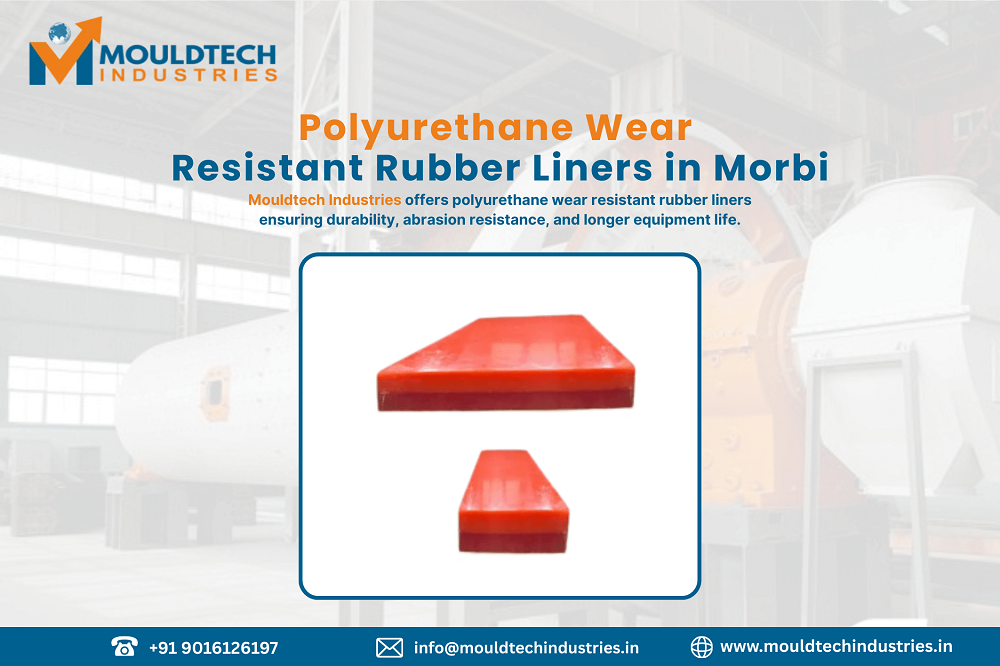
Mouldtech Industries is a Manufacturer of Polyurethane Wear Resistant Rubber Liners in Morbi.
Our Manufacturing Unit is in Vadodara, Gujarat, India.
Mouldtech Industries is a Manufacturer of Bridge Rubber Pad, Ball Mill Rubber Lining, Bridge Rubber Pad, Resistant Rubber Liner, Embedded Rubber Liners, Conveyors Solutions, Ceramic Lagging Sheet, Belt Cleaners, Bridge Rubber Pad, Ceramic Rubber Lagging Services, and Ceramic Rubber Lagging Sheet.
Polyurethane Wear Resistant Rubber Liners: Building Dependability for Tough Industrial Settings
Introduction
In sectors like mining, metal working, cement creation, ceramic production, and moving large quantities of material, equipment deterioration is a continuous operational hurdle. Rough materials, heavy impacts, caustic liquids, and non-stop operation put immense strain on machinery. For facilities running continuously, even small failures caused by wear can lead to unexpected stoppages, safety hazards, and subsequent loss of output.
In demanding industrial settings, safeguarding against wear isn’t optional—it’s a necessity for dependability. As worldwide need for minerals, building supplies, power, and refined metals keeps growing, plants are processing more material with shorter periods available for upkeep. This trend has boosted the requirement for specifically engineered lining solutions that can prolong machinery life while keeping operations stable.
Polyurethane Wear Resistant Rubber Liners have become a vital answer for uses where resistance to rubbing, impact dampening, defense against corrosion, and managed service intervals need to work in concert. When properly conceived and produced, these linings form a protective barrier between aggressive substances and valuable equipment, allowing plants to function predictably and securely.
Industrial Issues Driving the Need for Polyurethane Wear Resistant Rubber Liners
Seasoned plant operators frequently note that wear seldom stems from just one cause. Instead, it’s the combined result of multiple harsh operating circumstances:
- Intense rubbing from ores, processed rock, residue, ceramics, and general aggregates
- Significant impact forces during material transfer, crushing, and unloading
- Exposure to chemicals and moisture in wet processing and fluid handling
- Constant shaking and repeated stress
- Pressure for uptime due to tight production timetables
- Increasing upkeep expenditures linked to frequent lining swaps
In activities like mining and metal refinement, components such as grinding drums, chutes, storage bins, conveyors, and pipes encounter constant material aggression. Similar situations are present in cement factories, ceramic processing sites, power stations, and bulk storage terminals globally.
Polyurethane Wear Resistant Rubber Liners are increasingly chosen because they tackle these issues without introducing undue stiffness, fragility, or complicated setup procedures.
What Are Polyurethane Wear Resistant Rubber Liners?
Polyurethane Wear Resistant Rubber Liners are specially designed protective coverings made from high-performance flexible materials combined with polyurethane technology. These linings are engineered to absorb impact energy while resisting abrasion, tearing, and environmental decay.
In contrast to standard rigid linings, polyurethane-based rubber linings offer:
- Controlled flexibility for cushioning impacts
- A surface tough enough to oppose sliding wear
- Chemical stability in wet or corrosive settings
- Uniform shape retention under stress
They are frequently employed as internal covers for grinding drums, chutes, transfer points, hoppers, tanks, and conveyor systems where both wear defense and physical shielding are necessary.
Uses Across Different Industries
Mining Sector
Widely utilized in:
- Ball mills and SAG mills
- Ore transfer chutes
- Slurry conduits
- Feed hoppers
These linings lessen metal-on-metal contact, decrease sound levels, and safeguard the shell structure.
Cement Plants
Applied in:
- Raw material chutes
- Clinker handling assemblies
- Grinding mills
- Separators and ducting
They assist in managing abrasive limestone and clinker while minimizing downtime.
Metal & Steel Facilities
Installed in:
- Sinter plant chutes
- Slag handling systems
- Conveyor transfer points
- Storage silos and bins
Ceramic Manufacturing
Used in:
- Handling of raw materials
- Ball mills for ceramic dusts
- Glaze preparation apparatus
Power Plants
Applied in:
- Coal handling systems
- Ash slurry pipelines
- Storage bunkers and feeders
Bulk Material Handling
Common in:
- Ports
- Storage facilities
- Processing plants
- Conveyor networks
Material Science & Engineering Aspects
Producers with extensive industry background recognize that wear prevention is a challenge in material science, not just a sales pitch.
Key elements to consider include:
- Elastic modulus to balance pliability and load capacity
- Abrasion loss figures under sliding forces
- Resistance to tearing to stop cracks from spreading
- Elasticity for repeated impact sequences
- Bonding strength to the underlying structure
Polyurethane-enhanced rubber blends give extended service life compared to typical rubber while retaining the impact absorption that ceramics or metals alone cannot deliver.
Design & Customization Demands
No two plants operate under identical conditions. Effective linings necessitate:
- Shapes tailored to the specific equipment
- Variable thickness based on heavily worn areas
- Sectional designs for step-by-step replacement
- Compatibility with existing attachment methods
Linings custom-engineered reduce errors during fitting and promote even wear distribution across the equipment surface.
Manufacturing Quality & Process Oversight
Precise manufacturing is vital for lining performance. Essential elements include:
- Managed blending of materials
- Accurate shaping and setting procedures
- Verification of dimensions
- Tracking quality per production lot
Consistent quality ensures predictable wear rates and aids in accurate maintenance scheduling.
Fitting & Upkeep Matters
Polyurethane Wear Resistant Rubber Liners are valued for:
- Easier handling due to lower weight
- Streamlined fastening assemblies
- Shorter fitting times
- Less frequent maintenance intervention
Correct fitting methods directly influence how long the lining lasts and overall site safety.
Safety & Operational Dependability
From a safety viewpoint, these linings:
- Lower noise and vibration levels
- Reduce the chance of structural breakdowns
- Decrease the risk of lining pieces becoming detached
- Safeguard personnel performing maintenance
Stable lining systems contribute directly to safer work environments.
Value Over the Equipment’s Full Life
Instead of concentrating on the initial outlay, experienced operators look at:
- Longer periods between service needs
- Fewer unplanned outages
- Reduced frequency of repairs
- Predictable service planning
Across the lifespan of the equipment, well-conceived linings improve overall cost-effectiveness through enhanced reliability.
Export Preparedness & Worldwide Approval
International industrial purchasers anticipate:
- Precise dimensions
- Material validation
- Uniform high quality
- Technical paperwork
Producers prepared for export grasp worldwide norms and usage needs spanning mining centers and manufacturing hubs.
The Importance of Seasoned Manufacturers
Defense against wear functions only as expertly as its underlying design. Manufacturers with deep experience provide:
- Knowledge tailored to the specific use
- Validated material formulation
- Uniform production quality
- Dependable vendor networks
This proficiency directly influences operational availability.
Introducing Mouldtech Industries
Mouldtech Industries is a seasoned Indian producer focusing on industrial wear defense systems, such as polyurethane abrasion-resistant rubber linings, rubber liners for ball mills, ceramic safeguarding setups, rubber coating services, and conveyor elements.
Serving all of India across key industrial territories and metropolitan areas—including Maharashtra, Gujarat, Rajasthan, Odisha, Jharkhand, Chhattisgarh, Karnataka, Tamil Nadu, Andhra Pradesh, Telangana, Madhya Pradesh, West Bengal, Uttar Pradesh, Punjab, Haryana, Himachal Pradesh, Uttarakhand, Delhi NCR, Bihar, Assam, Meghalaya, Arunachal Pradesh, Manipur, Mizoram, Nagaland, Tripura, Sikkim, Kerala, Goa, Dadra & Nagar Haveli, Daman & Diu, Puducherry, Andaman & Nicobar Islands, and Jammu & Kashmir—Mouldtech Industries backs mining, cement, metallurgy, ceramics, power generation, and bulk material handling sectors.
Final Thoughts
Polyurethane wear-resistant rubber liners are essential for safeguarding vital machinery operating amid harsh, high-impact environments. When correctly developed, they boost facility dependability, promote safer working conditions, and allow for dependable upkeep scheduling.
For sectors where operational time, safety, and machinery lifespan are absolute necessities, appropriately engineered wear defense systems constitute a core operational asset.
Main Points To Remember
- Successful wear defense enhances equipment trustworthiness
- Polyurethane components strike a balance between resisting wear and absorbing shock influence
- Applicable across the mining, cement, metal, ceramic, and bulk handling sectors
- Correct design and fabrication dictate enduring functionality
- A widely accepted answer for heavy-duty industrial operations
Trending FAQs
Q1. What is the typical lifespan of polyurethane wear resistant rubber liners?
Lifespan depends on material handled, impact levels, and operating conditions, typically measured in operating hours rather than calendar time.
Q2. Are these liners suitable for wet and slurry applications?
Yes, they perform well in wet, slurry, and mildly corrosive environments.
Q3. How often do these liners require maintenance?
Maintenance cycles are generally longer compared to conventional rubber liners when properly installed.
Q4. How do rubber liners compare to ceramic wear solutions?
Rubber liners absorb impact better, while ceramics offer higher abrasion resistance. Selection depends on application conditions.
Q5. Are these liners used globally?
Yes, they are widely used across mining, cement, and bulk handling industries worldwide.
Q6. Is specialized installation required?
Standard mechanical fastening or bonding methods are typically sufficient when guided by proper installation procedures.
Contact Mouldtech Industries to discuss Polyurethane Wear Resistant Rubber Liners for mining, cement, steel, and bulk handling plants, ensuring reliability, safety, reduced downtime, efficiency, performance.
#PolyurethaneWearResistantRubberLiners #BallMillRubberLiner #RubberLiningSystems #CeramicWearProtection #WearResistantLiners #IndustrialRubberProducts #MiningWearSolutions #CementPlantLiners #SteelPlantWearProtection